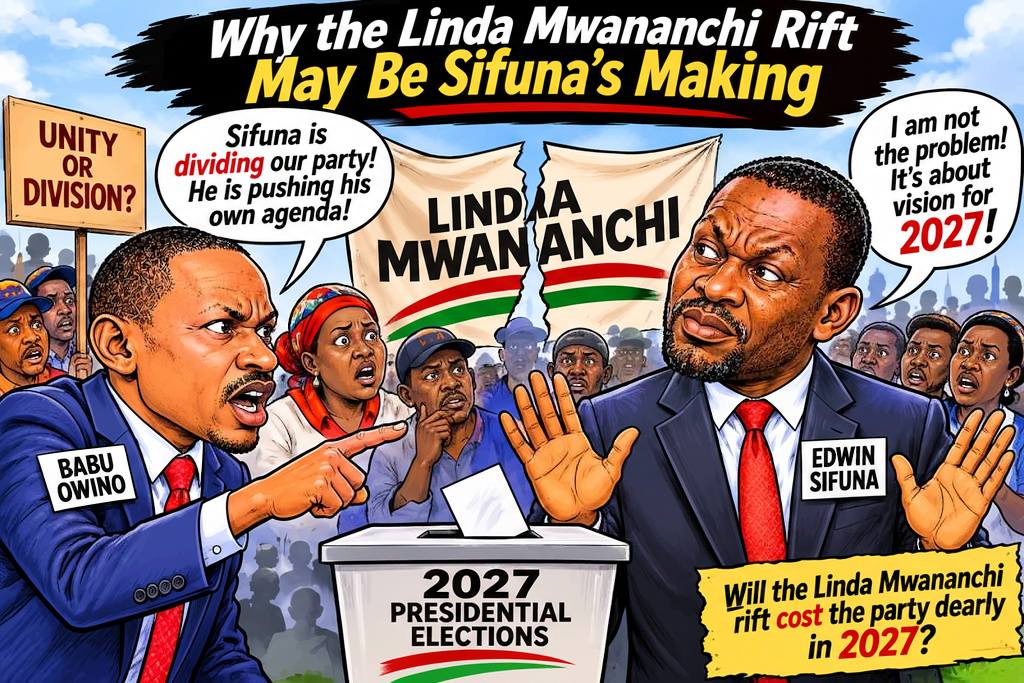
Kenyan politics has a long habit of testing political friendships at the moment they become useful. The latest test is the strain among Edwin Sifuna, Babu Owino and James Orengo, the three faces of the Linda Mwananchi movement.
An incarnation, not a clone
Since Raila Odinga’s death, the opposition has been trying to work out who inherits his defiance. Commentators have increasingly cast Nairobi Senator Edwin Sifuna as the heir to Raila’s restless spirit. The comparison rests on temperament more than lineage. Sifuna rose from ODM’s loudest defender to its Secretary General, then became the man who questioned his own party’s cooperation pact with President William Ruto. When ODM moved toward the government, he stayed with the argument that Raila’s real legacy was holding power to account.
Being pushed out of the party’s machinery completed the story. A man who loses office for resisting the establishment looks a lot like the leader he is compared to.
The early closeness
Babu Owino was Sifuna’s natural companion in that fight. Both wanted ODM to speak to Gen Z. Both opposed any deal that left the party without a presidential candidate. At the early rallies, crowds chanted both their names, and Babu’s slogan “Baada ya Baba ni Babu” showed that he, too, read the succession as open. Orengo, the elder statesman and veteran of the multiparty struggle, lent the trio intellectual weight.
It was a coalition of complementary strengths: Sifuna’s discipline, Babu’s street energy, Orengo’s gravitas. Complementary strengths can become competing ambitions, though.
Where it cracked
The cause is not one quarrel but a structural problem: one movement, several people with presidential-sized ambitions, and one party vehicle.
The sharpest flashpoint is the party. Babu has said an arrangement existed that made him party leader, with Orengo as patron, and that Sifuna reneged on it. Sifuna disputes this. He says five leaders offered their parties for consideration, that the choice of his was collective, and that none of his colleagues has confronted him personally with accusations of betrayal. Caleb Amisi has also said he left over disagreements. Whatever the truth of the agreement, the dispute is really about who owns the vehicle, and in Kenyan politics whoever owns the party owns the ticket.
Meanwhile the others drifted onto separate tracks. Babu is building his own Mwananchi Party and campaigning for the Nairobi governorship, while saying he backs Sifuna “100 percent.” Orengo has turned toward his own Liberal Democratic Party and was notably absent from the retreat that endorsed Sifuna as the movement’s presidential candidate. Both men deny a fallout. Their calendars say otherwise.
Why the rift could help Sifuna
It sounds perverse, but the argument is plausible on four counts.
First, it ends the crowded field. A movement with three people who could be presented as “Raila’s successor” confuses voters and donors. Once Babu is running for governor and Orengo is investing in his own party, Sifuna is left as the only presidential face of Linda Mwananchi. Even the movement’s allies have said they would settle for nothing less than a Sifuna presidency.
Second, it frees him from ownership disputes. Holding the party leadership gives Sifuna a document-backed claim to the ticket, which matters when negotiating with Kalonzo Musyoka, Rigathi Gachagua and Fred Matiang’i over a single opposition candidate. A leader who must first settle his own house negotiates from weakness. One who has settled it negotiates from strength.
Third, it sharpens his brand. Sifuna’s pitch is principled independence. A public disagreement over a party structure, handled calmly, lets him look like a leader who makes hard calls rather than a convenor who splits every difference. His insistence that he has no time for “side shows” frames him as the serious one.
Fourth, it tests his machine. A candidate who survives losing his two best-known allies from the front line, and keeps drawing crowds in Western and beyond, shows organisational depth rather than borrowed star power.
The risks he cannot wish away
The argument has limits. Babu commands a large and loyal Nairobi youth base, and Sifuna’s strength in the capital depends on it. Orengo brings credibility in Nyanza, where Raila’s legacy is emotional and family-linked. Analysts have warned that invoking Raila’s name does not guarantee the support of those with their own constituencies. If Babu’s governor campaign runs on a Linda Mwananchi ballot line that competes with the presidential ticket, a denied rift could become an open contest. A narrative of betrayal, true or not, could also cost Sifuna sympathy. And critics still ask how a candidate without a vast financial war chest competes with a sitting president’s resources.
The verdict
The rift will not decide the race, but it clarifies it. Sifuna’s presidential bid was always going to require someone to blink: Babu on the party, Orengo on the ambition, or Sifuna himself. If the others have blinked, he is better placed than before. The risk is that blinking was only the first stage of leaving.
If the three can still be seen together on one stage next year, this will be remembered as a negotiation. If not, it will be remembered as the moment Sifuna stopped being Raila’s heir by association and became a candidate in his own right, for better or worse.

