

President William Ruto’s reported directive to prohibit foreign nationals from operating small businesses in Kenya may sound politically attractive in a room full of frustrated local traders. Protect Kenyan businesses. Reserve the informal economy for Kenyans. Stop foreigners from competing with citizens for economic survival.
It is the kind of populist policy that produces applause before anyone asks the inconvenient question: what exactly is a “small business”?
That question is not a technicality. It is the entire problem.
Kenya’s informal economy does not operate according to neat categories drawn on government PowerPoint presentations. A hawker can become a shop owner. A kiosk can become a wholesale outlet. A small trader can import goods worth millions of shillings while technically operating from a tiny premises. A foreign national can employ Kenyan workers while running what authorities classify as a “small” enterprise.
Where does small business begin and where does it end?
Until the government provides a precise legal definition based on turnover, capital investment, employment numbers or sectoral classification, Ruto’s directive risks becoming an administrative weapon of selective enforcement. One foreign-owned salon may be closed while another survives. One trader may suddenly become an illegal “small businessman” while a politically connected competitor is classified differently.
That is not economic policy. It is regulatory ambiguity.
Recent reports indicate that Ruto has ordered a crackdown on foreign nationals involved in hawking and small-scale retail activities, arguing that such sectors should be reserved for Kenyans. But governments should be particularly cautious when transforming political rhetoric into economic restrictions without clearly defined legal boundaries.
The deeper contradiction is impossible to ignore.
Kenya has spent years projecting itself as a regional gateway and a continental commercial hub. It promotes mobility, trade, investment and integration. The East African Community Treaty explicitly envisages free movement of persons, labour, services and capital, together with the right of establishment and residence among Partner States. The Treaty also describes East African cooperation as people-centred and market-driven.
So what exactly is Kenya saying to the region?
You are welcome to enter Kenya, but perhaps not to earn a living there.
That is the contradiction at the heart of this policy.
Visa-free travel and open borders become politically meaningless if the person crossing the border is treated as an economic intruder the moment they attempt to establish a livelihood. Freedom of movement without meaningful economic opportunity is merely tourism with a political slogan attached.
More importantly, Ruto’s policy risks confusing genuine foreign economic domination with ordinary regional entrepreneurship.
A multinational corporation with billions in capital is not equivalent to a Ugandan running a small shop in Nairobi. A Tanzanian operating a salon is not an invading economic power. A Rwandan trader selling clothes in Mombasa is not responsible for Kenya’s unemployment crisis.
Yet policies framed around “foreigners” often deliberately erase these distinctions.
The most troubling consequence could be the damage inflicted on the already fragile dream of East African integration. For decades, politicians have spoken about an East African Federation, a common market and, ultimately, a politically integrated East African community. But unity cannot be constructed through speeches at summits while governments erect economic walls against each other’s citizens.
Kenya should remember the diplomatic outrage when Tanzania introduced restrictions affecting non-citizens in certain small business sectors. Nairobi itself raised concerns that such measures could conflict with the principles of the EAC Common Market, particularly the right of establishment and free movement of services.
Now Kenya appears to be walking toward the same protectionist cliff.
The danger is reciprocity.
If Kenya closes small businesses to Tanzanians, why should Tanzania remain open to Kenyans? If Uganda responds similarly, where does it stop? Rwanda? Burundi? South Sudan?
Soon every East African citizen becomes a foreigner first and a regional citizen second.
That would represent a spectacular betrayal of the EAC project.
Economic protectionism may win applause among struggling traders, but governments must address the actual causes of small-business distress: lack of affordable credit, excessive taxation, municipal harassment, corruption, high rents, poor infrastructure and unequal access to markets.
Blaming the foreign trader is politically easier.
But it is also intellectually lazy.
Ruto’s government must therefore answer a fundamental question: Does Kenya believe in East African integration, or only in integration when Kenyan businesses are expanding into neighbouring countries?
Regional unity cannot operate on a one-way street.
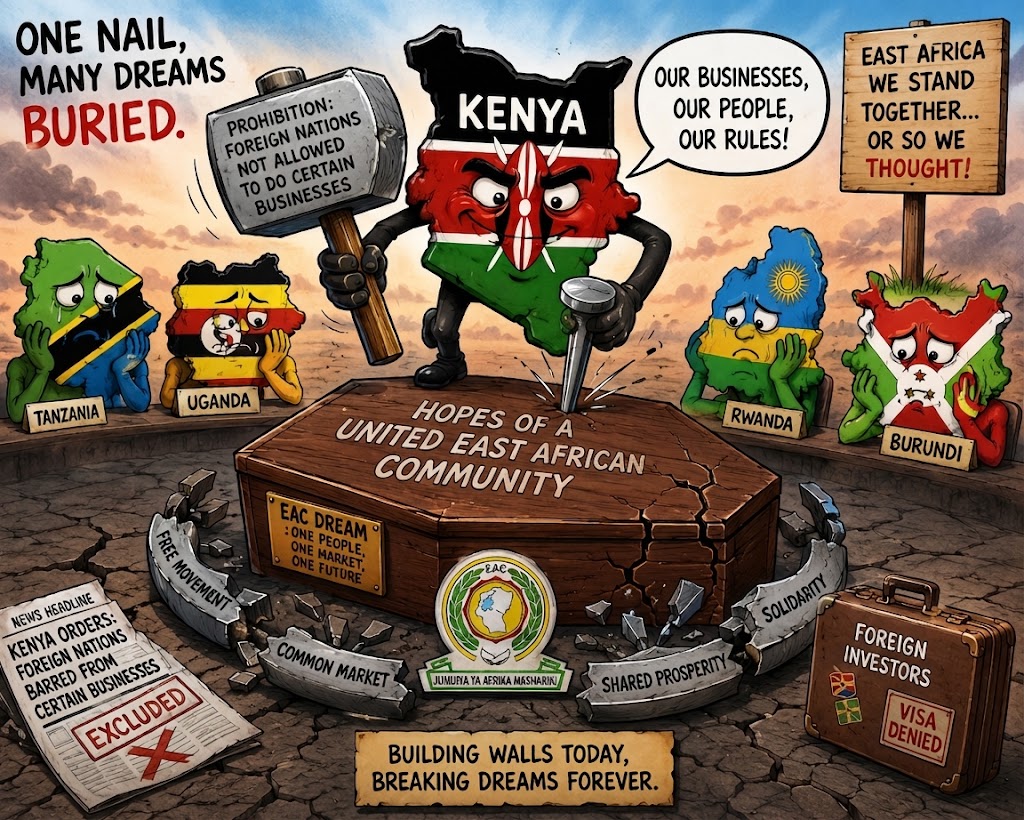
The satirical image of Kenya hammering a nail into the coffin of East African unity may be exaggerated, as political cartoons should be. But its underlying warning is serious. Every protectionist wall built against an East African neighbour weakens the idea that the people of the region share a common economic future.
President Ruto may believe he is protecting Kenyan traders.
He should be careful that, in doing so, he does not help bury the East African dream itself.