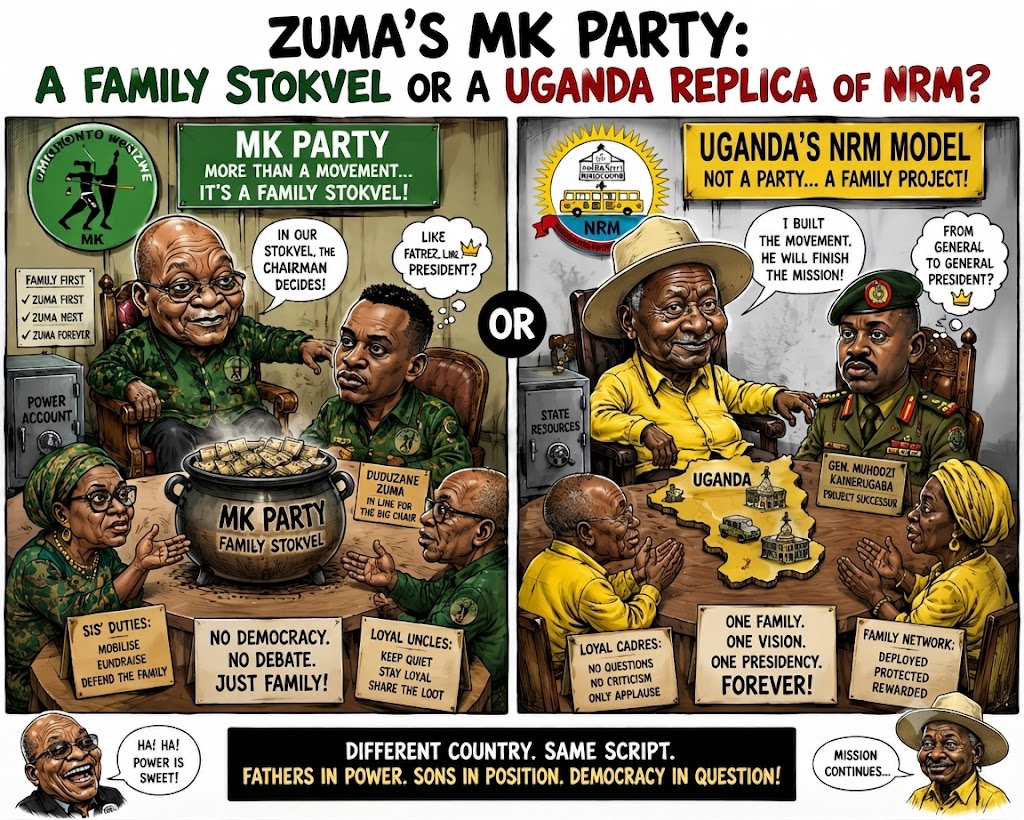


When former South African president Jacob Gedleyihlekisa Zuma launched the uMkhonto weSizwe (MK) Party, many supporters viewed it as a political vehicle to challenge the African National Congress and reshape South Africa’s political landscape. Two years later, however, the party increasingly finds itself confronting a different question: Is the MK Party evolving into a family-centred political movement rather than a conventional democratic organisation?
Recent organisational changes have intensified that debate. Although Dr. John Mandlakayise Hlophe remains the party’s First Deputy President following his reinstatement in March 2026, Jacob Zuma has steadily elevated his son, Duduzane Zuma, into the party’s inner circle through appointments to strategic leadership structures, including the Presidential Task Team responsible for assisting with the party’s day-to-day operations. Political observers have interpreted these moves as positioning Duduzane closer to the centre of power and potentially preparing him for a future leadership role.
This pattern has fueled accusations that the MK Party increasingly resembles what critics describe as a “family stokvel”, where political authority revolves around one family rather than established institutional processes. Since the party’s formation, key leadership positions have frequently changed through decisions made directly by Zuma, with secretaries-general, senior office bearers and parliamentary leaders appointed, suspended, dismissed or reinstated largely at his discretion. Such concentration of authority inevitably raises questions about internal democracy and succession planning.
The comparison extends beyond South Africa’s borders. In Uganda, President Yoweri Kaguta Museveni has gradually overseen the political rise of his son, General Muhoozi Kainerugaba. Muhoozi serves as the Chief of Defence Forces of the Uganda People’s Defence Force, commands the country’s armed forces and has become one of the most influential figures in Ugandan politics. While Museveni remains president, many analysts regard Muhoozi as a potential successor, giving rise to what has become known as the “Muhoozi Project”. Critics argue that this reflects an attempt to preserve political influence within one family across generations.
Although South Africa’s constitutional framework differs fundamentally from Uganda’s presidential system, parallels are increasingly being drawn. In both cases, political observers see powerful fathers strategically positioning their sons within influential structures long before any formal succession takes place.
Duduzane Zuma does not currently occupy a constitutional office or a senior executive position in government. His influence stems from his proximity to Jacob Zuma, whose authority within the MK Party remains virtually unquestioned. That distinction is important. Political power does not always depend on holding public office. In parliamentary democracies, party leaders frequently exercise significant influence over elected representatives, cabinet appointments, coalition negotiations and policy direction without personally occupying executive office.
Should the MK Party one day secure outright control of a municipality, province or the national government, Jacob Zuma could continue shaping political decisions from outside formal government structures simply through his authority as party leader. The elected president, premier or mayor would exercise constitutional powers, but the party leadership could remain the primary centre of political decision-making. South Africa has witnessed similar dynamics before, where party leaders outside government exercised substantial influence over those holding public office.
Supporters argue that Zuma is merely surrounding himself with trusted individuals during a period of rapid organisational growth. They contend that Duduzane’s appointments reflect confidence in his organisational abilities rather than an attempt to establish a political dynasty.
Critics remain unconvinced. They argue that repeated appointments involving close family members create perceptions of nepotism and weaken confidence in merit-based leadership. Political parties derive legitimacy not only from electoral success but also from transparent internal governance, competitive leadership contests and institutional stability. When authority appears concentrated within one family, those democratic credentials inevitably come under scrutiny.
Whether the MK Party ultimately develops into a durable national political institution or remains heavily dependent on Jacob Zuma’s personal authority may prove one of the defining questions in South African politics. The answer will depend less on who carries the Zuma surname and more on whether the party can demonstrate that leadership is earned through democratic processes rather than inherited through family ties.