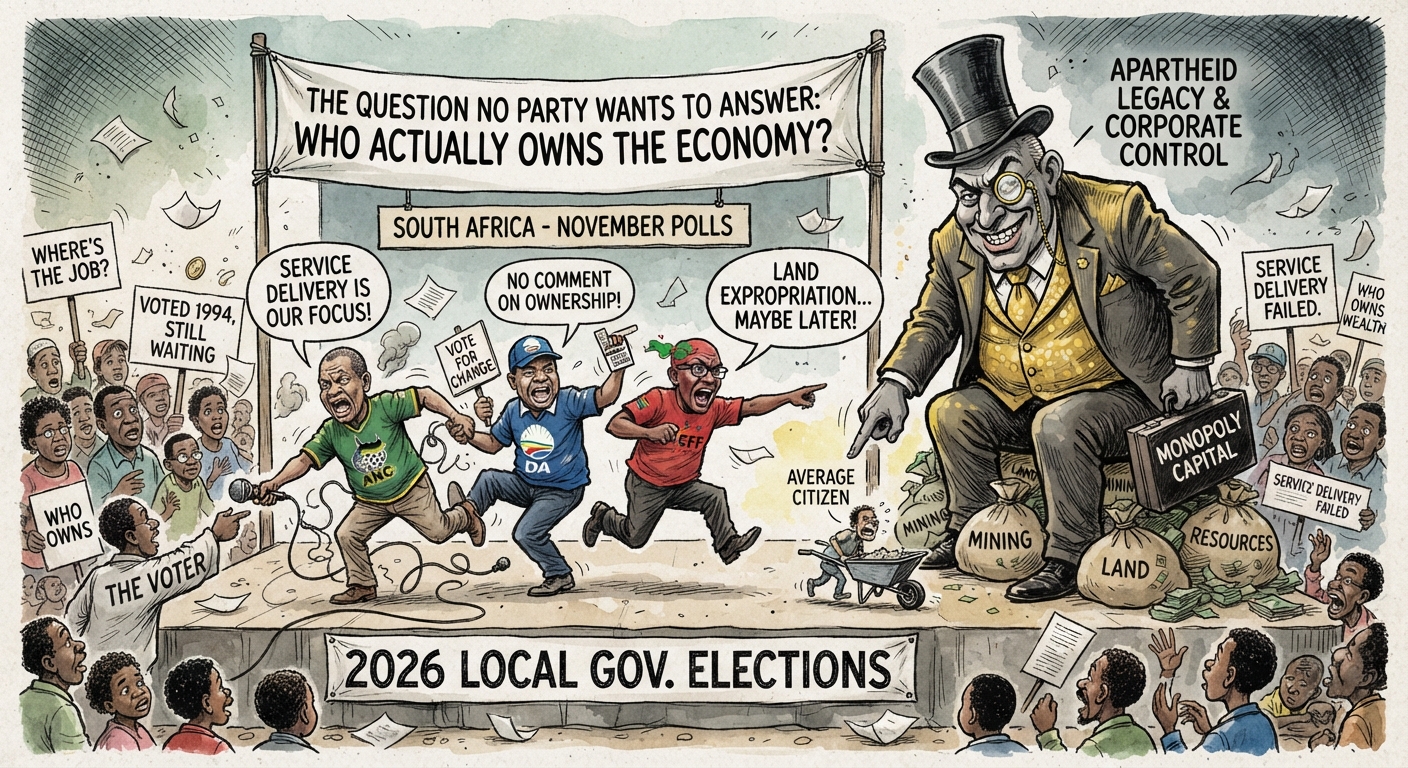

South Africa’s 2026 local government elections should force the country to confront a question more consequential than which party will control which municipality: who actually owns the economy, and who is South Africa building it for?
who actually owns the economy, and who is South Africa building it for?
The campaign will inevitably focus on potholes, water, electricity, corruption, failing infrastructure and dysfunctional coalitions. These are legitimate concerns. But beneath them lies a deeper failure that South Africa has never adequately resolved: political liberation has not translated into sufficient economic power for the majority.
This is where Eskom becomes more than an argument about whether a state-owned enterprise should operate commercially. Eskom is today a company and must be financially disciplined, professionally managed and properly governed. But its historical purpose was never simply to maximise profits.
Eskom is today a company and must be financially disciplined, professionally managed
Established in 1923 as the Electricity Supply Commission, Eskom formed part of a broader industrialisation project in which cheap and abundant electricity was understood as essential to economic development.
That principle remains true. No modern economy can function, let alone industrialise, without reliable and affordable electricity. Factories need electricity. Mines need it. Hospitals, universities, farms, construction sites, small businesses and households need it. The digital economy needs it. Artificial intelligence will not eliminate the physical foundations of industrialisation; it will increase demand for them.
The question should therefore not simply be whether Eskom resembles an ordinary commercial business. The question is whether South Africa has an energy system capable of powering the productive economy it claims to want.
Every hour without reliable electricity can become another hour of idle machinery
This matters enormously for the construction industry. Load-shedding has not merely inconvenienced construction companies. It has disrupted project schedules, increased costs, contributed to delays and rework, and placed particular pressure on smaller contractors and emerging enterprises that lack the balance sheets of major firms. Every hour without reliable electricity can become another hour of idle machinery, disrupted production, delayed materials, additional labour costs and postponed completion.
Electricity is therefore not merely something municipalities deliver to households. It is productive infrastructure.
The same logic applies to the country’s enormous infrastructure ambitions. In August 2026, President Cyril Ramaphosa said the estimated capital value of South Africa’s Strategic Integrated Projects portfolio had grown to more than R1.67 trillion, comprising 195 public- and private-led projects across priority sectors. Yet only 55 projects, worth more than R407 billion, were then in construction. The challenge is increasingly not the absence of plans, but converting plans into investment, construction and productive assets.
That gap should concern anyone interested in South Africa’s developmental future.
Because the question is not simply how much infrastructure South Africa builds. It is who builds it, who owns the resulting productive assets, where it is built and who benefits from it.
An economy cannot become a prosperous mass economy when the majority lacks adequate purchasing power and productive assets. Businesses require customers. Entrepreneurs require markets. Investors require productive opportunities. Households need income and assets. Economic growth therefore cannot be separated from the material capacity of citizens to participate in the economy.
An economy cannot become a prosperous mass economy when the majority lacks adequate purchasing power
This is especially important in a country where Black South Africans constitute more than 80% of the population. The question cannot simply be how many Black people occupy political office, sit on corporate boards or appear on election posters. The more difficult question is whether the majority is accumulating assets, building businesses, acquiring skills, accessing technology and developing the purchasing power necessary to participate meaningfully in the economy.
Black prosperity cannot be reduced to Black political representation.
Political power matters, but political power is an instrument. Its ultimate test is what it enables people to build, own and control.
A genuinely transformative economy must expand productive ownership, household assets, business formation, industrial participation, technological capability and purchasing power. Young people in townships should not be destined merely to become workers travelling long distances to economic centres. They should increasingly become entrepreneurs, engineers, developers, researchers, investors and owners in the places where they live.
This requires confronting South Africa’s built environment.
The country’s economic geography was never designed around mass Black ownership. The mining economy, migrant labour system, segregationist planning and apartheid spatial engineering created a system in which Black communities were separated from major centres of economic opportunity. The roots of this system predated 1948. Apartheid did not invent every feature of racial capitalism; it institutionalised, intensified and spatially entrenched structures that had developed over decades.
That geography did not disappear in 1994.
Political democracy changed the state, but spatial inequality possesses an extraordinary capacity to reproduce itself. When people live far from employment, when transport is expensive, when industrial infrastructure is absent and when access to capital is limited, poverty becomes geographically organised.
This is why local government matters.
Municipalities are not merely administrative machines responsible for collecting rubbish and fixing potholes. They are economic institutions. Their decisions about electricity distribution, water, roads, transport, land-use planning, infrastructure, procurement, digital connectivity and local economic development can either reinforce exclusion or begin dismantling it.
The 2026 elections should therefore force political parties to answer questions more difficult than whether they can repair a pothole.
Where will the next generation of jobs come from? Which municipalities are creating infrastructure for manufacturing and small industry? Where are the transport systems connecting township residents to economic opportunity? Which municipalities are releasing land for productive development? What are they doing to reduce the cost of operating township businesses? How will municipal procurement create sustainable enterprises rather than dependency on politically connected contractors?
And where is the electricity required to power the economy of tomorrow?
There is another uncomfortable question for the built environment professions themselves.
Our universities cannot continue treating European spatial thinking as the universal standard while South Africa’s most urgent challenges demand different intellectual and practical responses. Built environment education must prepare students to design the township economies, informal-settlement upgrades, indigenous infrastructure systems and locally appropriate urban environments that South Africa actually needs.
The colonial library, as V.Y. Mudimbe called it, is still open, in the lecture hall.
Decolonisation therefore cannot mean merely adding African authors to reading lists. It must also mean asking whether the knowledge being produced is capable of solving African problems. It must ask why graduates emerge from universities able to reproduce established professional models but often struggle to imagine fundamentally different spatial and economic systems.
And increasingly, municipalities are deciding something even bigger: whether South African communities will participate in the digital economy or simply be administered by it.
Municipal broadband, smart-city systems, digital land registries and BIM-enabled infrastructure asset management are not luxuries. They are becoming the new spatial infrastructure of economic inclusion.
Who owns the data? Who controls the platforms? Who develops the technology? Who supplies the systems? Who has the skills to maintain them? And will townships become digitally connected productive economies, or merely digitally administered communities?
These are economic questions.
They are also questions of power.
South Africa is constantly required to respond to racism, racial provocation, historical revisionism and attempts to reopen old ideological battles. Those issues cannot simply be ignored. Recent events demonstrate that the country’s history remains deeply contested and that those who benefited from apartheid have not uniformly reconciled themselves to transformation.
But reaction cannot become a permanent political strategy.
A society cannot build prosperity by spending all its energy responding to those who oppose its transformation. There comes a point when the more powerful response to exclusion is construction.
Build the company. Build the factory. Build the university. Build the technology. Build the township economy. Build the infrastructure. Build the assets. Build the purchasing power. Build institutions capable of competing globally.
This is not an argument for ignoring racism. It is an argument for refusing to allow racism to determine the entire political agenda of Black South Africans.
At some point, resistance must become construction.
The same principle applies to the developmental state. South Africa cannot become a developmental state by producing more policies, strategies and commissions. A developmental state requires capacity: competent municipalities, reliable energy, functioning infrastructure, effective transport, capable public servants, industrial policy, technological capability and institutions able to execute long-term plans beyond the electoral cycle.
With 2030 approaching, the gap between the National Development Plan’s ambition and South Africa’s lived reality should concern everyone.
The country has plans. What it lacks is sufficient execution, productive capacity and institutional capability.
The 2026 local government elections therefore present an opportunity to change the political conversation. Voters should ask not only which party can govern a municipality, but what economic future that municipality can produce.
Not only whether electricity will be restored, but whether electricity will power new businesses.
Not only whether houses will be built, but whether those communities will be connected to employment, markets and productive assets.
Not only how many tenders will be awarded, but whether procurement is creating durable enterprises capable of surviving beyond government contracts.
Not only how much infrastructure is promised, but who will own the companies, technologies, intellectual property and productive assets created through that infrastructure.
The majority should not merely have the vote. It should have purchasing power. It should not merely have political representation. It should have productive assets. It should not merely consume technology developed elsewhere. It should increasingly produce technology, knowledge and intellectual property of its own.
As someone who spends their working life asking why our R1.67-trillion infrastructure pipeline produces too few built assets, why our construction graduates enter an industry their education did not adequately prepare them for, and why our townships remain spatially disconnected from economic opportunity three decades after apartheid, I can say with professional certainty:
The problem is not that South Africa does not know what to build.
The problem is that we have not yet decided who the building is for.
South Africa has spent decades debating political power.
The next phase must be about productive economic power.
That is the unfinished business of the developmental state.
And if the 2026 local government elections are to mean more than another contest of political slogans, they must become an election about something much bigger than service delivery.
They must become an election about who owns the economy, who builds it, where it is built and ultimately, about Black prosperity.
Murendeni Lip
hadzi (PhD) is a built environment scholar and researcher at the University of Johannesburg whose work sits at the intersection of the construction industry, decolonial theory, and Leadership. He continues to argue that South Africa’s developmental state issues are not only technical problems, they are also leadership ones.

Murendeni Liphadzi (PhD) is a built environment scholar and researcher at the University of Johannesburg whose work sits at the intersection of the construction industry, decolonial theory, and Leadership. He continues to argue that South Africa’s developmental state issues are not only technical problems , they are also leadership ones.