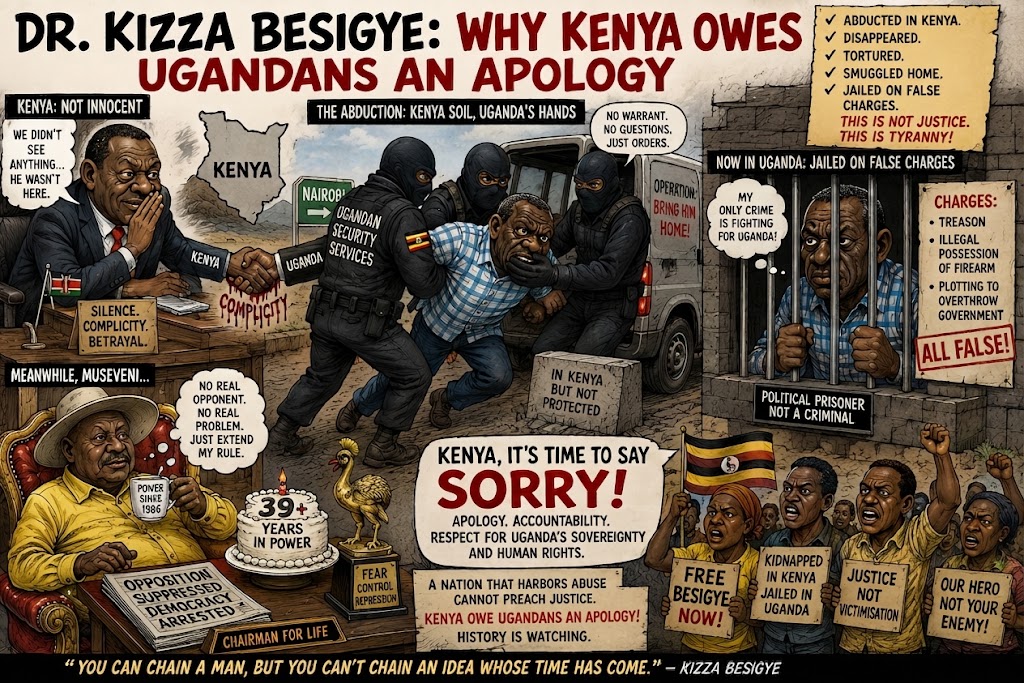


There is a peculiar cruelty in watching a man who once fought to bring a government to power become that government’s most enduring prisoner. Kizza Besigye served as Yoweri Museveni’s personal physician during the bush war that carried the National Resistance Movement to State House in 1986. He held ministerial rank in the government that followed. And for the better part of the last twenty-five years, he has been the person that same government most wants silenced. Today he lies in and out of intensive care, having collapsed in the dock during a treason trial that has already stretched past a year without a verdict, in a case built substantially on the word of a foreign informant describing an alleged assassination plot few outside government circles find credible.
Today he lies in and out of intensive care, having collapsed in the dock during a treason trial
Besigye disappeared from Nairobi in November 2024. Kenyan soil, Ugandan hands — an abduction dressed up afterward as an arrest. He was hauled before a military tribunal despite being a civilian, then before a court that could not lawfully try him, until Uganda’s own Supreme Court intervened and ruled that civilians cannot face military justice in that country. Did the state release him? It did not. It simply moved him to a civilian court and charged him instead with treason, a capital offence, this time over an alleged plot involving drones and coordinates for an airstrip hundreds of kilometres away in Congo. He has been denied bail repeatedly. His own lead lawyer has since been arrested and charged with failing to report the very treason his client stands accused of. The son of the president, who commands the army, has publicly called Besigye “a dead man walking.” That is not the language of a state confident in the rule of law. It is the language of a family settling a score.
The son of the president, who commands the army, has publicly called Besigye “a dead man walking.”
Museveni has now governed Uganda for four decades. What began in 1986 as the promise of a liberator who would end the bloodletting of Amin and Obote has calcified into something closer to a family enterprise, complete with a son positioned atop the military and an apparatus that treats electoral competition as an act of war. Besigye challenged Museveni four times at the ballot box and lost each time under circumstances his supporters have always disputed. He has been arrested, beaten, and tear-gassed more times than most Ugandans can count. Now, frail, wheelchair-bound in earlier court appearances, and reportedly unresponsive in a Kampala hospital bed after collapsing mid-trial, he has become something larger than a politician facing charges. He has become the living evidence of what happens to a liberation movement that never learns to let go of power.
Besigye challenged Museveni four times at the ballot box and lost each time under circumstances
Call it what it is: Uganda’s second liberation struggle, still unfinished, this time aimed not at a colonial administration but at the men who inherited the state built to replace it. Besigye is its most visible casualty, much as Tundu Lissu has become the same symbol next door in Tanzania, another liberation party, another veteran opposition figure, another treason charge timed conveniently around an election. The pattern across the region is no coincidence. It is a shared inheritance among ruling parties that fought colonialism honestly and have since discovered that the machinery of a liberation struggle, once turned inward, makes for an extremely effective tool of domestic repression.
What is perhaps most damning is the silence surrounding it. Western governments that speak fluently about human rights when it is convenient have found remarkably little to say about a man collapsing in a Kampala courtroom, or about the international informant whose testimony forms the backbone of a capital case. The United States, quick to sanction and condemn elsewhere, has treated Museveni as a security partner first and a rights violator only in passing footnotes. Human rights bodies issue statements; little enforcement follows. Uganda remains useful, strategically and diplomatically, and usefulness has a way of dulling outrage.
The pattern across the region is no coincidence. It is a shared inheritance among ruling parties that fought colonialism
This is the quiet double standard that liberation movements-turned-ruling-parties across Africa have learned to exploit: that the world’s appetite for calling out authoritarianism has limits, and those limits tend to fall exactly where geopolitical convenience begins. Besigye’s body, deteriorating in a Kampala hospital ward while his trial grinds on without him, is the cost of that convenience. So is Lissu’s, held in Tanzania on a similar charge for a similar offence, asking, too loudly, for his country to be governed honestly.
Liberation was supposed to be a beginning, not a inheritance to be hoarded. Until African publics, and the powers that claim to champion democracy abroad, treat the jailing of men like Besigye and Lissu with the seriousness such cases demand, the second liberation these two men have come to symbolise will remain exactly that, a struggle still waiting to be won.