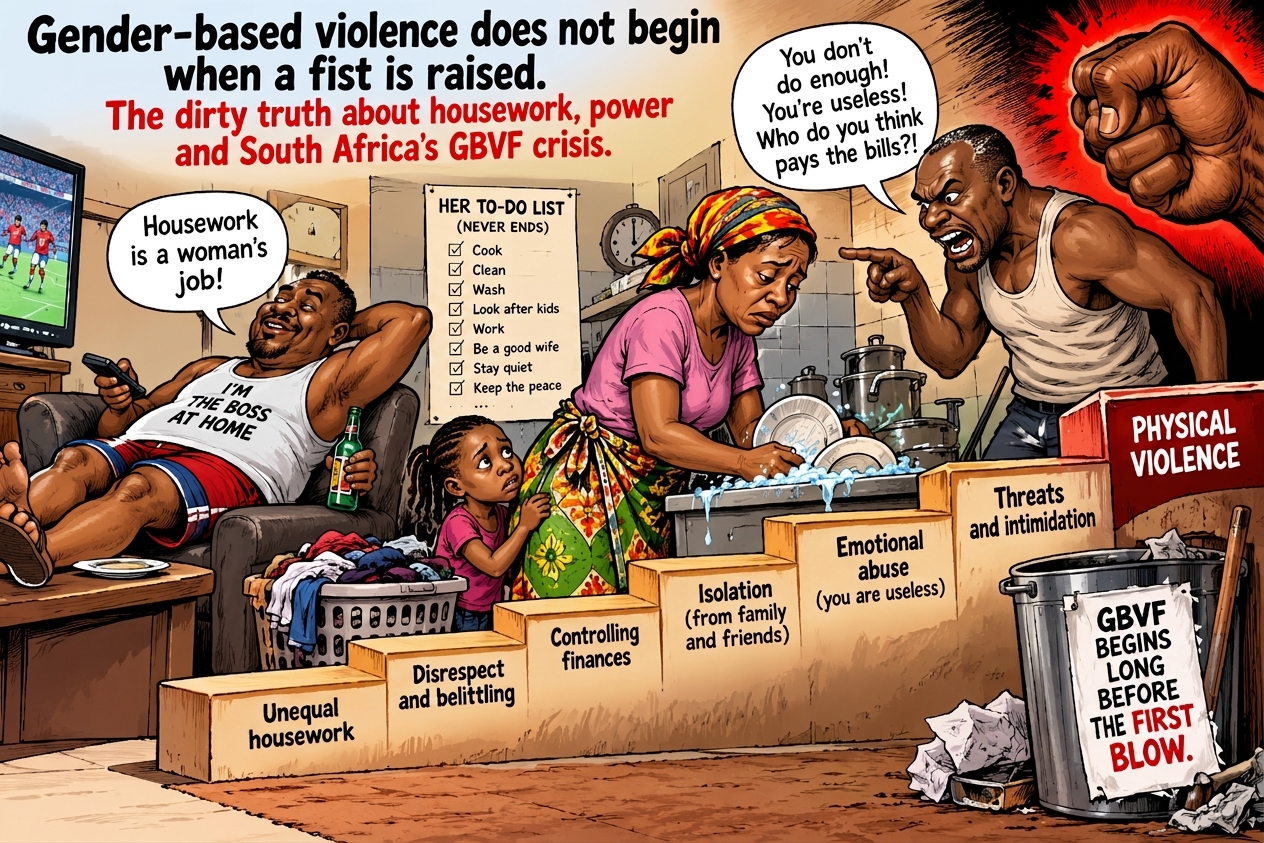

The dirty truth about housework, power and South Africa’s GBVF crisis
When we think about abuse in relationships, we picture a fist, a slap, a threat or a cruel word.
But gender-based violence often begins long before the first blow.
Sometimes, it can start with an argument over who controls the money, or with jealousy that a partner calls love. It can start with the belief that because one person earns the income, the other owes obedience. And sometimes it starts at the kitchen sink.
My research published in 2024, Constructing Housework as Abuse: African Men and Intimate Partner Violence in South Africa, interviewed 25 African men living in Johannesburg who came from South Africa, Zimbabwe, Congo, Nigeria, Mozambique, Malawi and Eswatini. It is a small qualitative study and does not tell us what African men in general believe. What it does show is how changing gender roles can turn into a contest over power inside a home.
But gender-based violence often begins long before the first blow.
Some participants described being expected to cook, clean or care for the children as abuse.
One put it bluntly: “It is a woman’s duty, but I am always forced to do things.”
For men raised to believe that housework belongs to women, being asked to do it did not register as sharing a load. It registered as an attack on the gender order they had inherited.
Some men are willing to “help out,” but only when asked politely or when “in the mood,” they framed domestic labour as a favour, not an obligation. Tensions surfaced when women insisted on more.
Some men are willing to “help out,” but only when asked politely
Other men reached the opposite conclusion. For them, leaving all domestic labour to a woman was exploitation. One participant argued that if a man leaves everything to his partner, “it is like you are abusing her”.
That contradiction matters, because under the argument about cooking and cleaning sits a larger question about what each partner believes they are entitled to.
South Africa is asking that question with new urgency.
On 29 September President Cyril Ramaphosa addressed the nation after the bodies of 11 women were found in Ekurhuleni since July. He admitted that government had not done enough to protect women, and he said that “gender-based violence does not begin when a fist is raised”. He also said: “We cannot police our way out of gender-based violence alone.” “We cannot arrest our way out of this crisis alone.”
His intervention matters because it places the country’s crisis beyond the narrow boundaries of policing. Attitudes of male entitlement, control, coercion, jealousy and the refusal to accept “no” are part of the social environment in which violence can develop.
We cannot police our way out of gender-based violence alone.
That is where the seemingly mundane politics of housework becomes relevant.
A disagreement over who washes the dishes is not violence, and not every unequal division of chores is coercive control.
But housework is one place where entitlement shows itself.
If a man believes his income gives him ownership of his partner, her domestic labour becomes something he expects rather than something they negotiate. If a woman works a full day and then comes home to do nearly all the cooking, cleaning and childcare, that burden is a form of exploitation in its own right. A dirty kitchen does not cause GBVF, but the arguments around it can show what a man believes he is owed.
This is why the GBVF conversation has to look past the cases that make headlines. The attitudes that make violence possible are learned around family tables and reinforced among friends, often for years, and relatives and communities frequently excuse them. When violence finally erupts, society acts surprised.
The scale is hard to absorb. The Human Sciences Research Council’s national prevalence study found that about 7.3 million women aged 18 and older had experienced physical violence in their lifetime, and more than 2.15 million had experienced sexual violence. Behind those figures are private calculations about survival:
A woman who changes the route she walks home.
A woman who shares her location with friends.
A woman who keeps emergency money hidden.
A woman who thinks twice before leaving a relationship because she has nowhere else to live.
A woman who remains because her children need food, shelter and school fees.
A woman who knows that calling the police may be necessary but is not convinced that the state will arrive in time.
Economic insecurity makes abusive relationships harder to leave
Economic insecurity makes abusive relationships harder to leave. High unemployment can undermine men’s identities as providers while making households more dependent on whoever still earns, and financial dependence hands an abusive partner another instrument of control.
None of this excuses violence. Responsibility stays with the perpetrator.
But prevention requires understanding the conditions in which control becomes possible.
Ramaphosa was direct about who has carried prevention so far. “We have placed the burden of male violence on women,” he said. Women change their routes home, share their locations with friends and avoid going out at night, while men remain largely absent from the prevention conversation. Men and boys have to become central to prevention, as participants in changing the norms that let entitlement and domination flourish, and not only as potential suspects.
Institutions matter too. The president warned that laws and programmes mean little if victims are turned away, forensic samples go unprocessed or cases collapse because investigations fail. A woman reporting abuse needs to believe that the officer taking her statement will take her seriously and that a protection order will be enforced.
Prevention also cannot be an annual campaign that peaks during 16 Days of Activism
Prevention also cannot be an annual campaign that peaks during 16 Days of Activism and then fades. Men’s programmes need to move past slogans and give men sustained spaces to deal with entitlement, rejection, conflict and accountability. Schools should teach consent, emotional literacy and healthy relationships from an early age, including the plain expectation that boys cook and clean. Faith-based and traditional leaders can use their authority to challenge abuse instead of pressuring victims into silence. Culture, religion and tradition cannot be allowed to shield violence.
Most of all, we need to stop treating domestic labour as inherently feminine. Domestic work is work. Partners should negotiate it fairly according to their circumstances, time, income, health and family responsibilities.
The men in my Johannesburg study did not agree about the kitchen. One said housework was a woman’s duty and that he was being forced into it. The other said it depends on his mood. Another said that leaving all of it to his partner amounted to abusing her. They were describing the same chores. What divided them was whether they believed a partner owed them her labour, and that belief is the one prevention work has to reach. It is easier to see over a sink of unwashed dishes than in a crime statistic, and in most homes the argument about who washes them happens long before anyone raises a fist.

Dr. Emmanuel Rowlands, PhD Sociology (University of Johannesburg). Research interest: Critical Masculinities, Intimate Partner Violence, Peacebuilding, Evidence Synthesis and Mapping.