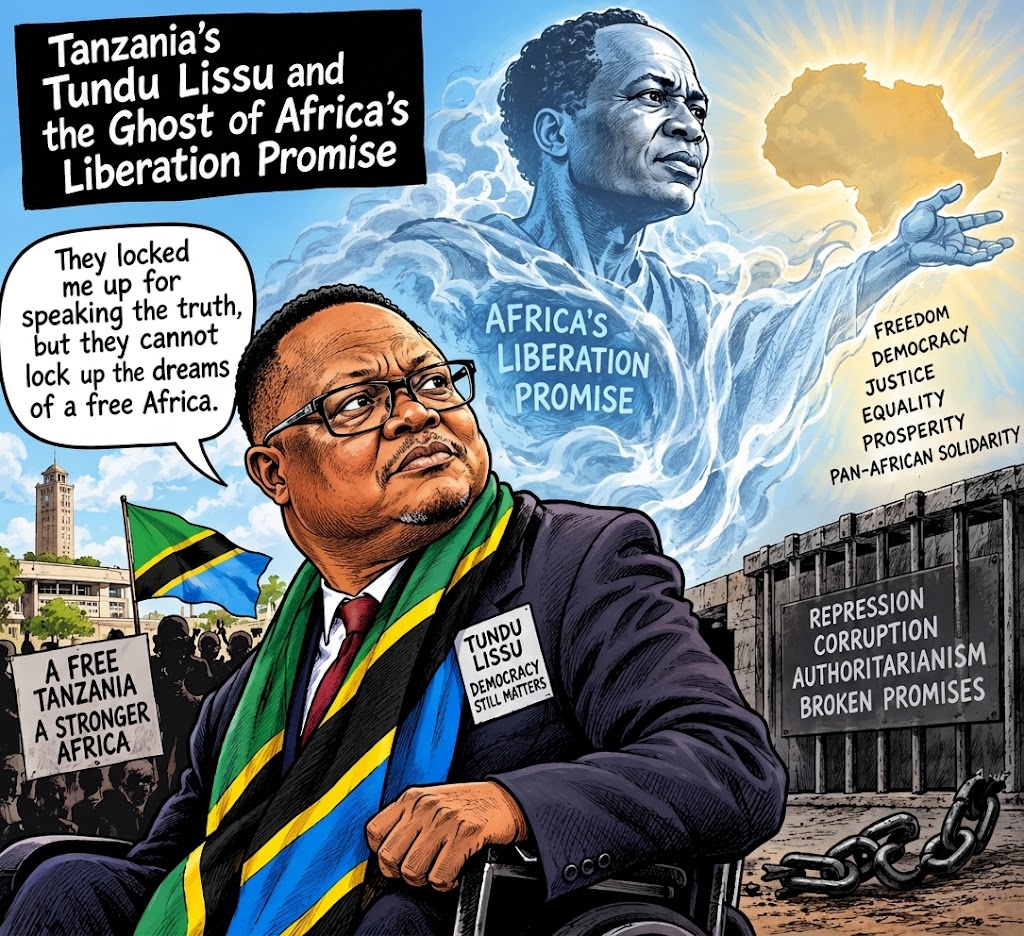

There is a particular kind of betrayal that stings more than ordinary tyranny, the betrayal that comes wrapped in the language of liberation. Tanzania’s ruling party, Chama Cha Mapinduzi, carries the inheritance of Julius Nyerere and the anti-colonial struggle that gave the country its independence. That inheritance is precisely what makes the treatment of Tundu Lissu so hard to stomach.
There is a particular kind of betrayal that comes wrapped in the language of liberation
Lissu is no stranger to danger. He survived sixteen bullets in an assassination attempt in 2017, an episode that alone should have marked him as a man the state owed protection, not persecution. Instead, in April 2025, he was pulled off a podium in Mbinga after addressing a peaceful rally calling for electoral reform, driven overnight across more than a thousand kilometres, held without word to his family or lawyers for nearly a full day, and eventually charged with treason, a charge that carries the death penalty. A working group at the United Nations has since called his detention unlawful. Tanzania’s government has simply ignored the finding.
Treason. For giving a speech. For asking, in effect, that an election be conducted fairly.
This is not incidental overreach. It is a pattern, and patterns tell us more than isolated incidents ever can. Lissu leads Chadema, the only opposition party with the standing to seriously challenge President Samia Suluhu Hassan. His party has since been barred outright from contesting the very election he was campaigning to reform. Put plainly: the leading obstacle to an uncontested victory has been removed from the field, first through arrest, then through a capital charge, then through disqualification. If this were a plot in a novel, an editor would call it too on-the-nose.
When Samia took office in 2021, following the death of John Magufuli, many allowed themselves a flicker of hope. She spoke the language of reform, eased some of the media restrictions her predecessor had imposed, and cultivated an image of pragmatic moderation. That goodwill has curdled. The machinery she now commands looks less like reform and more like Magufuli’s authoritarianism with better public relations. The tear gas fired at unarmed Chadema supporters in Mbinga was not a rhetorical flourish. It was policy.
Lissu is no stranger to danger. He survived sixteen bullets in an assassination attempt in 2017
What makes this story larger than Tanzania is the mirror it holds up to a continent’s unfinished business. Across Africa, parties that led liberation struggles against colonial rule have too often calcified into the very structures they once fought. The vocabulary of resistance gets repurposed as a shield for incumbency. Dissent becomes “destabilisation.” Opposition becomes “foreign interference.” Calling for a free election becomes treason. It happened in Zimbabwe. It has happened, in various shades, in Uganda and elsewhere. Tanzania’s turn should trouble anyone who cares about the credibility of Africa’s democratic project.
There is a term African commentators have started reaching for in Lissu’s case: a second liberation. The first freed the continent from colonial administrators. The second, still unfinished, must free citizens from the ruling parties who inherited that first freedom and, in some cases, have since treated it as personal property. Lissu, battered but unbowed, representing himself in court while facing a capital charge, has become an uncomfortable symbol of that second struggle. Uncomfortable, because it implicates not foreign powers but home-grown power, dressed in the flag of the very movement that was supposed to guarantee freedom.
Lissu, battered but unbowed, representing himself in court while facing a capital charge,
Defenders of the government will say Lissu is inflexible, uncompromising, difficult, and there is truth in that; his critics within Tanzanian politics have long noted his rigidity. But rigidity is not treason, and stubbornness is not a capital offence. A government confident in its legitimacy does not need to silence its loudest critic through a charge that could end his life. It argues, campaigns, and wins or loses at the ballot box.
Africa does not need saviours dressed up as strongmen, nor liberation movements that outlive their liberating purpose and become instruments of the very oppression they once opposed. Every leader who reaches for treason charges instead of debate, who disqualifies rather than defeats an opponent, chips away at the credibility every other African democracy is still trying to build. Samia Suluhu Hassan had the chance to be remembered as the president who steered Tanzania back toward openness. Instead, through Tundu Lissu’s cell, she risks being remembered as the one who proved that liberation, left unchecked, can curdle into its opposite.

The writer, Dr. Tiema Haji is an academic, researcher, author, journalist, communication specialist and an accomplished poet.