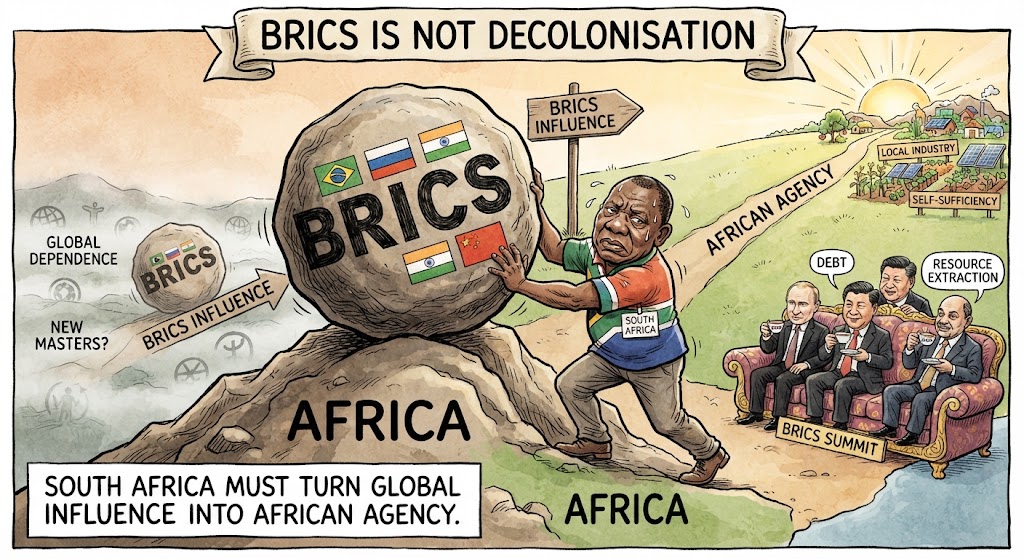

The recent BRICS summit in New Delhi offered South Africa a familiar diplomatic paradox: it can sit at the table where the rules of the emerging global order are discussed, but its presence at that table does not automatically mean that Africa is shaping the rules.
That distinction matters.
The 2026 summit demonstrated both the possibilities and limitations of BRICS. India facilitated an important meeting between Iranian President Masoud Pezeshkian and Abu Dhabi Crown Prince Sheikh Khaled bin Mohamed bin Zayed Al Nahyan despite the tensions created by the US–Iran war. The meeting did not resolve the underlying dispute, but it demonstrated the diplomatic value of a forum in which states with competing interests can still engage.
For India, this illustrated what BRICS can become: not an alternative United Nations, and certainly not a military alliance, but a diplomatic platform through which emerging powers attempt to manage a fragmented international system.
South Africa should take note.
But it should also ask a more uncomfortable question: what does South Africa’s BRICS membership actually mean for Africa? BRICS has expanded. So has the question of African agency
When South Africa joined BRICS in 2010, it became the bloc’s first African member. At the 2023 Johannesburg summit, Egypt and Ethiopia subsequently joined, changing South Africa’s position.
Pretoria can no longer plausibly describe itself as the sole institutional representative of African interests inside BRICS. The more useful role is that of an African state advancing African priorities within a wider coalition of developing and emerging economies.
Pretoria has historically exercised influence through coalition-building
South Africa’s economy is much smaller than those of China and India, constraining its bargaining power. Yet diplomatic influence does not correspond mechanically to GDP. Pretoria has historically exercised influence through coalition-building, agenda-setting and connecting BRICS debates with African institutions and priorities.
During South Africa’s 2023 BRICS presidency, expansion and stronger engagement with the African Continental Free Trade Area featured prominently. The 2026 summit likewise emphasised trade, supply chains, agriculture, digital development and innovation.
But representation is not agency.
The distinction between representation and agency is most visible not in diplomatic communiqués but in construction sites, technology procurement decisions and curriculum rooms.
South Africa’s BRICS participation means little for ordinary South Africans if…
South Africa’s BRICS participation means little for ordinary South Africans if infrastructure built with BRICS-linked finance still depends heavily on imported software, foreign engineering systems and supply chains that route economic value offshore. When a South African municipality builds a road with external finance but remains dependent on foreign-controlled project-management platforms, digital systems and intellectual property, representation at the summit table has not necessarily translated into agency on the ground.
Agency means owning more of the productive process: the design, the information management, the supply chain, the skills and, where possible, the intellectual property.
Chinua Achebe’s critique of postcolonial leadership remains useful, not because he wrote about BRICS, but because he repeatedly returned to the relationship between political leadership and the everyday lives of citizens.
Chinua Achebe’s critique of postcolonial leadership remains useful
The danger is that foreign-policy prestige becomes an end in itself.
South Africa can participate in summits, issue declarations and position itself as a bridge between North and South. But the meaningful measure of diplomacy ultimately lies in what such positioning produces in the material world.
Does it expand African industrial capacity? Improve infrastructure? Increase technological capability? Create better markets for African producers? Strengthen African negotiating power?
Or does Africa remain primarily the geographical site where other powers pursue their strategic interests?
Achebe therefore gives us a useful test: international recognition should not substitute for domestic transformation.
Es’kia Mphahlele offers another dimension often missing from geopolitical discussions.
Foreign-policy analysis tends to measure influence through GDP, trade volumes, investment flows and diplomatic access. Mphahlele’s intellectual tradition invites a different question: what kind of society are these economic and political arrangements producing?
African Humanism places human dignity, community and social relationships at the centre of development.
Replacing Western dominance with competition among Western, Asian and other centres of capital does not automatically constitute decolonisation. A Chinese, Indian, American or European company may operate under different national systems, but the question for Africa remains consistent: what value is created locally, who controls it, and who benefits?
Mahmood Mamdani’s Citizen and Subject provides a useful historical warning.
Mamdani’s analysis centres on institutional structures inherited from colonial rule, particularly the bifurcation between citizens and subjects and the persistence of forms of decentralised despotism. His broader contribution is to remind us that political independence does not necessarily dismantle the institutional structures through which power was organised.
Applied to BRICS, the lesson is straightforward.
Changing the geopolitical partner is not the same thing as changing the structure of dependence.
If Africa moves from dependence on Western capital towards dependence on Chinese, Indian, Gulf or Russian relationships without building its own productive capacity, technological capability and negotiating institutions, the vocabulary may change while the underlying asymmetry remains.
Nowhere is this asymmetry more acute than in the digital economy. The 2026 New Delhi Declaration placed artificial-intelligence governance on the BRICS agenda and committed members to implementing the BRICS Leaders’ Statement on Global AI Governance.
Yet Africa’s ability to shape this emerging technological order depends on capabilities beyond participation in diplomatic discussions. Much of the computing infrastructure, cloud capacity, semiconductor supply chains and foundational AI technology on which the global industry depends remains outside Africa.
Yet Africa’s ability to shape this emerging technological order depends on capabilities beyond participation in diplomatic discussions
The policy question is therefore whether BRICS cooperation can generate technology transfer, open-source AI adapted to African contexts, African data capabilities and digital infrastructure that African institutions can own and govern or whether multilateral cooperation simply creates another layer of technological dependence.
“African solutions to African problems” becomes an empty slogan if it means merely keeping outsiders away.
Africa cannot isolate itself from the global economy. The more consequential question is whether external partnerships strengthen or weaken African agency.
Possible areas for a concrete South African negotiating agenda include AfCFTA implementation, infrastructure financing, industrialisation, energy security, digital sovereignty, technology transfer, skills development and greater value addition to African resources.
The BRICS agenda already includes local-currency settlements, cross-border payment systems, infrastructure finance and artificial intelligence. The challenge is translating those broad commitments into productive capabilities.
South Africa’s task is therefore not simply to choose between East and West. It is to build enough African capacity that Africa can negotiate with both.
Infrastructure is where agency becomes measurable
One concrete arena is the built environment.
South Africa’s infrastructure pipeline has expanded to almost R2 trillion across 81 Strategic Integrated Projects, while government has committed more than R1 trillion in public infrastructure investment over three years.
That scale makes infrastructure more than a construction issue. It is also a question of technological sovereignty.
Projects increasingly depend on project-management systems, Building Information Modelling platforms, engineering software and digital asset-management tools. Much of this technological ecosystem is foreign-owned.
One possible BRICS initiative would therefore be a digital construction protocol: shared open standards for infrastructure information management that allow member states to retain greater control over the data generated by their infrastructure programmes, while facilitating interoperability across borders.
India’s experience in digital public infrastructure provides one possible reference point. For South Africa, the broader question is whether BRICS cooperation can help build African digital capabilities alongside physical infrastructure.
Having participated in the BRICS Working Group sessions and B2B meetings in New Delhi this week, what struck me most was not the scale of ambition in the official sessions, but the texture of the conversations on the margins.
Researchers, practitioners and digital-infrastructure specialists from across the BRICS family compared notes, identified shared problems and asked whether cooperation between institutions could produce knowledge and capability that none could build alone.
That is the BRICS possibility that much geopolitical analysis misses.
The summit communiqué is a diplomatic product. The more consequential question is what researchers, engineers, educators, entrepreneurs and policymakers take home and whether the institutions that sent them create the conditions for those conversations to compound into something real.
South Africa’s most valuable BRICS contribution may not be its diplomatic positioning. It may be its researchers.
South Africa’s BRICS membership is therefore best understood as an instrument, not an identity.
Achebe reminds us to interrogate leadership and material outcomes. Mphahlele reminds us that development must retain a human dimension. Mamdani reminds us that political independence does not automatically dismantle inherited structures of power.
Together, their intellectual traditions point towards a deeper proposition: African agency cannot be achieved simply by gaining access to another powerful international table.
The question is whether BRICS participation can help build the economic, technological, institutional and diplomatic capacity that allows Africa to negotiate at that table on increasingly equal terms.
That is a much harder project than joining a geopolitical bloc.
It is also the more demanding meaning of decolonisation.

Murendeni Liphadzi (PhD) is a built environment scholar and researcher at the University of Johannesburg whose work sits at the intersection of the construction industry, decolonial theory, and Leadership. He continues to argue that South Africa’s developmental state issues are not only technical problems , they are also leadership ones.