

Murendeni Liphadzi (PhD) is a built environment scholar and researcher at the University of Johannesburg whose work sits at the intersection of the construction industry, decolonial theory, and Leadership. He continues to argue that South Africa’s developmental state issues are not only technical problems , they are also leadership ones.
The death of Professor Jason Arday should not become another convenient weapon in the culture wars over race, diversity and academic merit. Nor should legitimate questions about academic integrity disappear because his story ended tragically. Arday, who became the youngest Black professor appointed at the University of Cambridge in 2023, resigned earlier this month amid allegations of plagiarism and questions concerning aspects of his academic record and public biography. He denied plagiarism. His death shortly afterwards has transformed what was already an academic controversy into a much larger debate about race, merit, institutional responsibility and belonging within elite universities.
Arday, who became the youngest Black professor appointed at the University of Cambridge in 2023,
Two competing interpretations have consequently emerged. One sees Arday as the victim of disproportionate and racialised scrutiny directed at a Black scholar occupying historically white institutional space. Another presents his appointment as evidence that diversity, equity and inclusion policies can undermine academic standards. Both arguments deserve examination. Neither, however, adequately interrogates the institution with perhaps the greatest responsibility for explaining what happened: Cambridge itself.
Arday did not appoint himself Professor of Sociology of Education. Universities possess appointment committees, external referees, academic boards, human-resource procedures and institutional governance precisely to determine whether candidates satisfy their standards. If Cambridge’s procedures were rigorous and Arday satisfied them, the university should defend that decision. If those procedures were inadequate, Cambridge must explain how and why they failed. Academic integrity matters, but so does institutional integrity.
Arday did not appoint himself Professor of Sociology of Education.
This is where Arday’s story raises a larger question about infrastructure. Universities are knowledge infrastructure. They determine whose scholarship is validated, whose research receives funding, whose work enters curricula, whose voice is amplified and, ultimately, what society comes to recognise as authoritative knowledge. When appointment processes fail whether through negligence, bias, weak governance or inconsistent standards, it is therefore not merely an individual professional failure. It represents the malfunctioning of critical institutional infrastructure.
That matters profoundly for the Global South because the battle for authentic transformation can no longer simply concern who occupies positions within inherited institutions; it must increasingly concern who controls the systems themselves. Who designs appointment criteria? Who determines academic excellence? Who controls journals, rankings, citation databases and research funding? And if institutions inherited from colonial intellectual traditions are not deliberately transformed, are Black scholars merely being integrated into structures designed without their histories and epistemologies in mind?
A questionable appointment involving a white professor generally becomes evidence
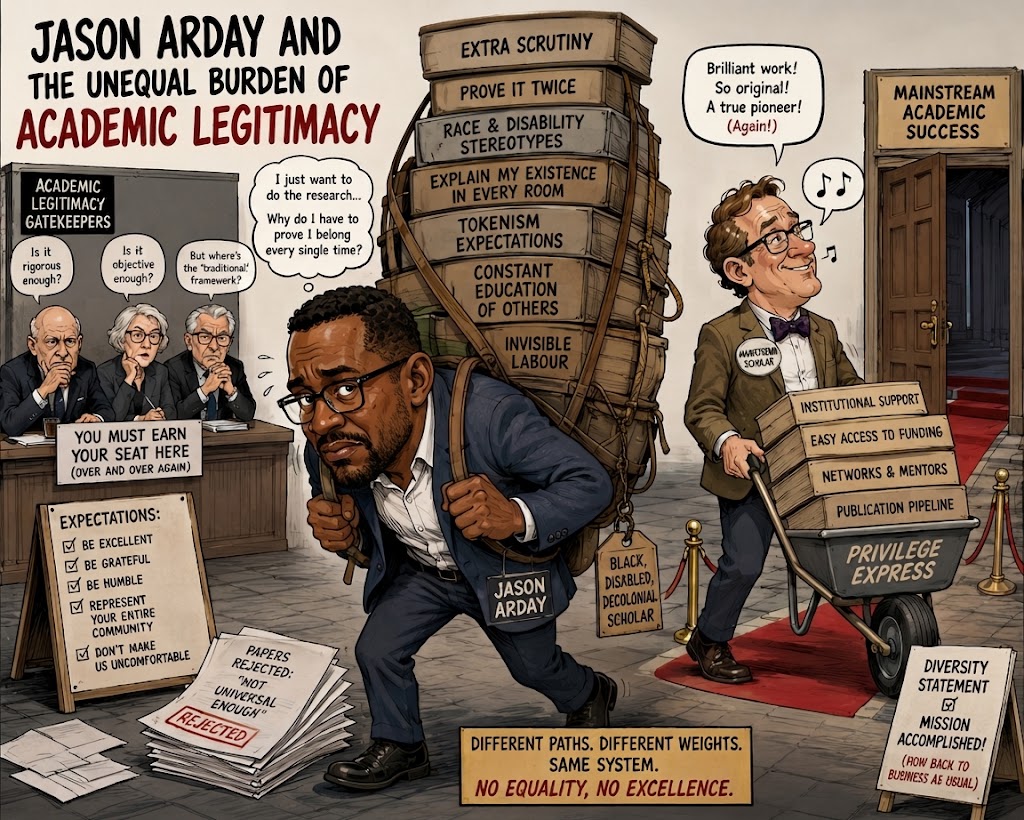
Arday’s appointment was celebrated partly because he became Cambridge’s youngest Black professor. That achievement inevitably made him symbolically larger than the position itself. Here lies the danger of representational transformation: once a Black academic becomes institutional evidence of diversity, his successes and failures cease to belong entirely to him. A questionable appointment involving a white professor generally becomes evidence of a questionable appointment. A controversial Black appointment can suddenly become evidence that diversity itself has failed.
That is the unequal burden of academic legitimacy.
Yet this debate is becoming even more consequential with artificial intelligence. The Arday controversy ultimately concerns who produces legitimate knowledge and which institutions possess the authority to validate it. AI introduces another actor into that relationship, because algorithms are increasingly determining what knowledge students encounter, which sources become visible and which intellectual traditions are treated as authoritative.
English remains overwhelmingly dominant online, accounting for roughly half of websites whose content language can be identified. That imbalance matters because large language models learn from digital environments already structured by inequalities of language, publishing, digitisation and institutional visibility.
The consequence is not that an AI system consciously decides that Western knowledge is superior. The danger is more structural. Knowledge produced in English, published by well-resourced institutions, indexed by major databases and repeatedly cited becomes computationally more visible. Knowledge transmitted through African languages, oral histories, indigenous intellectual traditions or poorly digitised local archives can become comparatively invisible.
This produces what might be called epistemic infrastructure inequality.
For an African student asking AI about African history, governance, medicine or philosophy, the resulting answer may therefore disproportionately reflect what highly digitised institutions have written about Africa, rather than what African intellectual traditions have produced about themselves. Where sufficiently rich digital information does not exist, “data voids” can produce unreliable answers or force culturally specific concepts into categories developed elsewhere.
Algorithmic gatekeeping compounds the problem. Search engines, social-media platforms and generative AI increasingly mediate what is visible, relevant and authoritative. Western universities, publishers and media organisations already possess enormous digital authority. Algorithms trained within this ecosystem can inadvertently reproduce that hierarchy, making established authority more discoverable and less digitised knowledge progressively harder to encounter.
AI therefore creates a paradox for decolonisation. It can democratise access to information while simultaneously centralising epistemic authority.
His story asks who gets recognised as a legitimate producer of knowledge
The problem becomes particularly serious in universities because generative AI speaks with remarkable confidence. Traditional academic research forces students to confront intellectual disagreement: search databases, read competing scholars, interrogate methodologies, identify contradictions and eventually construct an argument. Generative AI can compress this messy process into a polished paragraph. The danger is that fluency begins masquerading as neutrality.
A Eurocentric interpretation presented hesitantly invites interrogation. The same interpretation delivered instantly by an apparently neutral machine can acquire the appearance of universal truth.
The educational danger is therefore greater than plagiarism. It is cognitive outsourcing. Students risk surrendering the difficult intellectual labour of questioning authority, comparing perspectives and understanding why some knowledge became dominant while other knowledge was marginalised.
This brings us directly back to Arday.
His story asks who gets recognised as a legitimate producer of knowledge. AI raises the next question: who determines what legitimate knowledge is?
African universities should consequently resist two temptations. The first is believing that representation alone constitutes transformation. The second is believing that technological adoption automatically constitutes modernisation. Appointing more Black professors without interrogating the institutional architecture governing academic authority is incomplete transformation. Installing AI across universities without interrogating the epistemic architecture behind those systems risks digitising the very inequalities decolonisation seeks to dismantle.
What is required is something closer to transformative meritocracy: rigorous academic standards combined with deliberate efforts to transform the conditions through which merit is produced—mentorship, funding, doctoral supervision, publication opportunities, institutional networks and access to intellectual authority.
The same principle should govern AI. African universities need not reject these technologies. They should help shape them. That means digitising African archives, strengthening African journals and repositories, developing African-language datasets, protecting indigenous knowledge and ensuring African scholarship becomes part of the information infrastructure from which tomorrow’s knowledge systems learn.
Jason Arday should neither be canonised beyond scrutiny nor reduced to an exhibit in the prosecution of diversity. If misconduct occurred, evidence should establish it. If Cambridge’s appointment systems failed, Cambridge must account for them. And if racial hostility transformed legitimate academic scrutiny into something more pernicious, academia should possess sufficient intellectual honesty to confront that too.
The struggle for transformation has therefore moved beyond the question of who gets a seat at the table.
It concerns who built the table, who determines the rules for sitting around it, whose knowledge is recognised once there and increasingly, who designs the algorithms deciding what everyone around that table knows.
Decolonisation cannot stop at changing who occupies the professor’s chair.
It must transform the knowledge infrastructure surrounding it.
Murendeni Liphadzi (PhD) is a built environment scholar and researcher at the University of Johannesburg whose work sits at the intersection of the construction industry, decolonial theory, and Leadership. He continues to argue that South Africa’s developmental state issues are not only technical problems — they are also leadership ones.