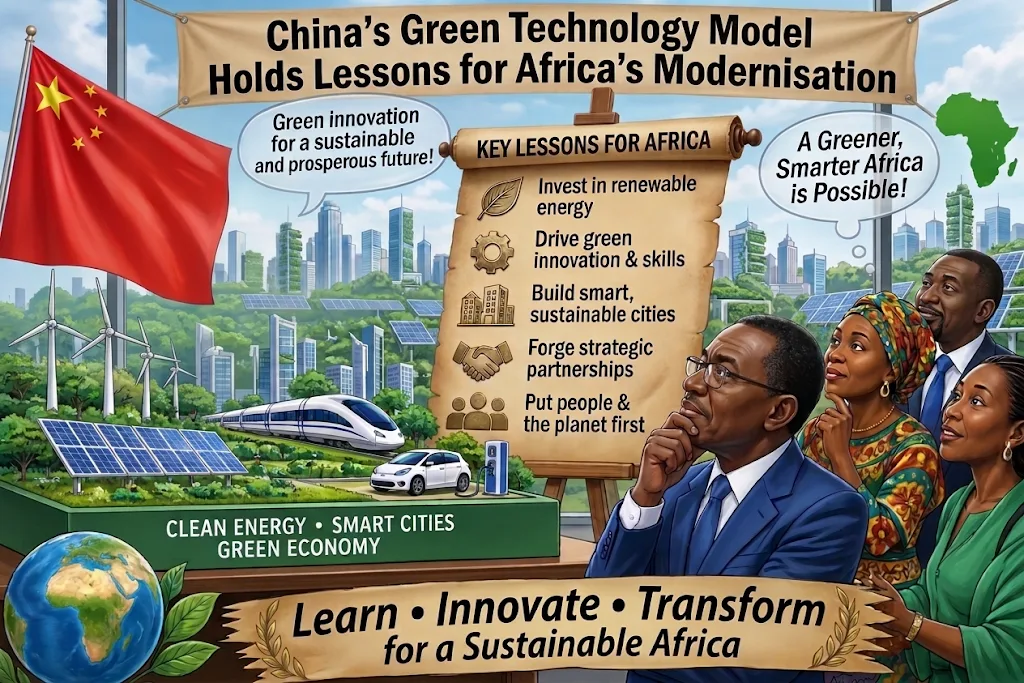
China’s use of green technology to advance sustainable development and modernisation emerged as a central theme during a recent seminar at the University of Venda (UNIVEN) in Limpopo, where academics, government representatives and state-owned enterprise officials examined the relevance of China’s development experience for Africa.
China has pursued high-quality development, placing greater emphasis on the quality rather than merely the speed of economic growth.
Held under the theme “Governance of China: Green Technology Cooperation and the Modernisation of Africa’s Governance Capacity,” the discussion drew inspiration from Chinese President Xi Jinping’s book series The Governance of China. Participants argued that aspects of China’s approach to green development and technological advancement offer valuable lessons for South Africa and the broader African continent.
The discussion aligned with China’s broader commitment to support Africa’s modernisation agenda, an undertaking reaffirmed on the sidelines of the G20 Leaders Summit held in Johannesburg in December 2025.
A recurring theme throughout the seminar was the role of green technology and innovation in driving development. Mukundi Mushaphi, manager of Local Economic Development at the Vhembe District Municipality, said China had made technological advancement a national priority by investing in and mobilising its most talented people.
According to Mushaphi, African countries should strengthen cooperation with China and learn from its experience while adapting those lessons to their own national circumstances and cultural realities. While China possesses advanced technological capabilities, Africa’s comparative advantage lies in its abundant natural resources, which can be utilised to improve the quality of life of its people. Such complementarity, he argued, creates opportunities for mutual growth and development.
Providing a broader historical perspective, Gundo Maswime, chief executive officer of the Musina-Makhado Special Economic Zone (SEZ), reflected on policy choices that have contributed to China’s economic rise.
Maswime noted that since the 18th National Congress of the Communist Party of China in 2012, the country has pursued high-quality development, placing greater emphasis on the quality rather than merely the speed of economic growth. He said Xi Jinping Thought on Socialism with Chinese Characteristics for a New Era had provided the guiding framework for this transition, emphasising that economic development should benefit society as a whole rather than a select group.
He highlighted China’s 2021 announcement that it had eliminated absolute poverty nationwide as a significant achievement flowing from this approach.
Maswime also linked China’s development experience to the growth of the Musina-Makhado SEZ, a flagship industrialisation project supported by the Limpopo Provincial Government and the Limpopo Economic Development Agency. The zone, approved and gazetted in December 2017, was established to stimulate regional trade and create employment opportunities near South Africa’s northern border. Its development has drawn on China’s experience with special economic zones and cooperation under the Belt and Road Initiative.
UNIVEN acting vice-chancellor and principal Fulufhelo Netswera focused on the importance of green technology in advancing sustainable development and strengthening governance systems through shared experience, technology transfer and capacity building.
“Green and low-carbon development has become an essential pathway to sustainable growth, environmental protection and the modernisation of national development systems,” Netswera said.
He argued that China’s green development experience, as outlined in Xi Jinping: The Governance of China Volume V, provides useful lessons for African countries. Through sustained investment in technological innovation, infrastructure and industrial transformation, China has demonstrated how green technology can improve livelihoods, enhance industrial competitiveness and support broader modernisation efforts.
Netswera stressed that the discussion was of immediate relevance to Africa rather than a purely academic exercise.
the continent possesses vast potential in the form of solar, wind and hydropower resources, abundant mineral wealth and a youthful population.
Many African countries continue to face challenges including energy shortages, inadequate infrastructure, limited access to green technologies and financing, as well as increasing vulnerability to climate change. At the same time, he noted that the continent possesses vast potential in the form of solar, wind and hydropower resources, abundant mineral wealth and a youthful population.
“The question before us is how to turn that potential into inclusive, sustainable modernisation,” Netswera said.
Introducing the seminar, Ni Yanshuo, chief reporter of the Africa Bureau of the CICG Centre for Europe and Africa, said the world was experiencing a new wave of scientific and technological innovation accompanied by profound industrial transformation and upgrading.
Against this backdrop, China and African countries are deepening cooperation in areas such as green technology to address common challenges, including climate change, energy security, environmental protection and economic transformation.
Ni pointed to China’s strengths in the manufacture of wind turbine equipment and solar photovoltaic technologies, saying these capabilities could assist African countries in expanding their clean-energy sectors.
Offering a provincial government perspective, Tovhowani Maswime, director of the Directorate of Mathematics, Science and Technology in the Limpopo Provincial Government, argued that green technology represents far more than an environmental imperative.
green technology represents far more than an environmental imperative.
“It can also strengthen economies, improve public services, expand access to energy, create jobs and build resilient communities,” he said.
The seminar concluded with a panel discussion on China-Africa cooperation in green technology and governance.
During the discussion, Ndivhuwo Madzusa, acting director of International Relations in the Limpopo Provincial Government, emphasised the importance of people-to-people exchanges and technology transfer in building governance capacity.
Taking a continental perspective, he noted that several African governments have drawn on Chinese experience to promote local manufacturing, technology transfer and integration into global value chains.
China has supported the development of special economic zones, industrial parks and local processing facilities
China has supported the development of special economic zones, industrial parks and local processing facilities in countries such as Nigeria, Ethiopia and Senegal. South Africa has adopted a similar approach, with Chinese companies investing in domestic special economic zones. In Limpopo, this cooperation includes the development of both the Musina-Makhado SEZ and the Fetakgomo-Tubatse SEZ.
Madzusa also highlighted training and skills-development initiatives. In 2023, Henan Province hosted a delegation of 10 public servants from Limpopo, North West and Mpumalanga provinces. The programme was designed to facilitate learning, exchange experiences and strengthen professional capabilities. Henan has since continued hosting delegations from the three provinces under the initiative.
While participants broadly welcomed deeper cooperation, some cautioned against assuming that technology alone guarantees development outcomes.
Jethro Zuwarimwe, a professor in UNIVEN’s Faculty of Science, Engineering and Agriculture, argued that green technology does not automatically translate into green development.
Africa’s development trajectory must remain African-owned and responsive to the continent’s diverse conditions.
He said China’s experience in strategic coordination, innovation, infrastructure development and industrialisation offered important lessons, but Africa’s development trajectory must remain African-owned and responsive to the continent’s diverse conditions.
According to Zuwarimwe, the success of cooperation should not be judged by the volume of imported equipment or the number of announced projects. Instead, it should be measured by tangible outcomes such as reliable services, stronger local capabilities, productive enterprises, decent employment opportunities, environmental protection and improved livelihoods.
“The opportunity before us is to turn green technology cooperation into a practical instrument for Africa’s sustainable modernisation,” he said.

