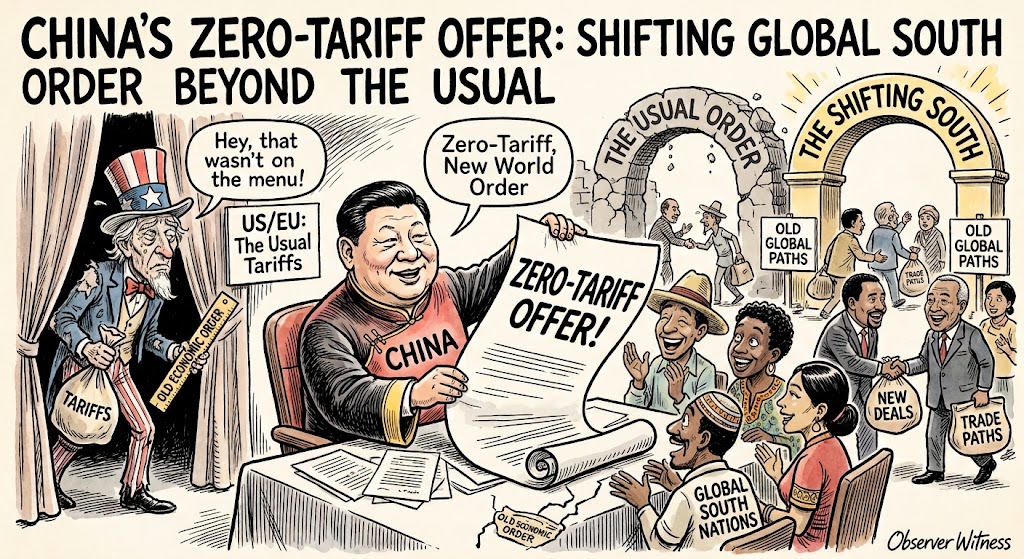
The debate surrounding China’s zero tariff trade offer to all 53 African countries with diplomatic relations with China has intensified, with experts weighing in on its implications for governance, development, and South–South cooperation.
The discussion unfolded at the National School of Government in Pretoria, South Africa, on 13 October 2026, during the unveiling of the South Africa–China–Africa Research Centre and a seminar titled “The Global South Working Together to Build a Community with Shared Future for Humanity.”
Beijing’s plan to strengthen trade relations through a zero tariff approach, positioning China as a partner in Africa’s independent modernisation
Senior representatives from the Beijing based Chinese Academy of Social Sciences, the China–Africa Institute, and South Africa’s National School of Government including the School’s Acting Principal, Phindile Mkwanazi, joined the event and made inputs. Chinese Ambassador Wu Peng outlined Beijing’s plan to strengthen trade relations through a zero tariff approach, positioning China as a partner in Africa’s independent modernisation. Wu emphasised the zero-tariff approach’s significance in strengthening trade relations between China and the 53 identified African countries.
Governance Exchange Beyond Western Templates
Deng Yating, deputy director of Security Studies at the China–Africa Institute, argued that the post Cold War consensus on a single Western path to modernisation has eroded. “As societies of the Global South engage directly — sharing experience, narratives and innovations, they build the collective capacity to shape international norms rather than receive them,” Deng said.
He emphasised that Chinese modernisation is framed not as Westernisation but as a contribution to the diversity of human civilisation. For Deng, the September 2024 Beijing summit, which elevated relations to an “all weather China–Africa community with a shared future,” placed governance exchange at the top of the agenda. China’s reform and opening experience, he argued, offers Africa latecomer development lessons without conditionality, breaking the donor–recipient hierarchy and enabling peer learning.
Chinese modernisation is framed not as Westernisation but as a contribution to the diversity of human civilisation
Shared Future, Trimmed but Central
Zhao Yating, Associate Research Fellow at the China–Africa Institute, explored how shared vision translates into sustained cooperation. His remarks, though extensive, can be distilled into three key points:
- Institutionalisation of Xi Jinping’s vision: Since 2013, the idea of a China–Africa community has evolved into structured arrangements, sectoral cooperation, and stronger strategic ties.
- FOCAC as anchor: The Forum on China–Africa Cooperation has become the multilateral platform for dialogue, governance exchange, and research collaboration.
- Zero tariff as extension of capacity building: Announced in June 2025 by President Xi Jinping, and effective May 2026, the policy moves beyond infrastructure and capital projects to strengthen trading capacity, linking development to everyday life through agricultural technology, vocational education, and scholarships.
China’s cooperation is not about exporting a “Chinese model” but about peer learning that enhances Africa’s autonomy.
Zhao highlighted China’s infrastructure footprint in Africa — railways, ports, power lines, and communication networks — as evidence of tangible outcomes. Projects such as the Mombasa–Nairobi railway and the Africa CDC headquarters illustrate how China’s role extends from trade facilitation to public health. His analysis underscored that cooperation is not about exporting a “Chinese model” but about peer learning that enhances Africa’s autonomy.
South African Perspectives: Development Alternatives
Dr Robert Nkuna, Senior Fellow at the National School of Government, contextualised China’s rise within Africa’s development trajectory. He noted that after structural adjustment, African states reasserted government led planning, and even institutions like the IMF and World Bank now concede neoliberalism’s limits. “China’s rise has been significant in these global shifts by showing that alternatives are possible even if diverse,” Nkuna said.
China’s governance experience is offering methodological lessons for institutional praxis
Nkuna’s research interrogates why long term development plans in African countries often fail to deliver outcomes. He sees China’s governance experience as offering methodological lessons for institutional praxis, particularly in industrial policy and state capacity.
Sustainability and Global Inequality
Bongani Mayimele, director for international relations and partnerships at the National School of Government, critiqued the dominant sustainability discourse. He argued that definitions of sustainable development are not politically neutral but reflect global power relations. “Sustainability cannot be separated from global inequality,” he said, urging the Global South to form closer alliances for development funding and green transitions on its own terms. He cited various scholars to explain the historical origins of ideas and the role of ruling-class ideas and literacies in shaping society, the historical origins and definitions of sustainable development, which he argues still has not addressed global poverty.
He said a definition of sustainable development can appear universal while containing profound political and normative choices. “Sustainable Development once more is a buzzword and a hallowed word,” Mayimele said, adding, “the dominant definition assumes that present generations can act on behalf of generations that do not yet exist”, but future societies may have different technologies, values, economies, social structures, environmental conditions and aspirations. Sustainable development is therefore shaped by global power relations.
Sustainability cannot be separated from global inequality.
Mayimele’s intervention reframed sustainability as a contested concept shaped by ruling class ideas and historical assumptions. For him, China’s engagement offers a chance to rethink sustainability beyond Western narratives.
China’s Role: From Infrastructure to Norm Shaping
Taken together, the voices at the Pretoria seminar reveal a pattern: China is positioning itself not only as Africa’s builder of railways and ports but also as a co-author of governance norms. Deng’s emphasis on plural modernisation, Zhao’s focus on institutionalised cooperation, Nkuna’s recognition of alternatives, and Mayimele’s critique of sustainability converge on a central theme, as Deng emphasises: the Global South is moving from rule taker to rule shaper, with China as a pivotal actor.
China is positioning itself not only as Africa’s builder of railways and ports but also as a co-author of governance norms
The zero tariff policy exemplifies this shift. It is not merely a trade concession but a symbolic gesture of South–South solidarity, embedding China more deeply in Africa’s economic and political fabric. As Zhao asserts, infrastructure projects reduce costs and connect producers to markets, while governance exchanges and research centres build intellectual capital. Together, they form the scaffolding of a China–Africa partnership that claims autonomy from Western prescriptions.
Seeds of a Shared Future
The Pretoria seminar underscored that China’s engagement in Africa is no longer confined to material projects. It is about shaping narratives, institutions, and futures. Zhao Yating’s detailed presentation, though trimmed here, illustrates the breadth of China’s ambition. Deng Yating’s analysis situates it within a plural modernisation framework. Nkuna and Mayimele remind us that Africa’s agency and critical reflection remain vital.
As the experts have revealed, China’s zero tariff offer is thus more than a trade policy. It is a strategic move in the reconfiguration of global governance, where the Global South seeks to define its own path. The challenge ahead is ensuring this partnership delivers not only infrastructure and trade but also genuine autonomy and sustainable development on African terms.
Other notable attendees included the Beijing-based Academy of Social Sciences’ Vice President, Peng Jinhui; Wei Nanzhi, Deputy Director-General of the Bureau of International Cooperation; Ye Hailin, Director General at the Institute of West Asian and African Studies and President of the China-Africa Institute; and He Jun, Deputy Director-General at the Institute of Industrial Economics. The ceremony also saw a joint unveiling of the plaque marking the opening of the China-Africa Research Centre at the National School of Government.

