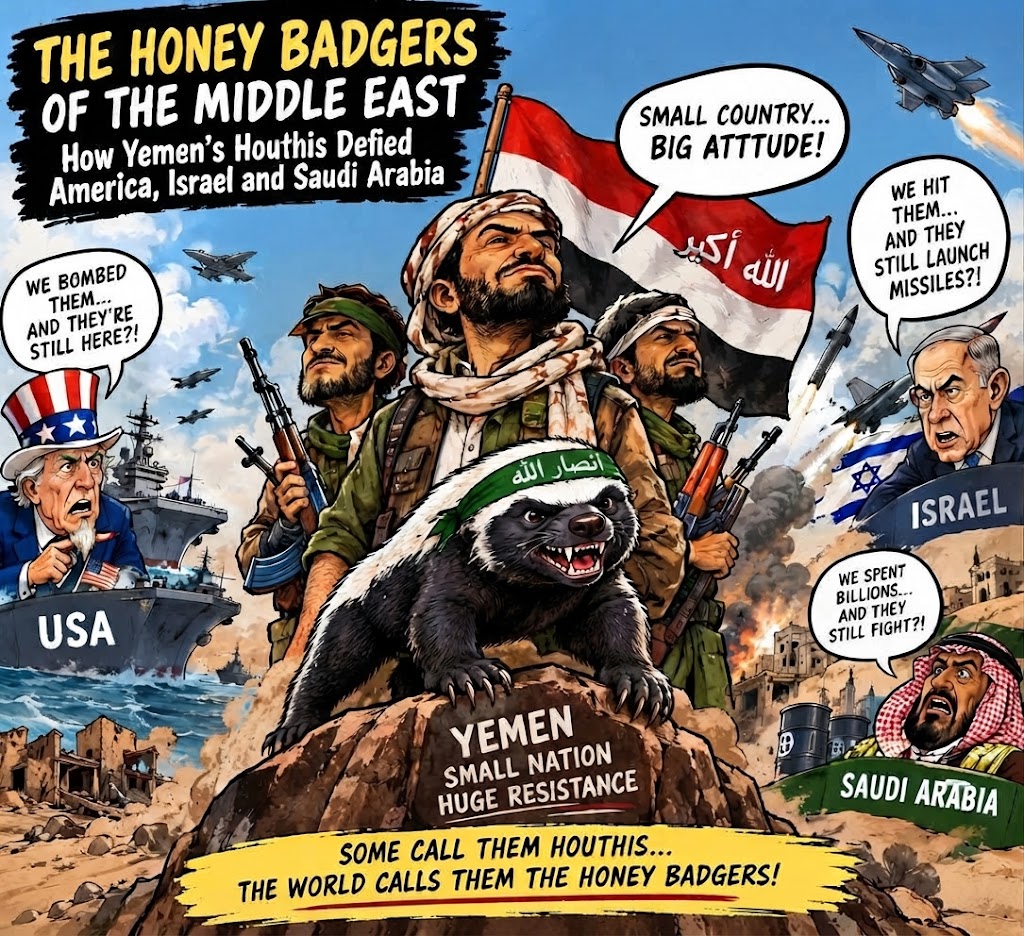
There is something strategically unsettling about the Yemeni Houthis. In one of the poorest and most devastated countries in the Middle East, a movement born out of Yemen’s political and sectarian struggles has managed to confront military powers vastly superior in technology, wealth and conventional firepower. The comparison to the honey badger is appropriate: small, aggressive, unusually resilient and apparently unwilling to retreat simply because the opponent is stronger.
a movement born out of Yemen’s political and sectarian struggles has managed to confront military powers vastly superior in technology, wealth and conventional firepower.
The Houthis, formally known as Ansar Allah, should not be romanticised. Their record includes attacks on civilian and commercial targets, arbitrary detention and serious allegations of human-rights abuses. Yet dismissing them as merely an Iranian proxy also misses an important strategic reality. They have developed into a durable military and political force capable of imposing costs on much larger adversaries.
Yemen was already among the poorest countries in the Middle East before the present conflict. The World Bank reported that Yemen had the region’s highest poverty incidence in its 2016 assessment. Since 2015, real GDP per capita has fallen by about 58 percent, leaving the country in one of the world’s most severe humanitarian crises. World Bank
Houthi’s poverty did not translate into military irrelevance.
The decisive turning point came in 2014, when the Houthis seized Sana’a and expanded their territorial control. In March 2015, Saudi Arabia intervened militarily at the head of a coalition supporting Yemen’s internationally recognised government. Saudi Arabia possessed advanced Western aircraft, sophisticated air-defence systems and enormous financial resources. The Houthis possessed considerably fewer conventional advantages.
The war nevertheless became a demonstration of the limits of conventional superiority.
The Houthis adapted to Yemen’s difficult mountainous terrain, dispersed their military infrastructure and increasingly relied on ballistic missiles, cruise missiles, drones and asymmetric tactics. Their ability to survive years of air strikes became one of the defining characteristics of the conflict.
Saudi Arabia discovered that expensive military technology does not automatically produce strategic security. The 2019 attacks on Saudi oil installations, which temporarily halved Saudi oil production, demonstrated the vulnerability of critical infrastructure to relatively inexpensive drones and cruise missiles. Reuters reported at the time that billions of dollars spent on sophisticated Western defence equipment had struggled against low-cost aerial systems.
Saudi Arabia discovered that expensive military technology does not automatically produce strategic security.
Then came the Red Sea.
Following the outbreak of the Gaza war in October 2023, the Houthis began attacking ships they identified as linked to Israel and launched missiles and drones towards Israel. Their intervention transformed a Yemeni conflict into an international maritime-security problem. According to the UK House of Commons Library, the Houthis launched nearly 190 attacks against commercial and naval vessels between November 2023 and October 2024. The disruption was significant enough to force major shipping companies to divert vessels around Africa. House of Commons Library
This was an extraordinary strategic achievement for a non-state armed movement operating from one of the world’s poorest countries.
The United States eventually responded with direct military action. In March 2025, Washington launched Operation Rough Rider, conducting more than 1,000 strikes against Houthi targets. Yet the bombardment did not eliminate the movement’s military capacity. Even after weeks of intense American attacks, the Houthis retained the ability to launch missiles towards Israel.
And then came the moment that deserves particular attention.
On 6 May 2025, Oman announced a ceasefire agreement between Washington and Sana’a. Under the arrangement, the United States and the Houthis agreed not to target one another, including American vessels in the Red Sea and Bab el-Mandab Strait.
That was not a traditional peace treaty, nor should it be portrayed as an American surrender. But it was a significant strategic concession: after launching a major bombing campaign, the world’s most powerful military ultimately accepted a negotiated cessation of hostilities with a non-state Yemeni movement.
Reuters subsequently reported that US intelligence had detected indications that the Houthis were also seeking an exit from the confrontation. The important point is that neither side achieved total victory.
Their survival exposes a recurring problem in modern warfare. Air superiority can destroy buildings, but it cannot necessarily destroy an organisation
The Houthis had survived.
Their survival exposes a recurring problem in modern warfare. Air superiority can destroy buildings, launch sites and infrastructure, but it cannot necessarily destroy an organisation embedded within difficult terrain, possessing decentralised command structures, local recruitment networks and an ability to regenerate military capabilities.
The Saudi experience also demonstrates another lesson: deterrence works both ways. Riyadh once intervened in Yemen believing its military superiority could produce a decisive outcome. Years later, Saudi officials were negotiating directly with Houthi representatives. In 2023, Houthi delegations travelled to Riyadh for negotiations concerning a possible settlement. Al Jazeera
The honey badger, therefore, is not necessarily the strongest animal in the fight. Its significance lies in its refusal to behave according to the expectations of stronger predators.
That is the Houthi phenomenon.
They have paid an enormous price, and Yemen’s civilians have paid an even greater one. Their military resilience should therefore not be confused with moral legitimacy. But strategically, the message is difficult to ignore: a movement operating from an impoverished, war-ravaged country forced Saudi Arabia into negotiations, disrupted one of the world’s most important maritime corridors, absorbed a massive American bombing campaign and compelled Washington into a ceasefire.
For a movement that many initially regarded as a local Yemeni insurgency, that is an extraordinary record.
The Houthis may be poor. They may be internationally isolated. But the history of the Yemen war has demonstrated that they are neither militarily irrelevant nor easily intimidated.

