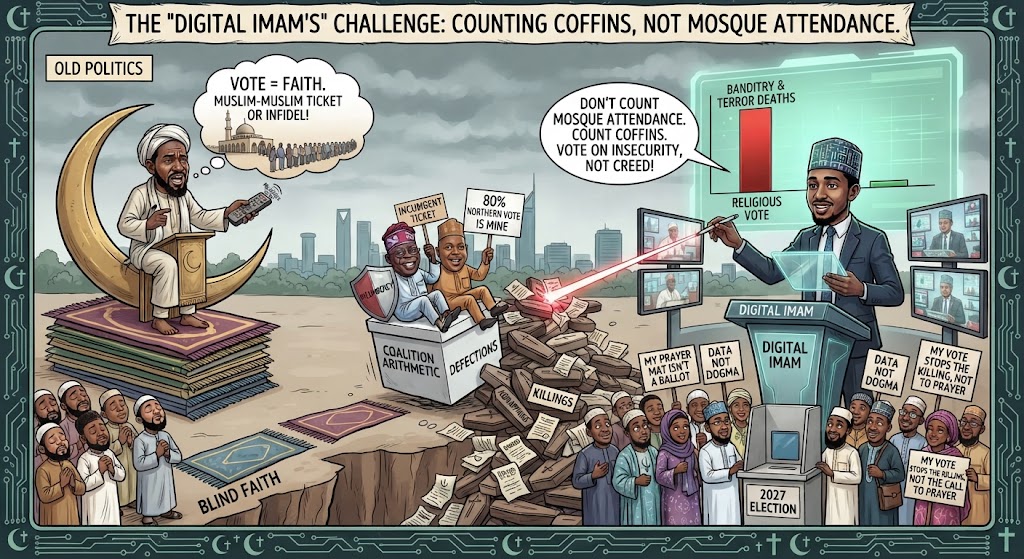


Nigeria’s 2027 election will likely still be decided by the familiar mechanics of incumbency, defections and coalition arithmetic
A short Facebook post travelling through Nigerian WhatsApp and Facebook groups this week carried more electoral weight than most of the coalition press conferences held in Abuja this year. In it, Sheikh Nuruddeen Khalid — popularly known as the “Digital Imam” for his prolific social-media preaching — is quoted urging Nigerians to make insecurity, not religion, the defining issue of the 2027 elections. Anyone incapable of stopping the killings, he reportedly declared, should not get their vote. It is a modest sentence. In the context of where Nigerian politics currently sits, it is close to a manifesto.
Nuru Khalid built his reputation as one of Northern Nigeria’s most media-savvy clerics,
To understand why, it helps to know who is saying it. Nuru Khalid built his reputation as one of Northern Nigeria’s most media-savvy clerics, broadcasting sermons to congregations far beyond his physical mosque. In 2022 he was suspended as Chief Imam of the Apo Legislative Quarters mosque in Abuja after criticising the APC government’s handling of insecurity — a costly stance for a cleric whose income and standing depend on institutional goodwill. That history gives his 2027 intervention real credibility: this is not a first-time critic finding a convenient cause, but a scholar who has already paid a price for saying similar things before.
The timing matters just as much as the message. His comments land only weeks after a very different cleric, Sheikh Sani Yahaya Jingir of the Izala Scholars Council, triggered national outrage by urging Muslims to back another Muslim-Muslim presidential ticket in 2027 and describing critics of that arrangement as “infidels” who should be shown their “limit.” Jingir’s remarks reopened a wound from 2023, when Bola Tinubu’s decision to run with a fellow Muslim, Kashim Shettima, as running mate drew accusations of religious exclusion even as it helped consolidate northern votes. Where Jingir wants Nigerians to count Friday-mosque attendance, Khalid is telling them to count coffins and ransom notes instead. That is a genuine ideological fault line running through the same religious establishment both men claim to represent, and it is playing out just as the country’s political class begins locking in its 2027 alliances.
Jingir’s remarks reopened a wound from 2023, when Bola Tinubu’s decision to run with a fellow Muslim, Kashim Shettima, as running mate drew accusations of religious exclusion
The security record he is invoking is not exaggerated. Independent monitors paint a grim picture: the Observatory for Religious Freedom in Africa has tallied tens of thousands of deaths and abductions in bandit and terrorist attacks over the past six years, while the rights group Intersociety counted roughly 720 attacks in the first half of 2026 alone, spreading well beyond the traditional insurgency zones of the northeast into farming communities and highways across the country. A mosque in Katsina, churches in Kaduna, schoolchildren in Kebbi and Niger, displaced families sheltering at a Catholic mission in Plateau — the casualty list crosses every faith line Jingir wants voters to draw. That is precisely Khalid’s point: banditry and terrorism in the north do not check ID cards for religion before they strike, so voting along sectarian lines to solve a security crisis is close to self-defeating.
Whether this message can actually move an election is a harder question, and an honest columnist should resist overselling it. Nigeria’s opposition remains badly fractured heading into January’s presidential vote, the Atiku-Obi coalition collapsed before it launched, rival blocs have formed around the ADC and the newer NDC, and 31 of the country’s 36 state governors now sit inside Tinubu’s APC after a wave of defections that has reshaped the political map in the incumbent’s favour. A cleric’s viral sermon, however widely shared, does not by itself produce a rival candidate, a party structure, or a get-out-the-vote machine capable of converting sentiment into ballots. Sermons move consciences; coalitions move votes, and right now Nigeria’s opposition has the former in surplus and the latter in short supply.
the Atiku-Obi coalition collapsed before it launched,
What the Digital Imam’s intervention does accomplish, though, is to puncture the assumption that northern Muslim votes are simply available for the taking on religious grounds alone. APC strategists have openly argued the party could lose “80 percent of northern Muslim votes” if it drops the Muslim-Muslim ticket, treating the northern electorate as a bloc that responds mainly to religious signalling. Khalid’s message, echoed by other voices uneasy with Jingir’s rhetoric, suggests that bloc is neither monolithic nor purely faith-driven — that competence in stopping bandits and terrorists may increasingly outweigh the symbolism of who sits in the mosque pew next to the president.
Nigeria’s 2027 election will likely still be decided by the familiar mechanics of incumbency, defections and coalition arithmetic rather than by sermons alone. But Khalid’s warning reframes the terms of legitimacy in a way that should worry every candidate, incumbent and challenger alike: in a country burying its citizens faster than it can protect them, no amount of religious solidarity substitutes for the basic promise that government exists to keep people alive. That, more than any coalition math, may be the real test the 2027 candidates cannot outmanoeuvre.