

Open TikTok on a slow evening, send a mobile money confirmation, log into a Teams call, or make a WhatsApp video call to a cousin in London, and you are, without knowing it, using the tail end of a story that started in a bedroom in Nairobi.
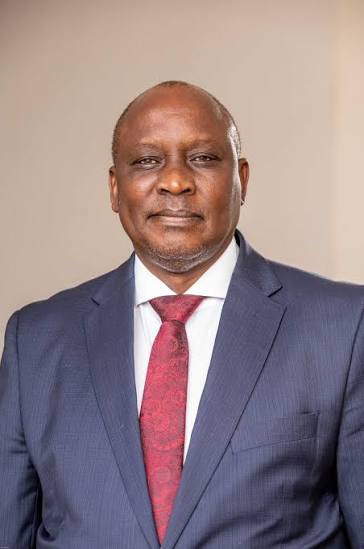
That bedroom belonged to Dr Shem Ochuodho.
Kenya today wears its digital reputation well. Nairobi is spoken of as a tech hub in the same breath as Lagos and Kigali. A teenager in Kisumu can sell handmade jewellery to a buyer in Denver before lunch. A university student in Eldoret can sit in on a seminar happening in Boston. None of that was inevitable. Someone had to first answer a much harder, much lonelier question: how does a country with no internet infrastructure get itself connected to a network that, in the early 1990s, barely existed outside a handful of American and European institutions?
Ochuodho was one of the people who set out to answer it.
He was not, on paper, an obvious candidate for the job of national internet pioneer. He had trained in physics and mathematics at the University of Nairobi, added a master’s in electrical and electronic engineering, and later completed a PhD in software engineering at the University of York. That mix of formal training, together with a restless curiosity about what computers could eventually do for a country like Kenya, put him in the right place at the right time, even if the “right place” was, quite literally, his own home.
Before Kenya had anything resembling live internet access, it had email, and even that arrived in the most unglamorous way imaginable. Messages leaving and entering the country passed through a store-and-forward server that Ochuodho ran from one of his bedrooms. The server would dial into an internet service provider called GreenNet in London, at first only once a week, then daily, then hourly, gradually pulling Kenya closer to something resembling continuous connectivity. It is a detail worth sitting with: the infrastructure that now lets a Nairobi-based accountant file taxes online in minutes once depended on a machine quietly phoning London in the middle of the night.
The breakthrough came on 24 October 1995, when Kenya switched on real-time internet access, reportedly making it one of the first countries in sub-Saharan Africa to do so. The connection ran through the African Regional Centre for Computing on Ngong Road in Nairobi, with backing from the United States National Science Foundation and technical support from the American internet engineer Randy Bush, who helped get the signal working. A narrow leased line of just 9,600 bits per second, costing an eye-watering sum each month by today’s standards, was Kenya’s first real doorway to the global network. It sounds almost quaint set against fibre-optic cables and 5G, but at the time it was a genuine national milestone.
Ochuodho’s role did not end with getting the lights on. In 1993, the Internet Assigned Numbers Authority, then still under the stewardship of internet pioneer Jon Postel, delegated administrative responsibility for Kenya’s “.ke” domain to him, with Randy Bush handling the technical side. For years, the two men managed the country’s slice of the internet’s address book on a voluntary basis, long before anyone in Kenya was thinking about domain registration as a business. That early, largely unpaid custodianship eventually gave way to the Kenya Network Information Centre, formally established in 2003, which administers the “.ke” domain today.
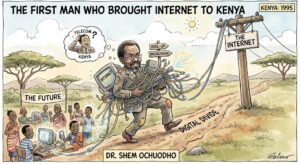
He also went on to represent Rangwe constituency in Parliament between 1997 and 2002, and later built a career as a corporate consultant and diaspora advocate, currently serving as global chairperson of the Kenya Diaspora Alliance. But it is the internet story, the one that rarely makes it into a headline, that arguably shaped the country more than anything else on his résumé.
Kenya’s digital growth after that first connection was, of course, the work of many hands, not one. The Kenya Education Network, founded in 1999 with support from USAID’s Leland Initiative, took on the job of linking universities, research institutes and libraries to affordable bandwidth, a mission it still carries out today, now connecting well over two hundred member institutions and extending fibre into rural schools and hospitals through community partnerships. Telecom operators, regulators, engineers and entrepreneurs who came after all added their own layers to what eventually became the Kenya we recognise now, a country where mobile money was invented, where tech hubs recruit straight out of university, and where a small business owner can build an entire customer base on Instagram without ever renting a shopfront.
But somebody has to lay the first stretch of road, and it is worth remembering who did.
There is a particular kind of contribution that does not photograph well. Nobody cuts a ribbon for a store-and-forward server humming away in a spare room. Nobody throws a parade for a leased line running at a fraction of today’s mobile data speeds. Yet without that unglamorous groundwork, the country’s later achievements, from the growth of Nairobi’s start-up scene to the ordinary convenience of a video call home, would have had nothing to build on.
So the next time you open an app without a second thought, it is worth remembering that Kenya was not born connected. A handful of people had to imagine that connection first, argue for it, and then quite literally wire it into existence from whatever room they had available. Dr Shem Ochuodho was one of them, and Kenya’s technological history is incomplete without his name in it.