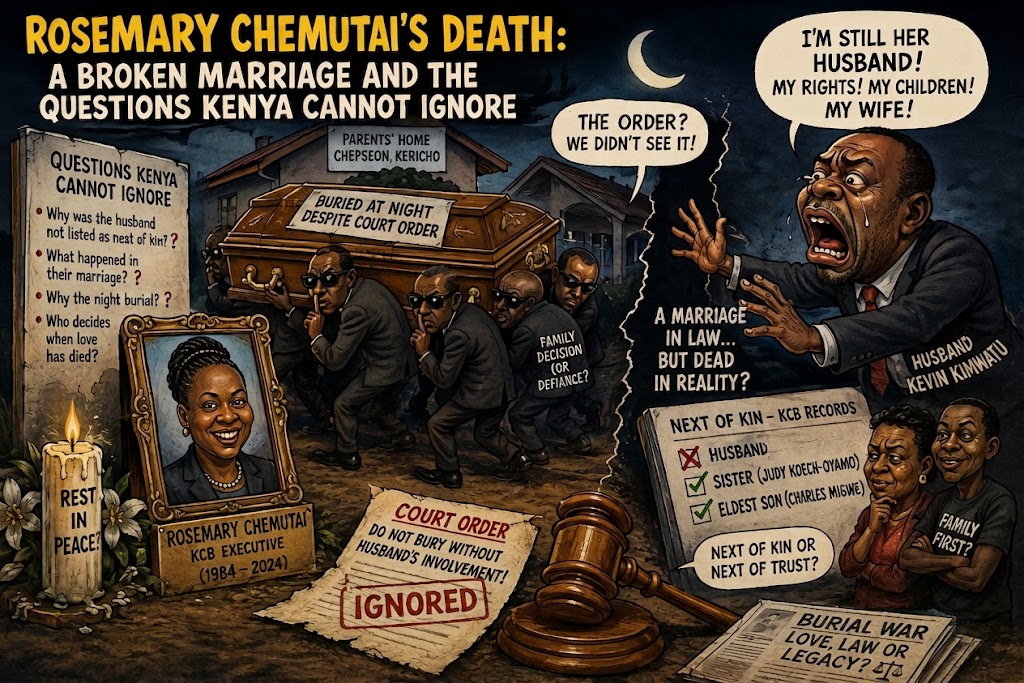


The burial of Rosemary Chemutai Koech-Kimwatu, the 40-year-old KCB executive and Head of Data Protection, should have been a solemn private farewell. Instead, her death has opened a disturbing public window into a marriage apparently fractured long before her final breath.
She was buried at night at her parents’ home in Chepseon, Kericho County, despite interim court orders issued hours earlier restraining her burial without the involvement and consent of her husband, Kevin Migwe Kimwatu. The family maintains that the court order had not been served before the burial proceeded. Nevertheless, the extraordinary circumstances surrounding the midnight interment have transformed a private tragedy into a case demanding difficult questions.
The most intriguing question is not simply where Rosemary was buried.
It is: What had happened to her marriage before she died?
The Husband Who Was Still Married, But Apparently No Longer “Next of Kin”
According to court documents reported by several Kenyan media outlets, Rosemary and Kevin Kimwatu married at St Austin’s Catholic Church in Nairobi in August 2013 and had four children. Legally, the marriage remained intact. Yet the documents also reveal that the couple had experienced serious marital difficulties and had reportedly lived apart for approximately four months before her death. The husband has maintained that they had reconciled and that Rosemary intended to return to their matrimonial home.
But another fact complicates that narrative.
KCB’s employment records reportedly identified Rosemary’s sister, Judy Koech-Oyamo, and her eldest son, Charles Migwe Kimwatu, as her nominated next of kin. Her husband was not listed.
That administrative decision may not determine succession rights or legally erase a marriage. But socially and emotionally, it speaks volumes.
People do not ordinarily remove a spouse from important personal records without a reason.
Did Rosemary deliberately change her next-of-kin details during the period of marital separation? If so, what circumstances informed that decision? Was it an expression of emotional estrangement? A practical administrative decision? A consequence of a deeper marital breakdown? Or did she simply place greater trust in her sister and eldest son to manage her affairs?
At present, the public record does not provide definitive answers.
But the questions are legitimate.
When a Marriage Exists in Law but Dies in Practice
Perhaps the Rosemary Chemutai case exposes an uncomfortable reality about modern marriages: a marriage certificate can survive long after the relationship itself has collapsed.
Kevin Kimwatu’s argument rests substantially on his status as the surviving husband. Rosemary’s employment records, however, appear to tell a different story about who she trusted with responsibility over her affairs.
There is a profound distinction between being a spouse in law and being the person someone considers their closest representative in life.
This distinction should not be casually dismissed.
The exclusion of a husband from next-of-kin records does not automatically prove hostility, abuse, abandonment or marital collapse. To suggest otherwise without evidence would be irresponsible. Yet neither should the decision be treated as meaningless. Particularly when it coincides with reports of a four-month separation and an apparent conflict between the husband and Rosemary’s natal family immediately following her death.
The picture emerging is of a family structure that may have been fractured long before the funeral dispute.
Was the Battle About Burial, or Something Bigger?
The dispute officially concerned burial arrangements. Kevin reportedly wanted Rosemary buried at his ancestral home in Matasia, Ngong, while her parents wanted her buried at Chepseon in Kericho.
But burial disputes are rarely only about geography.
They are often contests over identity, belonging, authority and, sometimes, future control over a deceased person’s legacy and estate.
This raises another unavoidable question: Did Rosemary’s nomination of her sister and son as next of kin represent an attempt to distance her husband from certain personal and administrative affairs?
There is currently no evidence that the nomination was designed to disinherit Kevin or deny him inheritance rights. It would be legally reckless to make such a conclusion. An employer’s next-of-kin record is not necessarily a will and does not independently determine succession. Indeed, the dispute itself raises important questions about the limits of an employer’s authority in funeral arrangements.
But perception matters.
For a husband to discover after his wife’s death that she had formally designated her sister and son, rather than him, as her recognised next of kin inevitably raises questions about the state of their relationship.
The Darkness Around the Burial
The decision to proceed with a night burial has added another layer of intrigue.
The family says it acted to give Rosemary a dignified burial and a resting place accessible to her children. Reports also indicate that the order may not have been served on the family before the burial. Those facts will matter when the court examines what happened.
Yet public perception is unavoidable.
A burial conducted after dark, hours after a court had issued orders concerning the interment, creates the appearance of urgency and secrecy, whether justified or not.
And appearances matter when public confidence in institutions and family processes is at stake.
Rosemary Chemutai’s death has therefore become more than a family dispute. It has exposed the private complexities hidden beneath respectable public identities: the successful executive, the wife, the mother, the daughter and the woman whose personal choices may only now be emerging after her death.
The court may eventually determine questions surrounding procedure and burial rights.
But one question may never receive a formal legal answer:
Why did Rosemary Chemutai apparently choose to leave her husband outside the circle of people formally entrusted with her affairs?
That question goes to the heart of this tragedy.
And perhaps the answer lies in a marriage whose legal existence survived, but whose emotional foundations may already have been quietly collapsing.