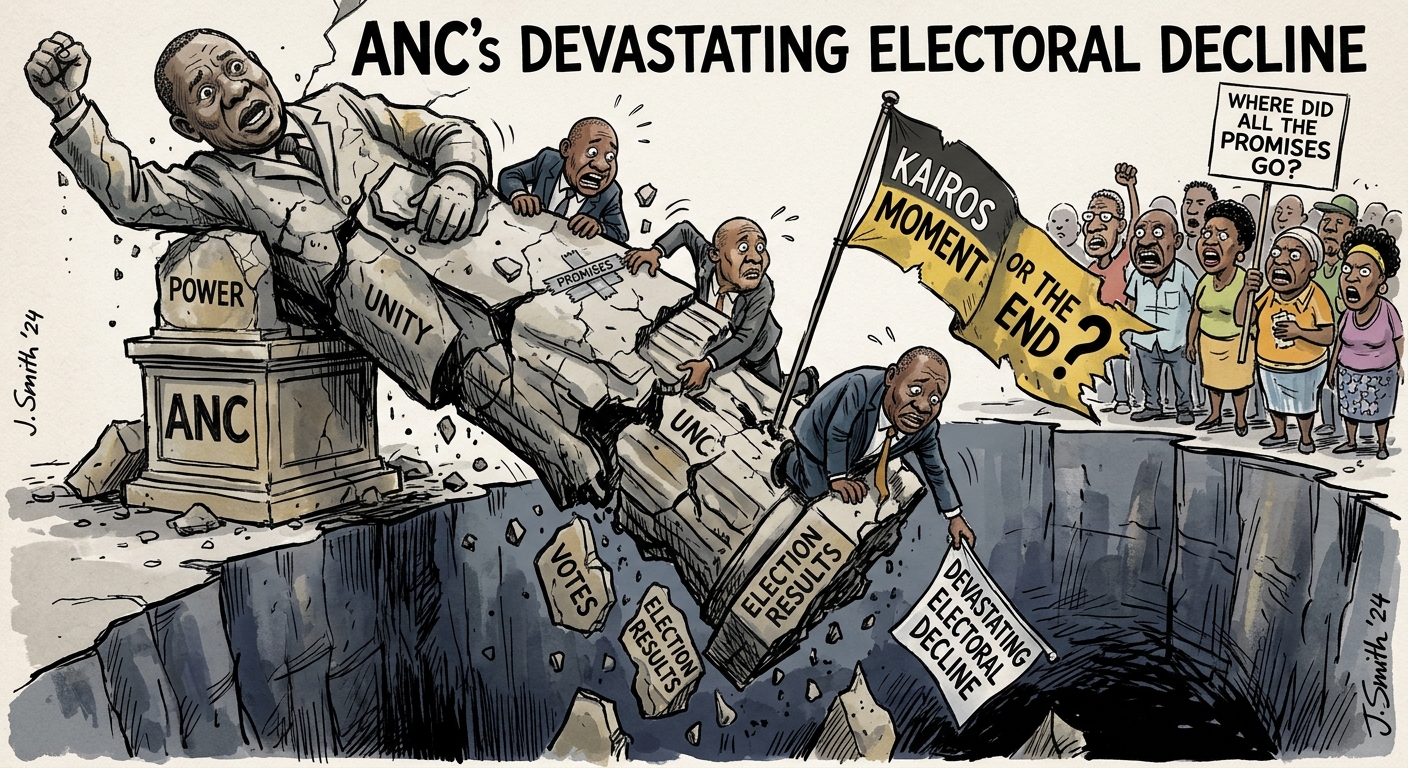

State power is not enough. When state power is not used to consolidate the broader power axis of society, that state power will eventually be lost. The other centres of power constitute the broader matrix of power in society and possess the ability and equal force to either elevate the reach and effectiveness of the State or serve as instruments to crush it. These I argue are the media, the universities, business and civil society.
State power is not enough. When state power is not used to consolidate the broader power axis
The use of the media, for 32 years now without ceasing, to ‘vigorously disseminate such information as it believes served to discredit and weaken the ANC’, has been instrumental in chipping away, piece by piece, on the credibility of the state and of the ANC.
The use of universities to “indoctrinate a whole generation”, that the Markets are the answer to all our problems, if only that Government did not get in the way, turns a generation of our brightest young minds against the state and entrenches a narrative that any problems in the markets, monopolies, oligopolies, barriers to entry, unemployment, inequality, inefficiencies, must be because of government because markets are perfect.
The use of NGOs and donors to undermine the state at every turn has turned frustrated citizens against the state
The use of the power of corporations to shape tastes, accustoms young people to individualism and self-serving indulgence, away from utilising their talents to solve community and societal problems leaving everything to the very state that is said to be a problem.
The use of NGOs and donors to undermine the state at every turn has turned frustrated citizens against the state for the seeming failure of the state to reign-in these NGOs who frequently use law-fare to undermine the broader will of the people.
Corporations seat at the centre of these power axis and have used their financial power to become political players, whether it’s through their media ownership, their highly unequal political party donations, university donorship and their civil society financial support, business owners are very much political players and use all their power to decide how different political parties are funded and how various political leaders are presented to the public
The use of all these power has relied on historically established stereotypes about black leaders and black government
The use of all these centres of power to discredit the ANC government, particularly the media, has relied on historically established stereotypes about black leaders and black government and part of the responsibility of the ANC, in the manner the party governs, has been to create a counter-stereotypical image of black people that dismantles old established narratives to restore pride in black leadership.
Historically, Black people have been unfairly stereotyped, as lacking competence, being unprofessional, unreliable, and volatile, among other tropes. Many people, both white and black, have internalised these stereotypes so that all black leaders, in a post colonial milieu, have had to first disabuse these stereotypes by proving themselves as highly competent black professionals, who are calm and cool, with an unshakable composure and demeanour, in order to break out of the stereotypes and make both black and white people lower their prejudices.
It is infact the rejection of these offensive black stereotypes that led to the formation of the South African National Native Congress in 1912
It is infact the rejection of these offensive black stereotypes that led to the formation of the South African National Native Congress in 1912 (changed to just ANC in 1923), by a group of highly competent black professionals, with their elite international education and their international accolades of excellence to match, who represented a counter-stereotypical image, using a universal language of nonracialism and equality and giving the organisation they founded broad appeal and everlasting existence
Since then the ANC has been led by this
highly competent black professional subtype, from Pixley ka Isaka Seme to AB Xuma to Thabo Mbeki.
Infact in the early 1960s, the ANC, confident that eventually the struggle will end and the organisation will need highly competent black professionals to govern the country post independence decided to select 16 young people to be taken abroad to study and prepare themselves for a free South Africa.
Thabo Mbeki was one of those 16 young people. Madiba, who was underground at the time, risked capture to come out and have a moment to speak to those 16 young people before they left the country, which emphasised the importance of the journey these young people were embarking on.
Thirty years later, when the ANC was back in the country and preparing to govern, holding conferences, drafting governing documents, decided, strangely, that those who will serve in the national executive of government would be elected by a conference. Madiba saw the risk of such a conference resolution and rejected that idea out of hand. Madiba said that allowing those who serve in government’s national executive to be a product of conference would be to replace competency with popularity which would be a disaster for the ANC.
During the Thabo Mbeki Presidency, the forces of populism grew too strong and in 2007
Unfortunately the struggle was not only fought by highly competent black professionals. At some point, those who did not fit the subtype but felt entitled to state power and its largess were going to put up a fight and reclaim a place in the post-struggle ANC that was now a governing party. While it is Mandela who insisted that every position in the National Executive of government be matched with proven skill and experience, thereby excluding those who possessed no such skill, the excluded waited for Madiba to leave office and took up the fight with his young successor.
During the Thabo Mbeki Presidency, the forces of populism grew too strong and in 2007, in Polokwane, popularism finally won the day and that line that had always been drawn between those elected by popular votes at conference and those selected by competence into governing was collapsed. The highly competent blacks were ultimately crushed in favor of popular leaders who were said to represented the forgotten masses.
Shortly after 2007, the highly competent black professional subtype was wiped out of the entire government, from the national executive down to the mayors and councillors in dwindling towns and faded villages, if you were popular, you were good enough to lead and competency was no longer a requirement.
After Polokwane, all the Historical Black stereotypes, lack of competence, unreliability, lack of professionalism, volatility, corruption, lack of sexual discipline, became synonymous with the state deployment so that it was no longer possible to dispute the old naysers who had predicted exactly this sort of decay that would follow the black government.
It was inevitable that after a while, a huge section of the population, both professional and ordinary, and especially black people, would distance themselves from this ANC that now shamefully gave credence to old narratives and stereotypes of a black government that was not fit to govern, unprofessional, incompetent, and eliciting a sense of moral decay.
For 15 years, Madiba and Mbeki had dismantled the historical anti-Black stereotypes, highly educated, poised intellectuals, lawyer and economist, leaders who would not pick a cent out of the sidewalk that did not belong to them, leaders with good intention, trustworthy, and extremely hard working: All replaced by a bunch of untrustworthy leaders, exploitative, low-competence, leaders that gave credence to black people accusers, that maybe the way they have always painted black people has been right all along.
Black people spent hundreds of years being forced to internalise a narrative of their inferiority. The task of the ANC was to restore black peoples confidence in their humanity by providing a counter-stereotypical image of black people, competent, professional, effective, incorruptible and hard working. The ANC did that….for 15 years.
The task of the ANC was to restore black peoples confidence in their humanity
The people unfortunately have inevitable defaulted to the group of people who have cultivated for themselves, through ownership of the other centres of power, especially their ownership of the tools of propaganda, stereotypes of competence and high performance, hiding their sins and exaggerating their wins, our erstwhile colonisers.
The ANC has a record of 15 years of exceptional good governance, up and down the state apparatus, from cabinet to local municipal committees. Its time to look back to those years and make the hard decisions that will be required. It may well be that the ANC will have to cut half of its deployees who don’t represent the highly competent and skilled subtype.
Better fewer but better.
Yonela Diko is an Author of the book ‘Ramaphosa – The Long Game’

Yonela Diko is an Author of the book 'Ramaphosa - The Long Game'
https://thelonggame.co.za/