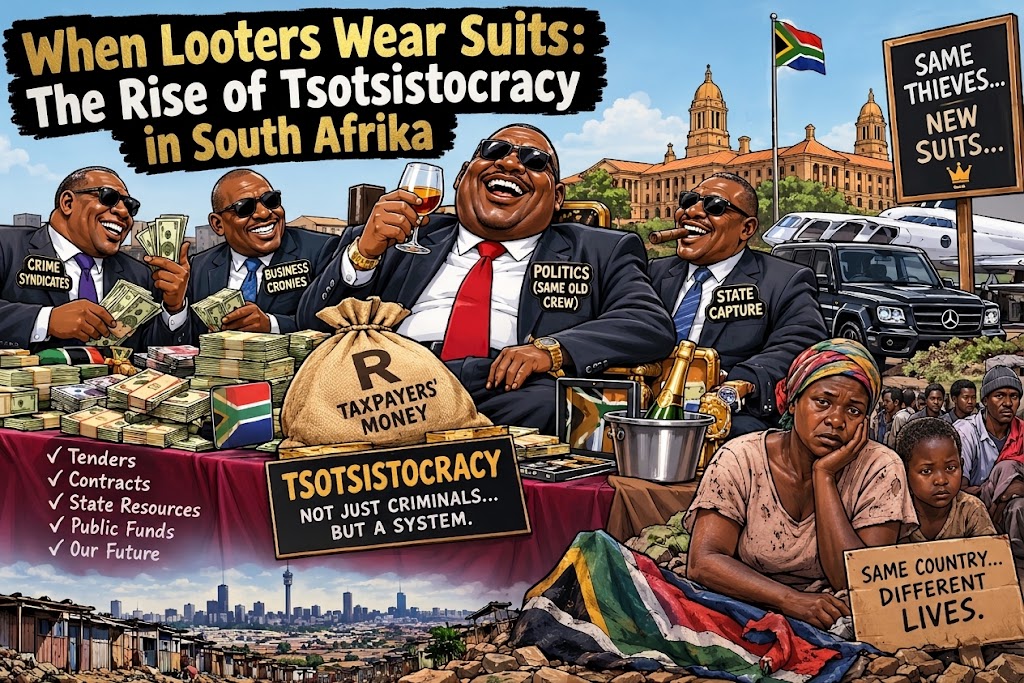

There was a time when communities expected its leaders to be the custodians of integrity and uprightfullness. Today, many South Africans watch with growing concern as individuals who prosper through patronage, manipulation, and corruption are increasingly celebrated rather than condemned. We are witnessing the rise of what might be called a tsotsistocracy.
A tsotsistocracy is not a government run by street criminals alone. It is a community in which the values associated with the tsotsi become acceptable in public life. It emerges when cunning is valued above competence, loyalty above merit, and personal enrichment above public service. This state of tsotsistocracy in South Afrika has been in our minds with few intellectual rebels and maybe the time is ripe to unmask it and decipher it.
A tsotsistocracy is a community in which the values associated with the tsotsi become acceptable in public life
In such an environment, the question is no longer who can best serve the people, but who can best position themselves to access power and resources. Commission of inquiry arraigned these Tsotsi but they still flash with suits and ties and snippers behind the tv cameras and newspaper headlines.
The danger of a tsotsistocracy is that it rarely arrives dramatically. It does not suspend the widely celebrated 30 years of South African Constitution or cancel local or national or provincial elections. Instead, it slowly destroys institutions from within.
Public offices become opportunities for accumulation. Accountability becomes selective. Ethical leadership is mocked as weakness while opportunism is celebrated as intelligence and fame.
Public offices become opportunities for accumulation.
South Africans are not unfamiliar with this phenomenon. From local government to national institutions, citizens have repeatedly witnessed scandals involving corruption, maladministration, and abuse of public funds.
While many honest public servants continue to serve with distinction, the public perception increasingly favours cynicism. Too many people believe that success depends less on hard work and more on political connections and proximity to power.
This perception is perhaps the most dangerous legacy of tsotsistocracy. When young people see corruption rewarded and integrity overlooked, they begin to question the value of education, professionalism, and honest labour.
The message they receive is simple: play the game or be left behind. Once that mindset takes root, the moral fabric of society begins to collapse. Things falls apart and the emperor is naked.
The tragedy is that South Africa’s democratic project was founded on entirely different principles and compromises- secret talks before the talks of talks.
The struggle against apartheid was not only about replacing one government with another. It was about building a society based on human dignity, justice, accountability, and equality.
The Constitutional desire and appetite envisioned ethical governance, not the normalization of corruption. It promised public service, not self-service. Batho Pele and not Masika Pele.
The challenge before us, therefore, is not merely political or economic. It is fundamentally moral. A nation cannot sustainably develop if its institutions are undermined by a culture of greed and impunity. Investors may hesitate, public trust declines, service delivery suffers, and social cohesion weakens. Ultimately, ordinary citizens bear the cost.
Yet there is an alternative. The African philosophy of ubuntu offers a powerful counterpoint to tsotsistocracy. Ubuntu teaches that leadership is a responsibility rather than a privilege.
It reminds us that a person’s success is connected to the wellbeing of others. Under ubuntu, leadership is measured not by what one takes from society, but by what one contributes and develops to it.
The struggle against tsotsistocracy will not be won in courtrooms or commissions of inquiry alone. It requires ethical leadership in government, principled conduct in business, active citizenship in communities, and a commitment by all South Africans to reject the normalization of corruption wherever it appears.
Ubuntucracy or Democracy survives not only through laws and institutions but through the values that citizens choose to uphold.
Ultimately, the question facing South Africa is simple: What kind of society do we wish to become? One where the tsotsi is admired because he wins, regardless of how he wins? Or one where integrity, service, and accountability remain the highest standards of public life?
The answer will determine not only the future of our Ubuntucracy or democracy but the character of the nation itself.
If we allow the ethics of the tsotsi to become the ethics of governance, we should not be surprised when public trust collapses. But if we restore the values of ubuntu, accountability, and service, South Africa may yet fulfil the promise of its democracy.
By Ras Adv Sipho Mantula researcher with Thabo Mbeki African School of Public and International Affairs ( UNISA) , Rastafarian Intellectual Soul Rebel.

Ras Adv Sipho Mantula is a researcher with Thabo Mbeki African School of Public and International Affairs ( UNISA) , Rastafarian Intellectual Soul Rebel.