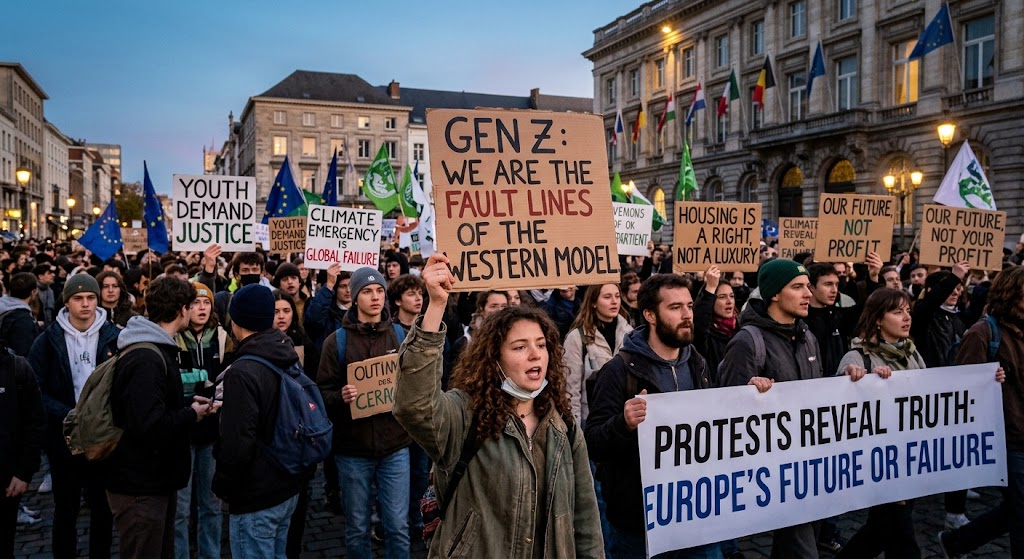
Police water cannons in Cologne, looted shopfronts in Frankfurt, Molotov cocktails in Paris and Tirana. Europe’s autumn has produced images that invite the word “revolution.” The evidence suggests something less cinematic but arguably more serious: a continent-wide stress test of governments that have stopped delivering for the young.
The triggers differ, but the grievances rhyme
The map of unrest
France is the epicentre. Protests there drew 320,000 people nationwide on 31 October, with tear gas used in multiple cities. The movement began with students angry at crumbling schools and an admissions system seen as unfair. Trade unions and a revived Yellow Vest movement joined them, demanding action on living costs. Prime Minister Sébastien Lecornu says more than 900 police have been injured since the protests began.
Germany saw its first major eruption on 31 October. The “Gen Z regelt” group organised demonstrations in 34 cities, demanding education investment and cost-of-living help, and opposing compulsory military service. Hesse’s interior minister blamed about 100 attackers motivated by extreme-left ideology for the violence in Frankfurt. Germany’s national school student umbrella organisation distanced itself from the initiative and plans its own protest day on 20 November. The movement is already splitting between its peaceful majority and a violent fringe.
Albania is arguably the most explicitly political case. Protesters want better education, more jobs, an end to alleged corruption and Prime Minister Edi Rama’s resignation. Student protests began outside the Education Ministry on 13 October, a fire broke out there the next day, and Molotov cocktails reached the prime minister’s office on 20 October. Rama has refused to quit.
Italy and Spain are more union-driven. Tens of thousands marched in Italy for higher wages, stronger public services and against rising military spending. In Spain, housing protests were sparked by the eviction of an 87-year-old woman after a 230 per cent rent increase imposed by an investment fund. Switzerland has also seen smaller violent gatherings, and Serbia’s earlier student movement helped unseat the country’s longtime leader at the ballot box.
What is driving it
The triggers differ, but the grievances rhyme. Schools and universities are decaying, housing and energy are unaffordable, and young people see no route to a decent life. Germany adds conscription and rearmament to the list. An Indian editorial noted that high-stakes elections loom in Spain, France, Italy, Poland and Greece amid growing far-right, anti-immigrant movements, which raises the stakes further.
Two cautions are in order. First, “Gen Z” is partly a media label: in France the crowds include unions, farmers, retirees and older Yellow Vest veterans. Second, the violence is largely a minority phenomenon grafted onto mostly peaceful marches. Governments blame the “ultra-left” and criminals, and that is partly true, but it is also convenient, because it avoids the underlying grievance.
“Gen Z” is partly a media label: in France the crowds include unions, farmers, retirees and older Yellow Vest veterans
What governments can do
Leaders have three broad options, and the evidence shows them mixing all three.
- Repression. France has deployed 70,000 police and promised a reinforced operation. Italy approved a new offence of violent participation in a demonstration and tougher penalties for rioters. This restores order but rarely cures anger.
- Concession. France has been largely quiet since Macron agreed to billions of euros in tax cuts. Concessions work, but they cost money in countries with strained budgets.
- Intransigence. Rama’s refusal to resign is a gamble: it may outlast a protest wave, or it may harden it.
The smartest course is the one Macron has himself hinted at: the anger is “huge and legitimate” and requires a political response, not repression. Whether he can deliver one is doubtful. He is in his final stretch, with a fragmented parliament and a presidential election due next year.
“Revolution” requires an alternative programme and an organised force to carry it
Revolution, or evolution?
“Revolution” requires an alternative programme and an organised force to carry it. Neither exists here. These movements are anti-austerity and anti-neglect, with no shared blueprint. A more accurate comparison is the 2011 wave of Indignados and Occupy protests, which changed politics slowly through new parties rather than overthrowing systems. Serbia shows the democratic channel working: students converted street energy into an electoral defeat.
What it means for Europe
Economy. Prolonged unrest raises the cost of any fiscal consolidation, since governments cannot cut services while schools crumble. It also strains retail and tourism. The tension between rearmament and social spending is now openly political.
Democracy. The danger is less the protesters than the beneficiaries. With elections approaching, anger at the centre tends to flow toward the populist right and hard left. Heavy-handed security laws carry their own risk of eroding civil liberties.
Global standing. Europe’s moral-governance claim rests on delivering social protection alongside freedom. Images of burning ministries dent that, but the sceptics’ conclusion, that the Western model has failed, is premature. The model is under strain from stagnation, ageing and defence costs, not repudiated. Protest is also part of how democracies self-correct, and Albania’s and Serbia’s very different outcomes suggest it matters how institutions respond.
The test is not whether the streets calm down, but whether schools, rents and jobs improve before the next election season. If they do not, the next wave will be more political and less peaceful.
Note: the situation is moving quickly, and French unions have called a national mobilisation for 5 November. Figures above come from news reports and may be revised.

