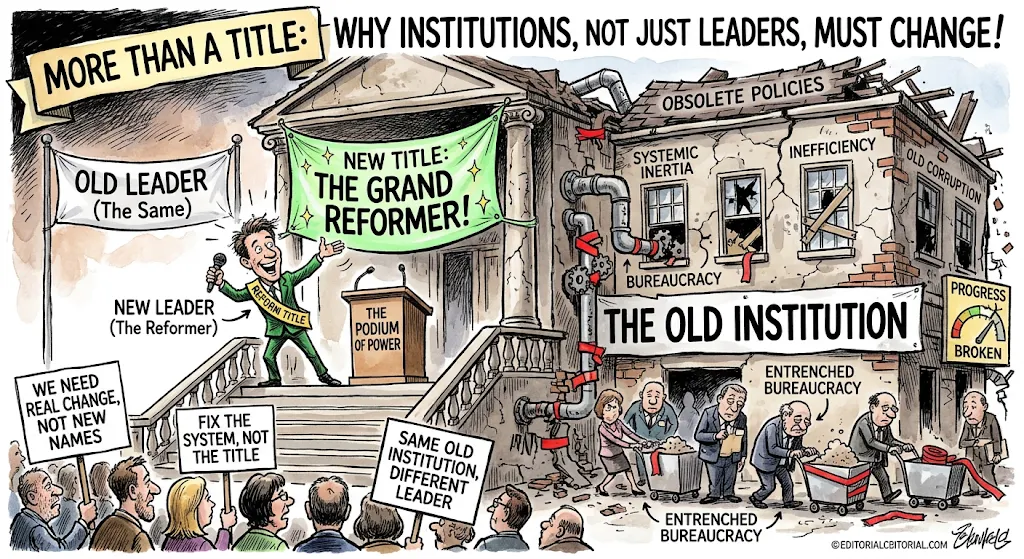

Leadership is often associated with titles, positions of authority, and the influence that comes with holding senior office. However, after more than two decades in public administration, I have come to appreciate that leadership is not defined by the position one holds, but by the courage to make difficult decisions, the ability to drive change, and the integrity with which one exercises authority.
leadership is defined by the courage to make difficult decisions, the ability to drive change, and the integrity with which one exercises authority.
In both the corporate world and the public sector, traditional approaches to leadership are increasingly being questioned. Institutions face complex governance challenges, economic uncertainty, rapid technological change, and rising public expectations. These realities demand more than experience and technical competence. They require leaders who can think independently, question established practices, and recognize that leadership entails responsibilities beyond personal achievement. For me, this is where thought leadership matters most.
Thought leadership is more than being recognized as an expert or invited to speak at conferences. It means having the intellectual curiosity to question conventional thinking, the confidence to offer new perspectives, and the willingness to help develop solutions that strengthen institutions. It also requires humility. No leader has all the answers, and experience should never excuse resistance to new ideas. As we reflect on leadership, we must also confront the ongoing challenges women face in positions of authority.
They require leaders who can think independently, question established practices, and recognize that leadership entails responsibilities beyond personal achievement
South Africa has made progress in advancing women into senior positions across government, business and other sectors, although it is not where it should be. However, while representation matters, we must be careful not to confuse appointments with meaningful transformation. Appointing a woman to a leadership position is often celebrated as an important milestone, and rightly so. Yet I believe the real test of transformation begins after the appointment.
Is she afforded the opportunity to exercise independent judgment? Is her professional contribution respected? Can she challenge a decision without being perceived as difficult? Is she given the same freedom to lead decisively as her male counterparts? These questions are uncomfortable, but necessary.
Women in leadership continue to work within institutions where assertiveness and independent thinking are not always received as they are when men display them. A man who challenges an established practice may be seen as decisive, while a woman raising a similar concern may be viewed as confrontational.
I do not believe that women should have to change who they are to be accepted as leaders. Nor should they be expected to adopt traditionally masculine leadership styles to prove their competence. Leadership should be measured by judgment, knowledge, ethical conduct, and the ability to achieve meaningful outcomes, not by gender or personality.
Women in leadership continue to work within institutions where assertiveness and independent thinking are not always received as they are when men display them
My recent appointment as BMFI’s first female Chairperson in its 30-year history has given me the opportunity to reflect more deeply on this issue. While I recognize the significance of this milestone, I am equally conscious that as the first black woman to hold this position, I carry responsibility beyond myself. It is an opportunity to contribute to institutional development, strengthen governance and encourage other women to pursue leadership without questioning whether they belong in those spaces.
However, I also believe that women should not be appointed merely to satisfy transformation targets. They must be recognized for their qualifications, experience, competence and the perspectives they bring to decision-making. A seat at the table matters, but it becomes meaningful only when one can contribute to the decisions made around it.
This is particularly relevant in corporate governance. Boards carry significant responsibilities for providing strategic direction, overseeing organizational performance, and ensuring accountability. Good governance requires more than compliance with legislation and governance codes. It requires directors prepared to ask difficult questions, exercise independent judgment, and put the institution’s interests above personal considerations.
A board that simply endorses decisions without meaningful engagement cannot be considered effective just because it meets formal governance requirements. Diversity in board composition should therefore lead to diversity of thought. Different professional backgrounds, experiences, and perspectives should strengthen decision quality rather than merely improve representation statistics.
Diversity in board composition should therefore lead to diversity of though
The same principles apply to public administration, although the institutional environment differs. Public sector leadership carries a particular responsibility because decisions involve public resources, constitutional obligations, and delivering services to communities.
Throughout my career, I have witnessed the complexities of leading in an environment where legislation, policy, institutional capacity, and competing priorities must be balanced constantly.
Public sector executives are expected to deliver results, often in difficult circumstances and with limited resources. However, achieving performance targets should never come at the expense of sound governance.
Sometimes professional advice is not what others want to hear, established procedures are questioned, or a decision requires further scrutiny. In such circumstances, I believe leadership requires the courage to act in line with one’s professional responsibilities.
Respecting authority is distinct from surrendering one’s independent judgement. Equally, questioning a decision should not automatically be construed as challenging authority. When done respectfully and on sound grounds, it is part of responsible leadership.
Institutions become stronger when leaders foster an environment in which people can express different views without fear of unfair consequences.
This brings me to another aspect of leadership that I consider especially important: the responsibility to develop others. Women in senior positions should recognize the importance of creating opportunities for those who follow them. However, transformation cannot rest solely on women’s shoulders.
Organizations must establish fair recruitment practices, transparent promotion processes and leadership development opportunities that recognize talent and potential.
Men must also play an active role in advancing gender equality. The objective should never be to replace one form of exclusion with another, but to create institutions where individuals are afforded opportunities based on their abilities and contributions.
I also recognize that leadership doesn’t always mean making popular decisions. Sometimes, doing the right thing can be uncomfortable and may not earn immediate recognition. Yet integrity cannot depend on convenience.
Leadership’s true character often emerges when difficult choices must be made, especially when pressure pushes us to compromise professional principles.
As leaders, we should constantly ask ourselves whether our decisions strengthen the institutions we serve, whether we act fairly, and whether we create an environment in which others can succeed.
To younger women aspiring to leadership positions, I would emphasize the importance of education, continuous learning, resilience and self-belief. Build your professional competence, understand the environment you operate in, and never underestimate the value of preparation.
But equally, don’t let the desire for acceptance silence your professional judgment. You do not need to become someone else to be an effective leader. Ultimately, I believe we need to reconsider how we measure leadership success. Appointments, titles and recognition are important milestones, but they are not the ultimate measure of a person’s contribution. What matters is whether we have strengthened governance, upheld ethical standards, influenced positive change and created opportunities for others.
The future of leadership, whether in corporate boardrooms or public institutions, must be built on competence, integrity, accountability and the willingness to embrace different perspectives. We should not only celebrate women who break glass ceilings. We should also ask whether the institutions they enter are prepared to change.
For me, that is the essence of thought leadership: not merely occupying a position of influence, but using it responsibly to question, improve and transform the institutions entrusted to our leadership.
And perhaps the most meaningful legacy we can leave is not the title we held, but the difference we made while holding it.

Ramona Grewan is BMFI's first female Chairperson in its 30-year history, a public sector executive with more than two decades of experience, and a legal academic and Supervisory Board Member of the HAAART Foundation for global peace. She holds a Master's degree in International Law and Diplomacy and an LLB. She writes in her personal capacity.