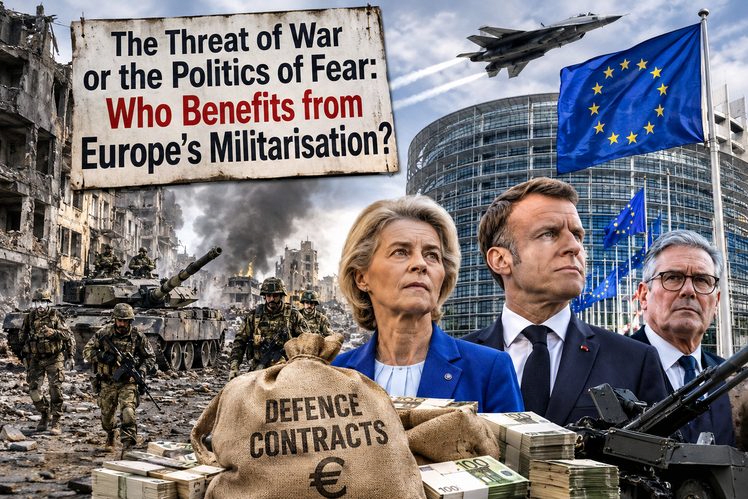
If there is one thing Europe has lived with throughout its history, it is war. From the tribal conflicts of antiquity to the devastating world wars of the twentieth century, the continent has repeatedly found itself at the centre of major military confrontations. The First and Second World Wars both originated in Europe before engulfing the globe, leaving destruction far beyond the continent’s borders. Today, as warnings about future conflict grow louder.
There are reasons to question whether Europe may once again be moving down a familiar and dangerous path.
Recent statements by British politicians about the need to prepare for a possible war within the next 1,000 days raise serious questions about the direction of European security policy. Across the continent, citizens are increasingly being urged to prepare for military confrontation, stockpile essential supplies and accept higher defence spending as a necessary reality. Yet the public has not been presented with convincing evidence that such a conflict is inevitable.
More importantly, political leaders are not openly discussing the extent to which strategic decisions may already have been made behind closed doors. The language of preparedness is often presented as a defensive necessity, but history shows that major military build-ups rarely occur without political calculations. The public is expected to bear the enormous economic and human costs of these decisions, while the benefits often accrue elsewhere.
As in previous conflicts, it is ordinary people who would suffer the most severe consequences. Millions, most of them civilians, could lose their lives. Entire societies would be disrupted, economies shattered and infrastructure destroyed. In an era of advanced military technology, any large-scale confrontation between major powers would have consequences far beyond Europe itself. The impact would be felt across the global economy, affecting countries and populations with no direct role in the conflict.
In an era of advanced military technology, any large-scale confrontation between major powers would have consequences
Whether such a war ultimately produces victory or defeat for those advocating military expansion is, in many ways, secondary. Once conflict begins, political leaders often shift their focus to maintaining narratives of national resolve and strategic necessity. Meanwhile, defence industries secure lucrative contracts and governments justify ever-increasing military budgets. The relationship between political power and the military-industrial complex is not a new phenomenon. Throughout modern history, periods of heightened international tension have frequently coincided with increased profits for defence manufacturers.
This reality raises legitimate questions about the motivations behind current warnings of future war. Are European leaders responding to genuine and imminent security threats, or are external dangers being used to rally public support at a time of growing domestic dissatisfaction?
Are European leaders responding to genuine and imminent security threats,
The Iraq War remains one of the most notable examples of how military intervention can be justified on grounds that later prove deeply flawed. The invasion proceeded on claims regarding weapons of mass destruction that were never found. Former British Prime Minister Tony Blair later acknowledged that mistakes had been made, reinforcing doubts about the credibility of the case presented to the public at the time. Such experiences have understandably left many citizens questioning official narratives surrounding military action.
Similar questions continue to surround NATO’s intervention in Libya. What was initially presented as a humanitarian mission ultimately contributed to the collapse of the Libyan state and the death of Muammar Gaddafi. For many Africans, the intervention remains a stark example of the consequences of external involvement in regional affairs and a source of continuing debate about sovereignty and self-determination on the continent.
Against this backdrop, warnings about a future war with Russia deserve careful scrutiny. Moscow has repeatedly stated that it has no intention of attacking NATO member states. While the conflict in Ukraine remains a grave and complex reality, claims that an assault on countries such as the United Kingdom is inevitable require independent and compelling evidence. Replacing objective risk assessments with emotionally charged rhetoric risks escalating tensions rather than reducing them.
War with Russia deserve careful scrutiny. Moscow has repeatedly stated that it has no intention of attacking NATO member states
At the same time, Europe faces serious domestic challenges. Rising living costs, pressures on healthcare systems, widening inequality and growing public discontent continue to dominate the daily lives of many citizens. Demonstrations and protests across European capitals reflect frustration with economic conditions and declining living standards. These are urgent problems demanding practical solutions and sustained political attention.
Yet public debate is increasingly focused on rearmament rather than addressing these underlying social and economic concerns. According to the Stockholm International Peace Research Institute, European military expenditure rose by 14% in 2025, reaching US$864 billion. Defence expansion is also creating lucrative opportunities for companies involved in advanced technologies, artificial intelligence and digital warfare systems. The resources required for such programmes ultimately come from taxpayers, many of whom are already struggling under significant financial pressures.
In the process of preparing for a war many now speak of as a future possibility, defence companies stand to make enormous profits. The potential human cost, the lives lost, the physical injuries, the displacement of civilians and the destruction of communities, appears too often to occupy a secondary place in the broader strategic conversation. Political leaders may gain from projecting strength, while defence industries benefit from increased spending, but ordinary citizens would be left to carry the burden of the consequences.
What makes this particularly alarming is that the next major war would almost certainly be more destructive than those that came before it. Advances in missile technology, cyber warfare, artificial intelligence and potentially nuclear capabilities mean that any direct confrontation between major powers could produce devastation on a scale previously unimaginable. The lessons of history should therefore encourage caution rather than recklessness.
The next major war would almost certainly be more destructive than those that came before it.
As a citizen of the Global South who believes in peaceful coexistence and negotiated solutions to international disputes, I find it unacceptable that potential security threats are increasingly being transformed into instruments of political pressure on society. National security is undeniably important, but it must not become a convenient justification for domestic policy failures, political grandstanding or the unchecked expansion of defence industry profits.
The world faces enough shared challenges, from poverty and inequality to climate change and economic instability, without adding another catastrophic war to the list. Rather than preparing populations to accept conflict as inevitable, leaders should be investing far greater effort in diplomacy, dialogue and conflict prevention.
History will not judge political leaders by how effectively they prepared for war, but by whether they did everything possible to prevent one. In an interconnected world, the real test of leadership is not the ability to mobilise armies, but the wisdom to avoid the need for them.

