

The writer, Dr. Tiema Haji is an academic, researcher, author, journalist, communication specialist and an accomplished poet.
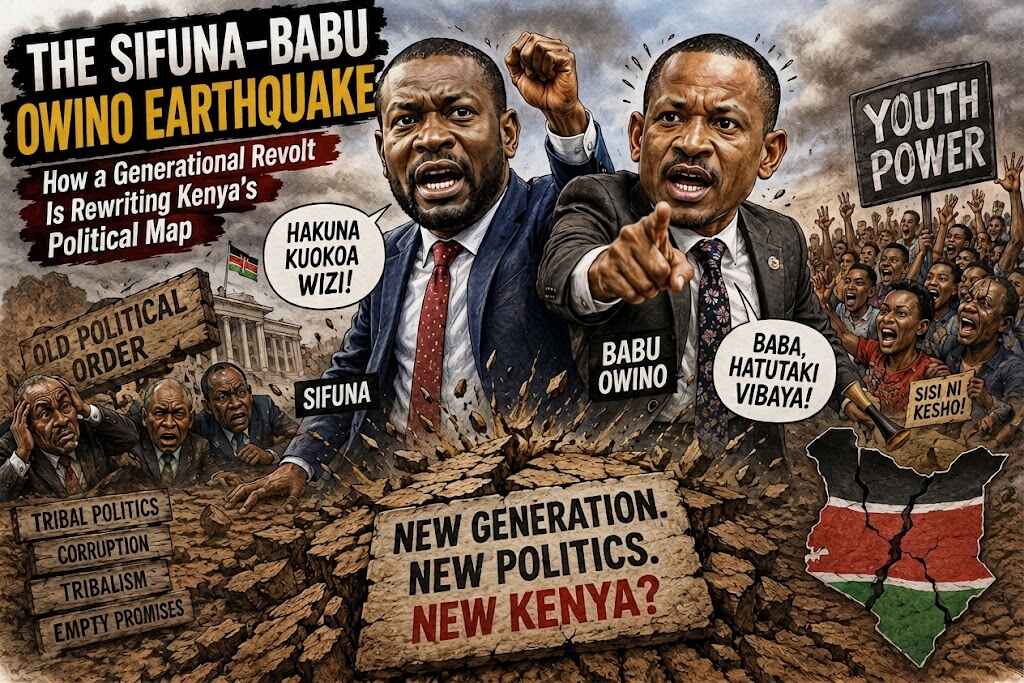
There is a particular sound Kenyan politics makes when the tectonic plates shift, and this year it has been unmistakable: the murmur of a Nairobi senator’s name spreading faster than the party machines built to contain him. Edwin Sifuna’s rise, alongside Embakasi East MP Babu Owino, is not simply another succession subplot inside the Orange Democratic Movement. It is a symptom of something larger, a generational impatience with the ethnic arithmetic that has governed Kenyan presidential politics since multipartyism returned in 1991.
For three decades, the formula was predictable. A handful of regional kingpins,
For three decades, the formula was predictable. A handful of regional kingpins, Kalonzo Musyoka in Ukambani, Martha Karua and, more recently, Rigathi Gachagua in Mt Kenya, Eugene Wamalwa in parts of Western, would each command a bloc, then bargain their numbers upward into a coalition. Whoever assembled the biggest arithmetic won. It was less an election than an auction of ethnic blocs, and it produced leadership that owed its mandate to negotiated tribal loyalty rather than generational conviction.
Sifuna and Owino represent a different proposition, and it is not accidental that their loudest constituency is Gen Z , the same cohort that filled the streets in the 2024 anti-tax protests and has since made clear it will not simply inherit its parents’ political loyalties. Sifuna’s ouster as ODM secretary-general by the party’s National Executive Committee, under Party Leader Oburu Odinga, in February this year was meant to discipline a troublesome junior officer. Instead, it produced a martyr and a movement. The “Sisi ni Sifuna” chant that followed his removal, and the Linda Mwananchi tour that has since crossed dozens of counties, suggest ODM miscalculated badly: it tried to excise a symptom while ignoring the disease, a base that no longer wants managed succession from above.
Sifuna and Owino represent a different proposition, and it is not accidental that their loudest constituency is Gen Z
What makes the Sifuna-Owino axis genuinely disruptive is that it does not fit neatly into the old ethnic-bloc model. Sifuna draws from Nairobi’s urban, digitally literate electorate and, through his Luhya heritage, from parts of Western Kenya now openly courting him as their presidential standard-bearer. Owino brings Nairobi’s youth and university constituencies and a combative online presence that translates protest energy into organised turnout. Together they are attempting something the old guard never had to: building a coalition around generational identity rather than ancestral geography.
That project, however, remains unfinished business, and honesty compels an opinion writer to say so plainly. Despite persistent chatter, including reports of an intended “Ukombozi” banner and a mooted Ukombozi-Linda Mwananchi alliance with Kalonzo Musyoka, the movement has not yet successfully registered a party bearing that name. Registration attempts under the “Linda” identity have hit real obstacles: a rival outfit, the Liberty National Democratic Alliance, has already secured that acronym, and competing claimants are now contesting the Linda Mwananchi name itself before the Registrar of Political Parties. As of this week, Sifuna has publicly conceded the movement may abandon its current branding altogether and adopt a different vehicle before the October deadline for parties to submit authorised signatories. Social media accounts, including commentator Maverick Aoko, have floated “Ukombozi Peoples Party” as the vehicle’s new name, a claim Sifuna’s camp has neither confirmed nor denied.
The earthquake, in other words, is real, but its final architecture is still being poured.
This should temper, not deflate, enthusiasm around Sifuna. Kenyan political history is littered with insurgent energy that arrived without a functioning party machine and paid for it at the ballot box. What Linda Mwananchi has that earlier reform movements lacked is scale, county tours reaching Western, Nyanza, the Rift and the Coast, and a claim on the Gen Z imagination that older aspirants, however well-funded, cannot manufacture. Analysts increasingly speak of Sifuna as a “factor in himself,” a candidate whose appeal travels across regions that used to belong to rival kingpins.
A generation that buried friends after the 2024 protests is no longer content to be traded
Whether this coalesces into a credible 2027 run, potentially alongside unlikely allies such as former Chief Justice David Maraga, whose institutional gravitas could complement Sifuna’s street fluency , or dissolves into the squabbling that has undone so many Kenyan opposition experiments, is genuinely an open question. But the underlying signal should not be missed by anyone still counting votes the old way. A generation that buried friends after the 2024 protests is no longer content to be traded between kingpins. It wants a candidate who speaks its language, in its digital spaces, on its own terms. Whether that candidate is ultimately Sifuna, or someone the movement produces next, the tyranny of ethnic numbers has, for the first time in a generation, a real challenger. The new dawn is not yet guaranteed. But for the first time in decades, it is not merely rhetorical either, it is organisationally, demographically, and digitally within reach.