

The writer, Dr. Tiema Haji is an academic, researcher, author, journalist, communication specialist and an accomplished poet.
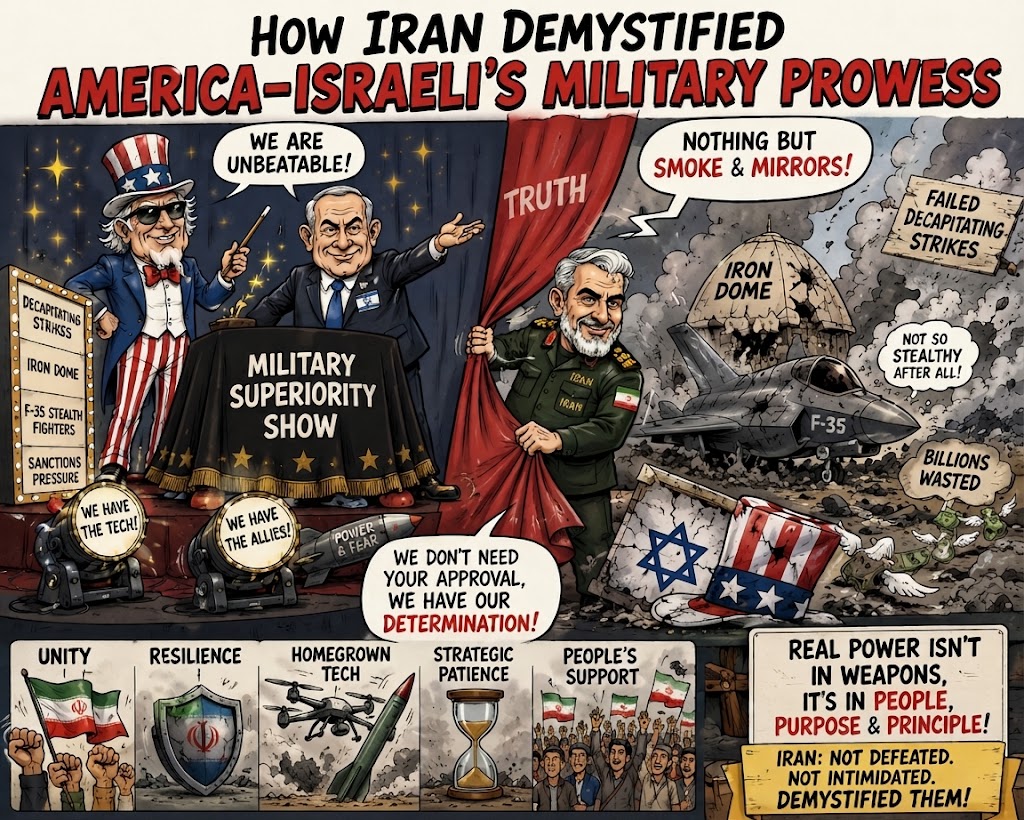
The ongoing war against Iran has exposed a fundamental miscalculation in American and Israeli strategic thinking. Washington and Tel Aviv appear to have assumed that overwhelming air power, decapitation strikes and the assassination of senior political and military figures would eventually force the Islamic Republic onto its knees. Months into the confrontation, that assumption has failed to materialise.
the Islamic Republic is not simply a collection of powerful individuals occupying offices. It is an ideological state with institutional depth,
Israel’s initial attacks were undoubtedly devastating. During the June 2025 Twelve-Day War, Israeli strikes killed some of Iran’s most senior military commanders, including IRGC Commander Hossein Salami and Armed Forces Chief of Staff Mohammad Bagheri. The campaign targeted military infrastructure, command centres, missile facilities and nuclear installations. Yet the Iranian state survived, its governing system remained intact, and its capacity to retaliate persisted.
The assassination of leaders was supposed to produce paralysis. Instead, Iran demonstrated something its adversaries appear to have underestimated: the Islamic Republic is not simply a collection of powerful individuals occupying offices. It is an ideological state with institutional depth, parallel command structures and mechanisms of succession designed precisely for periods of existential confrontation.
This is Iran’s strategic “dead man’s switch”. Remove one commander and another assumes responsibility.
This is Iran’s strategic “dead man’s switch”. Remove one commander and another assumes responsibility. Destroy a command centre and authority becomes more decentralised. Kill senior officials and the machinery of government continues functioning. Recent assessments have noted Iran’s deliberate efforts to adapt its governance and military structures to conditions in which senior leaders could be isolated or eliminated, including strengthened succession arrangements and decentralised authority.
That institutional resilience has undermined the central logic of decapitation warfare.
The historical comparison is striking. In the 1967 Six-Day War, Israel defeated the combined conventional forces of Egypt, Jordan and Syria in less than a week, fundamentally altering the military balance of the Middle East. The Israeli military built much of its reputation on rapid mobilisation, air superiority and the destruction of enemy command structures.
Iran has presented a fundamentally different military challenge.
Israel, backed directly by the world’s most powerful military, has been unable to produce a comparable strategic outcome. The United States possesses vastly superior air power, global intelligence capabilities and a military network spanning the Middle East. Yet despite sustained strikes, economic pressure and the elimination of senior Iranian commanders, Tehran has neither collapsed nor surrendered.
Instead, the war has become a demonstration of the limits of technological superiority.
Iran cannot match the United States militarily in conventional terms. Its air force cannot compete with America’s. Its navy cannot challenge the US Navy on the open ocean. But Tehran has never designed its military doctrine around fighting America symmetrically. Its doctrine is based on imposing costs, dispersing military assets, maintaining missile deterrence and making any attack against Iran regionally expensive.
That strategy is increasingly visible.
Iran has demonstrated its capacity to target American military positions across the Gulf and wider Middle East. Recent exchanges have involved Iranian missile and drone attacks against US facilities in Bahrain, Kuwait, Jordan and Iraq following American strikes on Iranian territory.
Gulf states relied heavily on the assumption that American military protection would insulate them from regional conflict.
This changes the strategic equation.
For decades, Gulf states relied heavily on the assumption that American military protection would insulate them from regional conflict. Iran has demonstrated that a war against Tehran cannot remain geographically confined to Iranian territory. American bases, energy infrastructure and strategic shipping routes are all potentially exposed.
The Strait of Hormuz has become particularly important in demonstrating Iranian leverage. A military confrontation with Tehran carries consequences far beyond Iran and Israel. It affects global oil markets, Gulf economies and international shipping.
This explains why regional states increasingly advocate diplomacy rather than escalation. Iran does not need to defeat America militarily to demonstrate power. It only needs to make the cost of war politically, economically and strategically unacceptable.
The IRGC has therefore emerged from this confrontation with an altered reputation. It would be inaccurate to claim that it has become militarily superior to the United States or Israel in conventional capability. It has not. However, it has demonstrated something arguably more consequential: strategic survivability.
The IRGC can absorb losses, replace commanders and continue operations
The IRGC can absorb losses, replace commanders and continue operations. That is precisely what happened after Israel’s initial decapitation campaign. The killing of generals did not terminate Iran’s military capacity. The system adapted.
The greater failure, however, lies in the political assumptions behind American and Israeli strategy. Peace negotiations, temporary pauses and ceasefires have repeatedly failed to establish lasting stability. Each pause becomes vulnerable to accusations that one side is merely buying time to reorganise, rearm and prepare for another round of confrontation. The result is a cycle in which diplomacy increasingly appears tactical rather than transformational. (The Guardian)
Iran’s greatest strength may therefore be psychological and institutional rather than purely military.
The Islamic Republic has survived revolution, an eight-year war with Iraq, international sanctions, assassinations, cyberattacks and now direct confrontation with Israel and the United States. Its opponents have repeatedly predicted its imminent collapse. Yet it remains.
This does not mean Iran is invincible. The country has suffered immense economic damage, military losses and domestic pressures. Nor does survival automatically constitute victory.
But neither America nor Israel has achieved its apparent strategic objective of forcing Iran into submission.
That reality matters.
Iran has demonstrated that military superiority does not automatically produce political victory. Bombing can destroy infrastructure. Assassinations can eliminate commanders. Sanctions can damage an economy. None of these necessarily destroys a political system whose institutions are designed to survive the removal of individuals.
Iran, in this sense, is more than its generals, presidents or even individual supreme leaders. It is an ideological and institutional system capable of reproducing itself under pressure.
America and Israel may possess overwhelming firepower. Iran possesses something their strategy has repeatedly struggled to defeat: endurance.
And in a war where the weaker side refuses to collapse, endurance itself becomes a form of power.