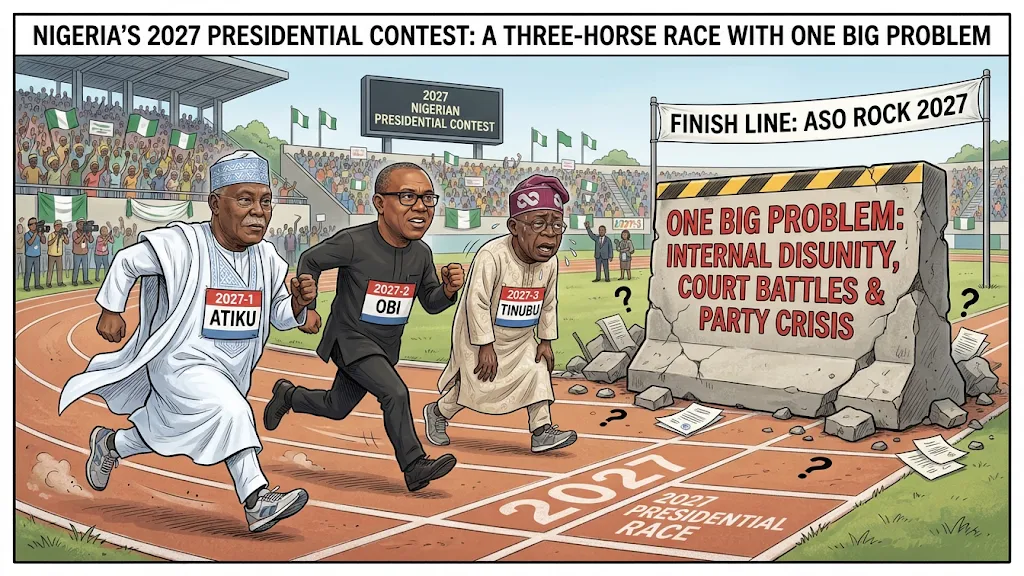

Nigerians vote on January 16, 2027, less than two months away, and the contest looks like a sequel nobody ordered. Obi’s adoption by the NDC has set up a three-way rematch. The cast has changed party labels, but the plot is familiar.
The field of eighteen candidates
INEC has cleared eighteen candidates, but only three matter in practice. President Bola Tinubu carries the APC banner, with Kashim Shettima again as running mate. Atiku Abubakar, who left the PDP, runs on the ADC alongside Rotimi Amaechi. Peter Obi runs on the NDC, ratified alongside Rabiu Kwankwaso. The age contrast is striking: Atiku, 79, and Tinubu are the two oldest names on the list, while Obi is the youngest of the big three.
The 2023 arithmetic: the two losers polled well above the winnerWhen
The last result is the baseline everyone argues from. Tinubu won with 8.79 million votes, or 36.61 per cent, ahead of Atiku’s 6.98 million and Obi’s 6.10 million. Together, the two losers polled well above the winner. That is the heart of the opposition’s grievance, and it is also its trap, because the same two men are again splitting the anti-Tinubu vote. Obi and Atiku began 2025 in the same ADC coalition, then Obi left for the NDC with Kwankwaso. Whatever the reasons, the effect is a fractured challenge.
What the polls say, and why to treat them cautiously
The polling picture is messy, and the honest reading is that none of it is decisive.
The Oxford-Metro Analytics poll gave Tinubu 35.41%, Obi 33.86% and Atiku 26.67%. That sounds close, but the pollster itself says its poll is an open, self-selected survey, not a representative sample or a prediction of the election. A Tinubu Must Go online poll pointed the other way, giving the Atiku/Amaechi ticket 73.6%. Online polls reward the most motivated and best-organised supporters, not the electorate. Treat both as measures of enthusiasm.
The most useful number comes from Yiaga Africa, an election observation group. Its survey found 54 percent of voters disapprove of Tinubu’s performance, while nearly half have not yet decided who to support. Read together, those figures are the whole story: the incumbent is unpopular, but unpopularity only becomes defeat if the opposition consolidates.
Who appears most likely to win
On the evidence available, Tinubu appears best placed, not because he is beloved but because of structure. Three factors favour him.
First, fragmentation. Two serious challengers drawing from the same pool of discontent is the incumbent’s best friend. A data scientist’s simulation reported by The Guardian put Tinubu’s chances at 64% if Atiku steps aside for Obi, and 58% if Obi steps aside for Atiku. That is one analyst’s model, so treat it with care, but it points to the same lesson: even unity may not be enough.
Second, the machine. Incumbency in Nigeria means control of federal resources and a wide network of governors and party structures. A Guardian-reported forecast projected Tinubu leading in 20 states, Atiku nine, Obi eight.
Third, the Southwest and the spread requirement. Nigeria’s constitution demands more than a plurality: a winner needs the most votes plus at least a quarter in two-thirds of the states. A candidate with a narrow regional base struggles here, and that is the test Obi, whose strength is the Southeast and urban youth, and Atiku, whose base is the North, must each pass.
The case for an upset
Still, an upset is plausible, and it would be wrong to write the race off. Obi’s 2023 surge came largely from first-time and urban voters, and Obi has secured Kwankwaso, a northern figure with a real Kano following, as his running mate. That cross-regional pairing is a smart attempt at the spread problem. Atiku, for his part, enjoys support among northern governors and lawmakers. The promises are also sharply contested: Atiku and Obi back a return to fuel subsidy, while Tinubu defends its removal, which makes the cost of living the central campaign battleground. With nearly half of voters undecided, a late swing driven by food prices and insecurity is a real possibility.
The verdict
If you want a single sentence: Tinubu is the favourite not because opinion is behind him, but because opinion against him is divided. The real contest is happening inside the opposition, over whether Obi and Atiku can ever agree on a single standard-bearer, a conversation the Tinubu Must Go movement has already pushed for. With the deadline passing and both names on the ballot, that window looks closed.
The risk for the opposition is a repeat of 2023: a majority of voters wanting change and a plurality winning anyway. Nigerians have the numbers to decide this differently. Whether the candidates do is another question.
A fair counterpoint: APC supporters would say Tinubu’s reforms, including subsidy removal and currency changes, are painful but necessary, and that his organisation and spread across regions are the real basis of his lead, not just opposition division. Opposition supporters would argue that disapproval ratings and undecided voters make the outcome genuinely open. Both claims will be tested at the polls, and the late-campaign surveys from credible, representative pollsters will matter far more than the online polls so far.

The writer, Dr. Aba Appiah is a Ghanaian academic, researcher, and lecturer in her mid-20s with a professional focus on media and communication. Her career spans journalism and communication consultancy. As an accomplished author and researcher, she contributes to academic discourse through peer-reviewed studies and published works.