

The writer, Dr. Aba Appiah is a Ghanaian academic, researcher, and lecturer in her mid-20s with a professional focus on media and communication. Her career spans journalism and communication consultancy. As an accomplished author and researcher, she contributes to academic discourse through peer-reviewed studies and published works.
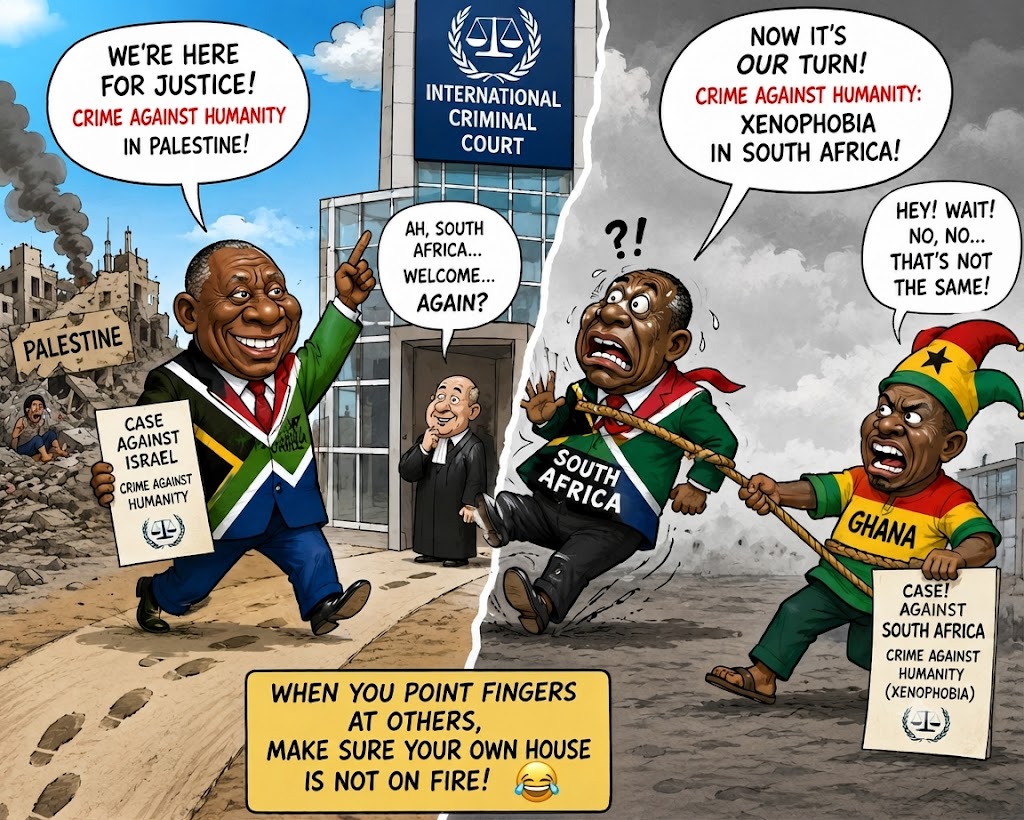
For years, South Africa has cast itself as the continent’s conscience. It marched to The Hague to accuse Israel of crimes against humanity in Gaza, invoking the memory of its own liberation struggle as moral authority. The world listened, because the symbolism was powerful: a nation once crushed under a system of racial division standing up for another oppressed people.
It seems moral authority is not a permanent inheritance for South Africans
But moral authority is not a permanent inheritance. It has to be earned every day, at home, not just performed abroad. And at home, South Africa has spent years allowing a slow-burning campaign of violence against African migrants, Nigerians, Zimbabweans, Mozambicans, Ghanaians, to fester into something that looks disturbingly systematic. Business premises torched. Migrants beaten in the streets. Politicians who flirt with anti-foreigner rhetoric for cheap applause. And a state that, by its own critics’ account, has repeatedly failed to prosecute the perpetrators with any real seriousness.
That two Ghanaian citizens have now taken this pattern to the International Criminal Court
That two Ghanaian citizens have now taken this pattern to the International Criminal Court is not “opportunistic,” as Pretoria’s spokesman dismissively called it. It is a mirror held up to a government that has grown far too comfortable pointing fingers outward while ignoring the rot inside its own borders. If widespread, systematic violence against a civilian population is a crime against humanity when it happens in Gaza, the same legal logic does not evaporate when the victims are black African migrants in Johannesburg and Durban. South Africa cannot have it both ways: international law as a sword when convenient, and a shield of denial when the accusation turns homeward.
Call it what it increasingly resembles: a new, informal apartheid, not written into statute like the old one, but enforced through neglect, scapegoating, and selective policing, where an entire class of people is marked as unwelcome, disposable, and unprotected by the state that is supposed to serve everyone within its borders.
Ghana, to its credit, has not stayed quiet. President John Mahama has repeatedly pushed the African Union to treat this as a continental emergency
Ghana, to its credit, has not stayed quiet. President John Mahama has repeatedly pushed the African Union to treat this as a continental emergency rather than a bilateral irritation, refusing to let diplomatic politeness bury the deaths of his citizens. He postponed a presidential visit rather than pretend business as usual. Ordinary Ghanaians, not just officials, have been the ones willing to escalate this to the ICC, at real personal and diplomatic risk, because their government’s patience with quiet backchannel diplomacy had run out. That took nerve. Pretoria is a far more powerful player on the continent than Accra, and standing up to it invites retaliation, economic and otherwise. Ghana did it anyway.
What’s harder to defend is the silence surrounding Ghana. Nigeria has recalled ambassadors before over this exact issue, yet in this latest chapter Abuja has been muted, perhaps wary of jeopardizing trade ties with Africa’s most industrialized economy. Kenya, quick to lecture on pan-African solidarity when it suits its diplomatic branding, has said almost nothing substantive. Zimbabwe, whose own citizens have been among the most frequent victims of these attacks, has offered little beyond boilerplate statements, likely constrained by its own government’s dependence on Pretoria’s goodwill. This is the quiet hypocrisy of African diplomacy: solidarity that flows freely toward distant conflicts but dries up the moment confronting a regional heavyweight might cost something.
Tinubu has been muted, perhaps wary of jeopardizing trade ties with Africa’s most industrialized economy
That silence is itself a form of complicity. Every leader who declines to back Ghana’s petition, who mutters about “not escalating tensions,” is choosing continental politeness over the safety of their own citizens abroad. It lets South Africa continue believing that its rhetorical commitment to human rights on the world stage exempts it from scrutiny of its conduct at home.
If the African Union has any credibility left as a body that protects Africans, this is the test. Not whether it can produce a strongly worded statement about Gaza, but whether it can hold one of its own most powerful members accountable for how it treats fellow Africans within its own streets. Ghana has shown what moral consistency looks like, however uncomfortable. The rest of the continent’s leaders now have to decide whether they believe in the principle they applauded when it was aimed at Israel, or only when it costs them nothing to say so