

The writer, Dr. Aba Appiah is a Ghanaian academic, researcher, and lecturer in her mid-20s with a professional focus on media and communication. Her career spans journalism and communication consultancy. As an accomplished author and researcher, she contributes to academic discourse through peer-reviewed studies and published works.
The 2027 Nigerian presidential election is shaping into a high-stakes contest defined less by new ideological alternatives and more by shifting alliances among established political figures. Early signals indicate fragmentation within the opposition and consolidation within the ruling All Progressives Congress (APC), creating a competitive but uneven field.
At the centre of the race is the incumbent, President Bola Ahmed Tinubu, leader of the APC. Tinubu enters the cycle with the structural advantage of incumbency, a consolidated party machinery, and formal endorsement by the APC for re-election. His administration’s economic reforms, particularly subsidy removal and currency adjustments, have been framed as necessary stabilisation measures but have also generated inflationary pressure and public dissatisfaction. This duality defines his candidacy: institutional strength on one side, and socioeconomic backlash on the other.
The opposition landscape is more fragmented. The most prominent figure remains Alhaji Atiku Abubakar, former Vice President of Nigeria and long-standing presidential contender under the Peoples Democratic Party (PDP). Atiku’s strengths lie in his extensive political network, experience in federal executive governance, and ability to mobilise elite bargaining coalitions. However, his repeated electoral defeats and perceptions of political longevity without renewal weaken his appeal among younger voters.
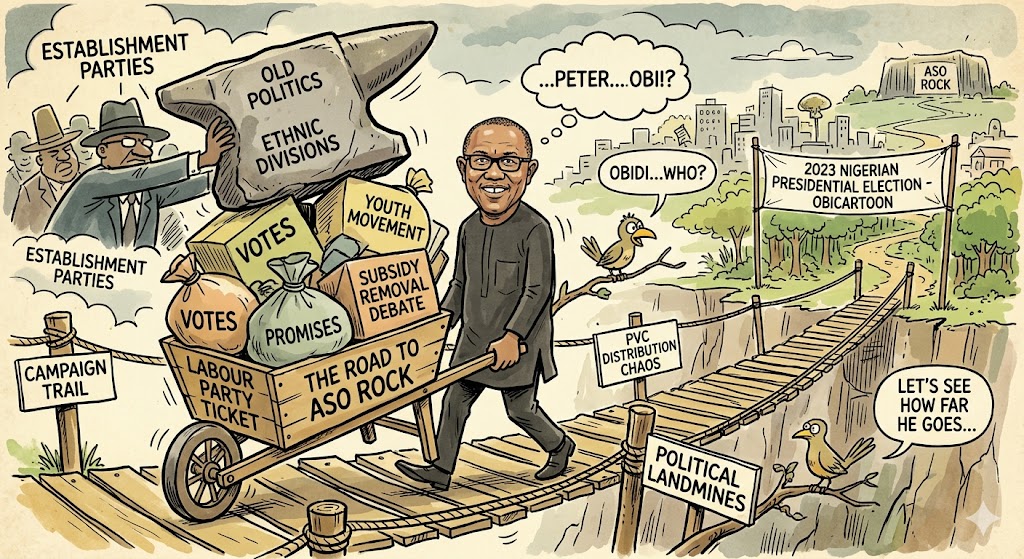
Another key figure is Mr. Peter Gregory Obi, former Governor of Anambra State and 2023 Labour Party presidential candidate. Obi represents a distinct political shift driven by urban youth mobilisation, digital campaigning, and anti-establishment sentiment. He remains highly competitive in southern urban centres and among first-time voters. However, his national coalition structure is inconsistent, and recent fragmentation within opposition alliances has reduced the coherence of his 2027 pathway. (Reuters)
From the northern political establishment, Alhaji Rabiu Musa Kwankwaso, former Governor of Kano State and 2023 New Nigeria People’s Party (NNPP) candidate, remains influential. His strength is rooted in disciplined grassroots organisation and strong loyalty within Kano and parts of the North-West. However, his national penetration remains limited compared to the two leading opposition figures.
Within the APC ecosystem, Mr. Rotimi Chibuike Amaechi, former Governor of Rivers State and ex-Minister of Transportation, is frequently discussed in coalition scenarios. He carries technocratic credibility and experience in national infrastructure delivery but lacks a consolidated electoral base. Similarly, Mallam Nasir Ahmad El-Rufai, former Governor of Kaduna State, remains a strategic political operator with strong policy reputation but faces regional and political constraints that limit national viability as a standalone candidate.
Recent political developments indicate that opposition unity efforts are weakening. A previously proposed coalition structure aimed at consolidating figures such as Atiku Abubakar, Peter Gregory Obi, and Rabiu Musa Kwankwaso has experienced internal fragmentation. Reports indicate withdrawals and repositioning that have undermined the feasibility of a single opposition candidate for 2027. (Reuters) This fragmentation is strategically significant because Nigerian presidential elections are structurally difficult to win without broad regional alignment.
In assessing the emerging hierarchy, President Bola Ahmed Tinubu remains the clear front-runner. This assessment is not purely ideological; it is structural. He benefits from incumbency, party cohesion, access to state resources, and opposition disunity. The central weakness of his position is economic performance, particularly inflation and cost-of-living pressures, which could erode voter satisfaction.
The opposition, by contrast, has high-profile candidates but lacks integration. Alhaji Atiku Abubakar, Mr. Peter Gregory Obi, and Alhaji Rabiu Musa Kwankwaso each command significant but geographically segmented support bases. None has yet demonstrated the capacity to unify Nigeria’s three major political blocs into a single electoral majority.
The likely outcome, based on current trajectories, is that 2027 will be determined less by new political entrants and more by whether the opposition can overcome structural fragmentation. Without consolidation, the advantage remains decisively with the incumbent.
In sum, Nigeria’s 2027 presidential race is not defined by a lack of candidates but by a deficit of cohesion. The system continues to reward organisational scale over popularity, and on that metric, President Bola Ahmed Tinubu currently leads the field.