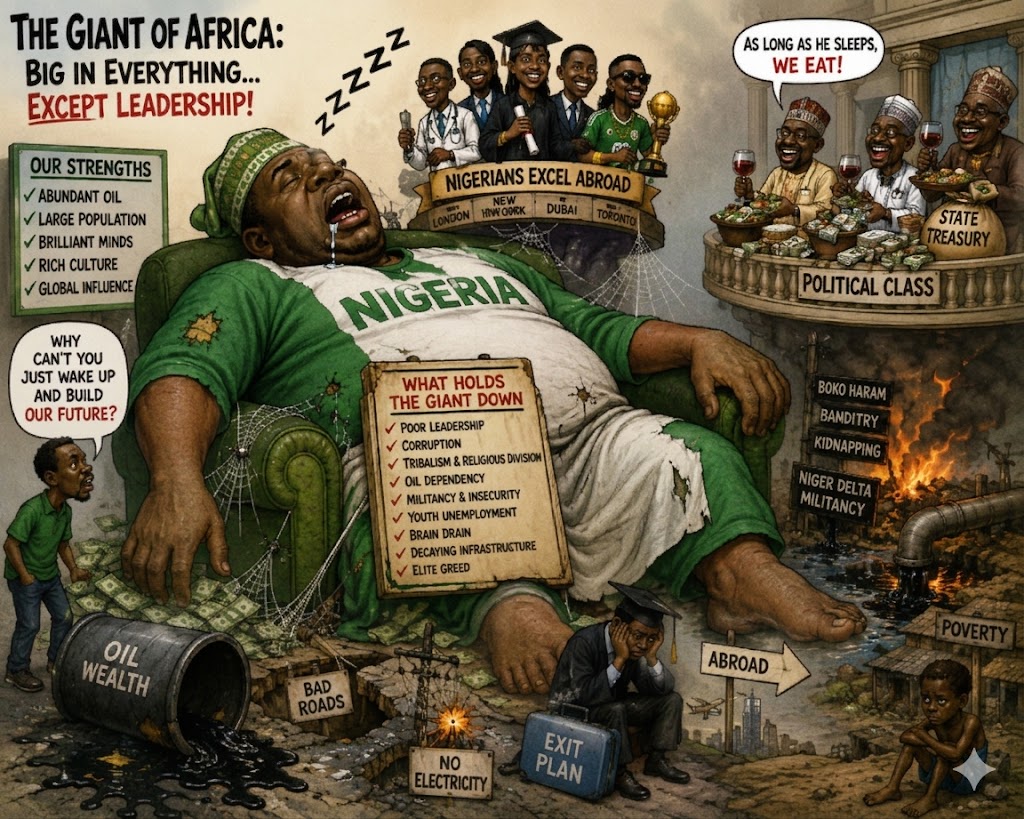

For decades, Nigeria has been described as the “Giant of Africa.” The phrase appears in diplomatic speeches, economic reports, and continental politics with almost ritualistic certainty. On paper, the title makes sense. Nigeria possesses the continent’s largest population, one of the world’s largest oil reserves, a globally influential entertainment industry, and a vast educated middle class spread across Africa, Europe, and North America. Nigerians dominate sectors ranging from banking and literature to medicine, academia, and technology. Yet the country itself remains trapped in recurring cycles of dysfunction.
The contradiction is staggering. A nation so rich in both talent and resources continues to battle chronic insecurity, collapsing infrastructure, youth unemployment, corruption, and institutional paralysis. Nigeria has everything required to become a major global power except one thing: a governing elite genuinely committed to building a functional state.
Nigerians dominate sectors ranging from banking and literature to medicine, academia
The tragedy of Nigeria is not lack of intelligence. Nigerians are among the most industrious and academically successful people on the continent. Walk through hospitals in the United Kingdom, universities in the United States, or financial institutions in Canada, and Nigerian professionals are everywhere. From the global success of Ngozi Okonjo-Iweala to the international dominance of artists like Burna Boy, the country continuously exports excellence. Even in football, Nigerian athletes often develop into world-class professionals once exposed to organised systems abroad.
This is why the Nigerian crisis cannot honestly be blamed on citizens. The problem is institutional decay sustained by political elites who have repeatedly treated the state as a private feeding structure rather than a national project.
Since independence in 1960, successive military and civilian governments have failed to establish durable institutions capable of enforcing accountability and long-term planning. Corruption in Nigeria is not merely incidental misconduct. It is deeply embedded within political culture. Public office often functions less as a platform for governance and more as an avenue for wealth extraction. Ministries become patronage centres. Oil revenue becomes political currency. National budgets become opportunities for elite accumulation.
The problem is institutional decay sustained by political elites
Under former military rulers and later civilian administrations, billions of dollars generated through petroleum exports disappeared into networks of political patronage while basic infrastructure deteriorated. Roads collapsed, electricity generation stagnated, and public universities suffered endless strikes. Despite decades of oil wealth, millions of Nigerians still lack reliable access to clean water and stable electricity.
The failure becomes even more striking when compared to countries with fewer natural advantages. Nations with limited mineral wealth have invested heavily in education, manufacturing, and institutional development. Nigeria, meanwhile, remained dangerously dependent on crude oil exports. Rather than using petroleum wealth to diversify the economy, political leaders often expanded consumption and import dependency.
Former President Olusegun Obasanjo frequently spoke about reform and anti-corruption measures, yet corruption remained deeply entrenched under his administration. The government of Muhammadu Buhari came to power promising discipline and anti-corruption reform, but insecurity worsened dramatically while economic hardship intensified. Under current President Bola Ahmed Tinubu, Nigerians continue to endure inflation, currency instability, and rising public frustration over living costs.
Meanwhile, militant violence and insecurity continue to expose the weakness of the Nigerian state. In the Niger Delta, armed groups emerged partly from legitimate grievances surrounding environmental destruction and unequal resource distribution. Yet over time, militancy also evolved into a profitable criminal economy involving oil theft, extortion, and political manipulation.
Rather than using petroleum wealth to diversify the economy, political leaders often expanded consumption and import dependency.
In northern Nigeria, the rise of Boko Haram revealed even deeper structural failures. Decades of poverty, underdevelopment, corruption, and weak governance created conditions where extremism could flourish. The insurgency has killed thousands, displaced millions, and damaged the country’s international image. Yet despite enormous military spending, insecurity remains widespread.
Ethnic and religious divisions further complicate governance. Nigerian politics often revolves around balancing regional power blocs rather than building meritocratic national institutions. Elections become high-stakes ethnic contests where political survival frequently matters more than coherent national policy. Political parties themselves often lack ideological substance, functioning instead as vehicles for elite alliances and electoral bargaining.
The consequences are devastating for young Nigerians. Every year, universities produce graduates into an economy unable to absorb them. Youth unemployment and underemployment remain severe despite the country’s enormous economic potential. Many talented Nigerians increasingly view emigration not as an ambition, but as survival.
Political parties themselves often lack ideological substance,
This brain drain represents one of Nigeria’s greatest long-term dangers. Doctors leave for the United Kingdom and Saudi Arabia. Academics relocate to Europe and North America. Engineers move to Canada. Technology professionals seek opportunities abroad. The country continuously loses precisely the people needed to modernise it.
Ironically, Nigerian excellence becomes most visible once Nigerians escape Nigerian systems.
The deeper issue is that instability often benefits sections of the ruling class. Weak institutions allow political godfathers, corrupt contractors, and rent-seeking elites to operate with limited accountability. A functioning state with transparent institutions would threaten entrenched networks of patronage and corruption. As a result, reform is repeatedly discussed but selectively implemented.
Nigeria therefore exists in a strange condition: rich but unstable, influential but fragile, ambitious but structurally weakened. It possesses the population of a major power without the institutional discipline of one. It has brilliant citizens trapped inside systems designed by mediocre leadership.
It has brilliant citizens trapped inside systems designed by mediocre leadership.
The real question is no longer whether Nigeria has potential. That debate ended decades ago. The evidence of Nigerian talent already exists across the world. The more uncomfortable question is whether Nigeria’s political class actually wants a transformed nation at all.
Because the country’s greatest obstacle is not lack of oil, intelligence, manpower, or opportunity. It is the persistent unwillingness of those who control the state to build institutions stronger than their personal interests.