

MP Khwezi Ka Ceza is Gqeberha-based independent political commentator, community leader and a social activist.
Following the sentencing of EFF President Julius Malema, South Africa’s political landscape has taken a dramatic turn. There is now a need to dissect both the judgment and the contestation surrounding it. As a point of departure, the judgment has been interpreted by some as a victory for the US and the white establishment, locally represented by AfriForum. The trial, and the manner in which it was handled, is viewed as an open declaration of war against both an individual and the political party he leads, and by extension, against Black aspirations.
The trial, and the manner in which it was handled, is viewed as an open declaration of war against Black aspirations.
Malema is not merely a political party leader or a vocal opposition figure in Parliament. He is an individual who has recently become a subject of debate in the White House. The implication, therefore, is that there was a clear intention to remove him from the political arena. This perception is reinforced by what is seen as white jubilation following the judgment, accompanied by approval from some Black individuals, interpreted here as a reflection of internalised oppression.
In this context, white supremacist demagoguery is understood as operating to preserve dominance, including the protection of white heritage, culture, religion, and systems that sustain Black stratification. The negotiators of the Kempton Park settlement ensured that the democratic dispensation did not dismantle these entrenched privileges. To justify these compromises, minimal developmental gains are presented as sufficient, such as the construction of hospitals, some of which have since deteriorated or closed. This raises a fundamental question: why should politicians be applauded for building schools, hospitals, or roads using public funds? This is akin to congratulating an ATM for dispensing one’s own money.
why should politicians be applauded for building schools, hospitals, or roads using public funds?
Those who fail to recognise the structural mechanisms employed by the white establishment to preserve the status quo may overlook what is perceived as a broader agenda, including the strategic use of judicial platforms to achieve political outcomes. Without engaging extensively with the merits of the case, the criminal justice system is here characterised as being influenced by entrenched power structures, with Black actors sometimes positioned within these processes in ways that obscure underlying dynamics. Ongoing investigations, such as those linked to the Madlanga Commission of Inquiry and parliamentary processes, are cited as evidence that post-apartheid reforms may have been largely superficial.
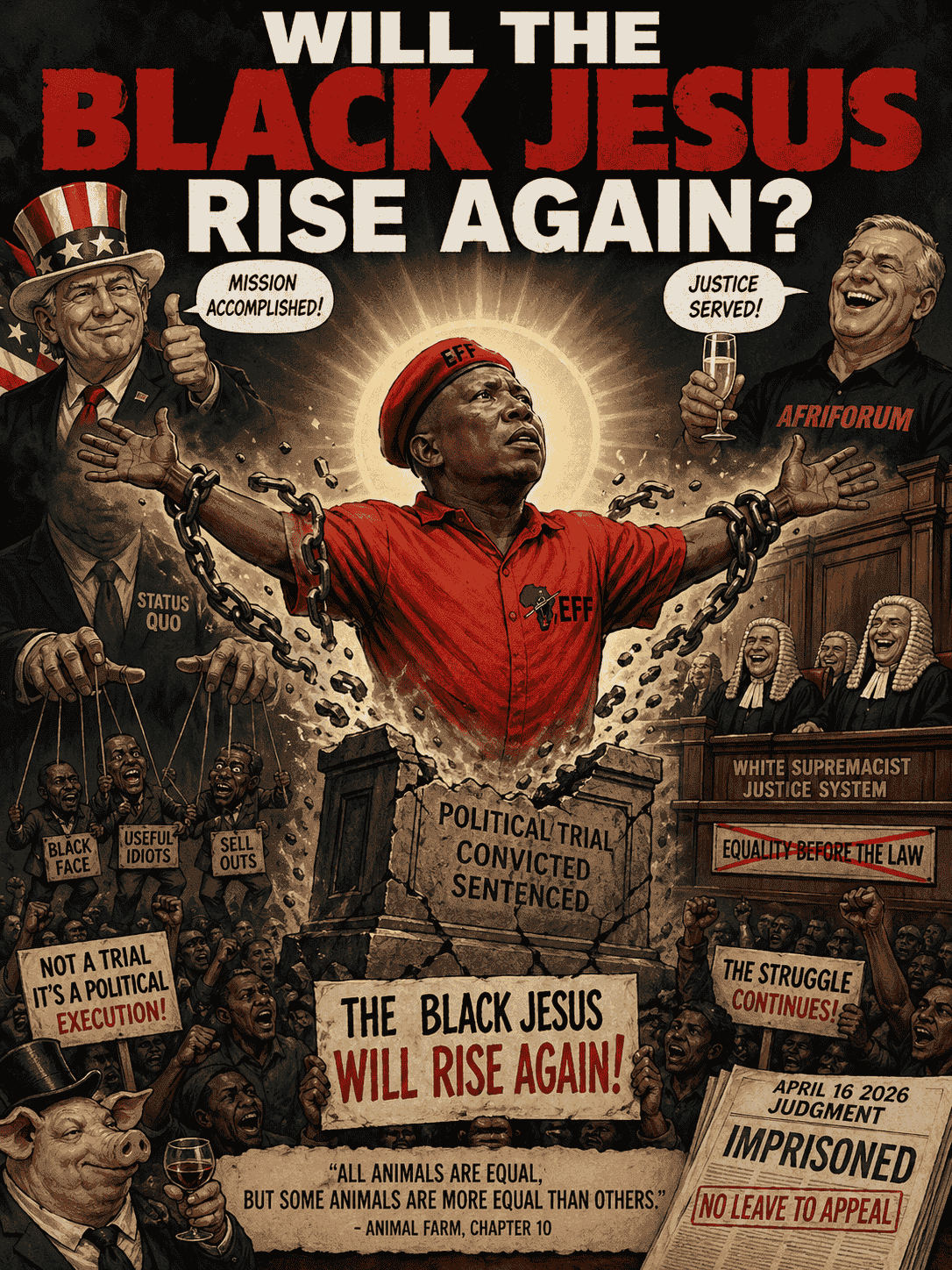
Recent developments are beginning to expose individuals who operate at lower levels within these systems, often becoming expendable when outcomes are contested. Against this backdrop, Malema’s trial, conviction, and sentencing are framed as a constructed narrative that raises a symbolic question: will the “Black Jesus” rise again? The answer offered is affirmative.
will MALEMA, the “Black Jesus” rise again?
Perceived inconsistencies during the trial and in the judgment are interpreted as revealing deeper systemic issues. A comparative example is drawn from September 2011, when Jacobus Stephenus “Bees” Roux, a former Blue Bulls rugby player, was convicted of killing Tshwane Metro Police Sergeant Ntshimabe Mogale. Through a negotiated plea bargain, he received a suspended five-year sentence and was ordered to pay R750,000 to the deceased’s wife. In contrast, the April 16, 2026 judgment against Malema, who did not threaten life or property, is viewed as structured to ensure imprisonment.
Even the inclusion of fines on certain charges is interpreted as superficial, given that the primary charge results in incarceration without a remedial alternative, and leave to appeal was denied. This recalls George Orwell’s Animal Farm, particularly the paradox in Chapter 10, where the appearance of equality masks a fundamentally unequal reality.