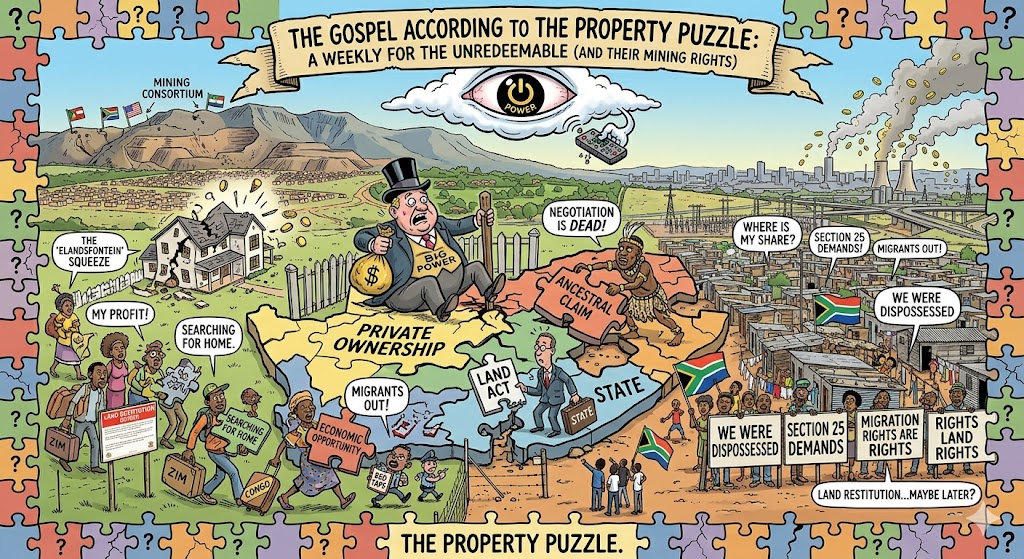
South Africa’s land and property landscape is a battleground where history, race, and economic disparity collide in a volatile mix. The legacy of apartheid’s land dispossession still lingers, but today, new dynamics threaten to rewrite the property map – dynamics that some argue favour certain groups over others, fuelling tensions and deepening divides.
Historical dispossession and the new Land Grabs
For centuries, white South Africans – privileged and often protected by the state – ruthlessly accumulated land, locking out black South Africans from owning the very soil that was their ancestral homeland. Post-apartheid land reforms seek to rectify this, but the process remains fraught with controversy, often accused of favoring political elites or failing to deliver meaningful redistribution.
Meanwhile, properties that once symbolised white dominance – vast farms, urban estates and commercial shops – are increasingly occupied or owned by newcomers. Who are these newcomers? Migrants from neighboring countries and abroad, often with little formal recognition or legal standing, occupying spaces that were historically the domain of white South Africans. Is this a natural migration, or a calculated shift of the land’s ownership to those who are willing to operate outside the law?
Floods in the Cape Flats: A stark revelation of inequality
Recent catastrophic floods in the Cape Flats have brutally exposed the deep inequalities that define South Africa’s land and housing landscape. Entire communities – mostly Black South Africans – were submerged, their fragile shanties and informal settlements washed away. These floods laid bare the brutal truth: millions of Black South Africans live in land that is unsuitable, unprotected, and utterly neglected by those in power.
The floods did not discriminate in their destruction – they targeted the landlessness and systemic neglect that have persisted for generations. While properties formerly owned by whites may now be occupied by opportunists or migrants, many Black South Africans remain landless, living in informal settlements with no security, no access to proper infrastructure, and no hope of formal property rights.
This land hunger among Black South Africans is palpable. The floods have heightened the urgency – these communities are crying out for land, for dignity, for the basic human right to shelter and security. Yet, the real question remains: who is willing to give it to them? Who owns the land now, and who controls the future of South Africa’s soil?
The resistance of White South Africans to transformation
Amid these upheavals, a significant portion of white South Africans continues to resist efforts at land redistribution and transformation. Many cling to a narrative of victimisation, viewing land reform as a threat to their historical privileges and economic security. This resistance often manifests in legal challenges, political rhetoric, and efforts to stall or dilute land reform policies.
Such opposition fuels the perception that the pace of transformation is being deliberately slowed or sabotaged. It stokes fears of a “redistribution of land” that, to some, seems to threaten their identity and ill-gotten economic interests. This unwillingness to genuinely embrace redress not only hampers progress but also deepens the racial and economic divides, making a sustainable and equitable solution even more elusive.
The City of Cape Town’s ill-fated wall: A symbol of failed solutions
Instead of addressing these systemic issues head-on, the City of Cape Town has proposed erecting a wall – an expensive, divisive structure meant to separate communities rather than unify them. This wall, ostensibly aimed at controlling migration and “protecting” certain areas, exemplifies the government’s failure to confront the underlying causes of spatial injustice.
Building barriers instead of investing in affordable housing, infrastructure, and land reform is a symbolic abdication of responsibility. It signals a refusal to deal with the root issues: inequality, land hunger, and the need for inclusive urban planning. Walls may serve short-term political narratives, but they will not solve the deeper social fractures that threaten to explode if left unaddressed.
The legal grey zone and systemic failures
South African property law stipulates rules and regulations, but enforcement is inconsistent, and corruption often muddies the waters. Illegal immigrants, in many cases, exploit loopholes or operate in the shadows, occupying prime properties without proper titles. Their presence raises uncomfortable questions: Are these new landowners or squatters? Is this a sign of systemic failure, or a deliberate strategy to shift ownership away from the historically privileged?
Many black South Africans find themselves locked out of the property market, facing insurmountable barriers to land ownership. Meanwhile, individuals from neighbouring countries and elsewhere – some with dubious legal status – seize opportunities denied to locals. This creates a paradox: the very people most marginalised are now occupying spaces that symbolise inequality and injustice.
A growing divide: Who holds the power?
For some, the current situation exposes a disturbing reality: a land reform process hijacked by those with less-than-noble intentions. It’s a new form of land grabbing, cloaked in the language of inclusion but driven by opportunism. The narrative of migration as a harmless pursuit ignores the geopolitical and economic undercurrents that threaten to destabilise the fragile social fabric.
The question remains: who truly benefits from this new landscape? Is it the migrants seeking survival, or a small white elite manipulating the system to entrench their grip on land and power? As properties once owned by white South Africans change hands – whether legally or otherwise – the underlying tensions threaten to boil over.
A land in turmoil
South Africa stands at a crossroads. Without decisive action – rigorous enforcement of immigration laws, transparent land reform, and policies that prioritise the needs of its long-suffering black majority – the land question risks spiralling into chaos. The recent floods and the city’s futile wall serve as stark warnings: neglect, inequality, and superficial solutions only deepen the crisis. If ignored, land will remain a source of conflict, a symbol of unfulfilled promises and systemic failure.
Conclusion: A land in reckoning
South Africa’s property and migration saga is not merely about land; it is about power, history, and identity. The floods and the futile wall highlight the urgent need for honest dialogue and genuine reform – yet, without political will and systemic change, these issues will continue to fester. If the nation does not confront its brutal inequalities head-on, the land will remain a battleground – an unresolved symbol of injustice and the fierce struggle for control of the soil that sustains us all.
Dr Phindile Ntliziywana is a constitutional law expert, an Advocate of the High Court of South Africa and a State law adviser