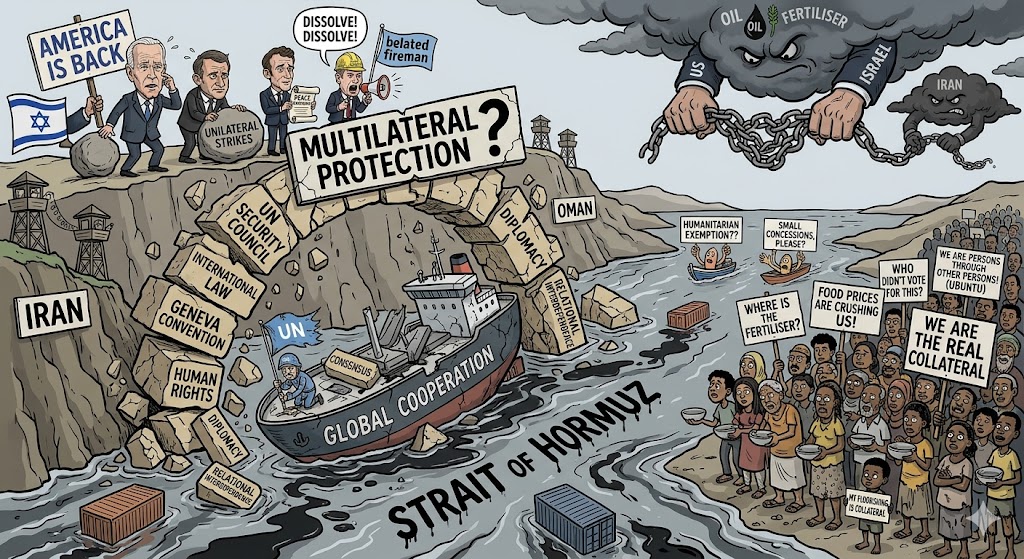

There is a 33-kilometre passage of water between Iran and Oman that currently holds the world’s breath. The Strait of Hormuz through which, until recently, roughly 30 percent of the world’s seaborne crude oil passed every single day has become the most consequential chokepoint not merely for energy, but for the idea that multilateral order can still protect human life.
It cannot. Or rather: it will not.
On 28 February 2026, joint US-Israeli strikes on Iran, including the killing of Supreme Leader Ali Khamenei, triggered a cascade of retaliation that effectively halted shipping through the strait. What followed was the spectacle of unilateralism wearing the mask of security, and the global South paying the price in silence.
I write as a scholar of human flourishing and transformative constitutionalism, and as someone who has spent twenty-five years arguing that ubuntu – the relational African philosophy that insists ‘umuntu ngumuntu ngabantu’, that a person is a person through other persons – is not merely a cultural value but a legal and political obligation. What is happening in the Strait of Hormuz is, in the most precise sense, a denial of flourishing. Not only for Iranians. For all of us.
Consider what flows through that narrow passage. Approximately 20 percent of the world’s crude oil and liquefied natural gas, alongside substantial volumes of petrochemicals, fertiliser, and raw materials used in manufacturing. But more than commodities transit there. Food security transits there. Up to 30 percent of internationally traded fertilisers normally move through the Strait of Hormuz, and unlike oil, the fertiliser sector has no internationally coordinated strategic reserves meaning that disruption cannot be buffered. Middle East fertiliser prices have already risen by nearly 20 percent, and global prices could average 15 to 20 percent higher in the first half of 2026 if the crisis continues. The farmers of the Global South in sub-Saharan Africa, in South Asia, in the Pacific did not vote for this war. They will harvest its consequences.
This is what flourishing denied looks like in practice: not as abstraction, but as a child in Mozambique or Bangladesh who will face food prices their family cannot bear, because two states decided outside any multilateral framework, without UN Security Council authorisation, in defiance of international law that assassination and bombardment were preferable to negotiation.
Critics, including legal and international relations experts, have described the US-Israeli strikes as illegal under US law, an act of imperialism, and a violation of Iranian sovereignty under international law. The UN Secretary-General condemned them. Yet the Security Council passed a resolution condemning only Iran’s retaliatory strikes on Gulf states, a procedural inversion that tells us everything about whose flourishing the current international architecture is designed to protect.
The multilateral system did not merely fail to prevent this war. It was used, selectively, to legitimise its asymmetries.
What is the alternative? It is not naïveté about Iranian state violence. It is the insistence that relational interdependence is a fact before it is a value. Interdependence cannot be weaponised by the powerful and ignored by the same powerful when inconvenient. That is not an international order. That is dominion.
Iran and Oman are now reportedly drafting a protocol to monitor transit through the strait, and Iran has agreed to allow humanitarian and fertiliser shipments through in the form of small, fragile concessions that carry within them the seed of what diplomacy might still achieve. British Prime Minister Starmer has convened world leaders to discuss the waterway, finally, belatedly, as though multilateralism were a fire brigade rather than a standing architecture of prevention.
The question this crisis demands is not how we reopen the Strait of Hormuz. It is how we rebuild the international institutions capable of ensuring that no passage of water, no corridor of food, and no artery of human sustenance can ever again be held hostage to the strategic calculations of two states acting in unchecked concert.
is not how we reopen the Strait of Hormuz. It is how we rebuild the international institutions
Three things must follow from this moment. First, the UN General Assembly should convene an emergency special session to establish a permanent International Straits and Maritime Commons Commission, a standing multilateral body with the mandate to monitor, mediate, and where necessary, physically protect critical waterways from unilateral closure. The Law of the Sea exists. What it lacks is institutional teeth. Second, the G20 must place fertiliser supply chain resilience on its formal agenda, with binding commitments to create internationally coordinated strategic reserves equivalent to those that exist for oil. The asymmetry between energy and food security mechanisms is a political choice, and it can be unmade. Third, states acting outside UN authorisation in ways that foreseeably close global commons must bear legal and financial liability for the humanitarian consequences. The International Court of Justice has jurisdiction. What is required is the political will to use it.
Human flourishing is not a metaphor. It is the material condition of billions of people who need fertiliser, fuel, and the dignity of a world that does not treat their survival as collateral. The strait is narrow. Our collective moral failure is vast. But moral failure is not destiny: it is a choice we are still, barely, able to unmake.
Narnia Bohler-Muller LLD is an Advocate of the High Court of South Africa, incoming Professor in the Flourishing Life Research Theme at the University of the Free State, and former Co-Chair of W20 South Africa, where she led the historic inclusion of modern slavery and women’s food security on the W20 agenda during South Africa’s G20 Presidency.