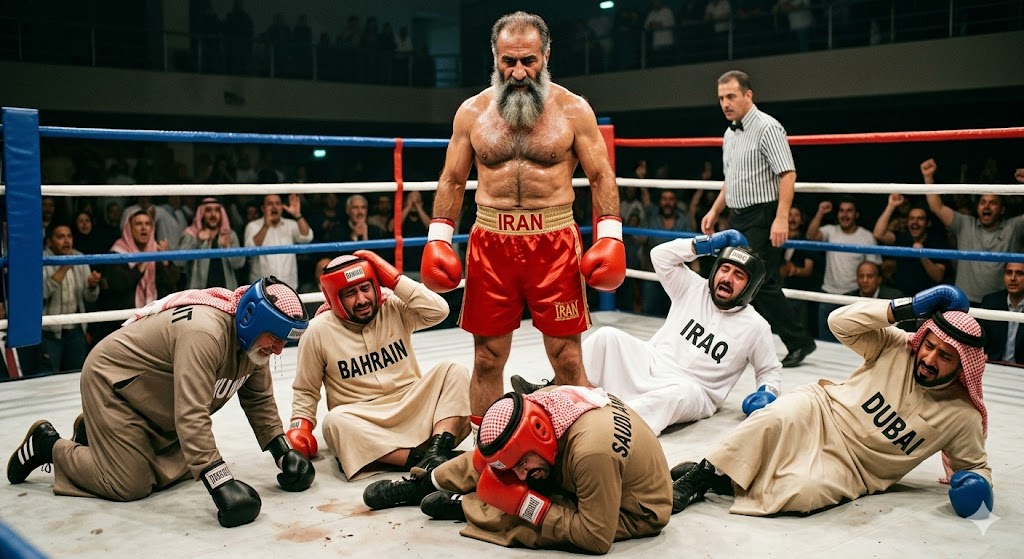
The widening confrontation between Iran, Israel, and the United States has entered a structurally volatile phase. What began as a shadow war—cyber operations, proxy engagements, deniable strikes—now risks mutating into a more overt regional contest. At the center of this transformation are the Arab states that host American military infrastructure. For decades, these basing arrangements were marketed as strategic insurance policies. Today, they are increasingly exposed as strategic liabilities.
The American footprint across the Gulf is extensive and deeply embedded. Bahrain hosts the U.S. Navy’s Fifth Fleet, the maritime backbone of Washington’s presence in the Gulf. Qatar is home to Al Udeid Air Base, a critical command-and-control hub. Kuwait provides staging grounds for ground forces and logistics. Saudi Arabia and the United Arab Emirates host air assets and rotational deployments. Jordan and Oman facilitate overflight rights, training, and maritime access.
The American footprint across the Gulf is extensive and deeply embedded.
For host governments, the logic was straightforward: American power would deter adversaries, chief among them Iran, while underwriting regime security. The presence of U.S. forces functioned as a tripwire, signaling that any aggression against these states would implicate Washington directly. This framework held as long as escalation thresholds remained ambiguous and Tehran’s strategy remained calibrated.
That equilibrium is now deteriorating.
Iranian officials have increasingly framed U.S. bases in the Gulf as operational enablers of Israeli strikes. In Tehran’s narrative, these facilities are not neutral defensive outposts but components of an integrated Western military architecture aimed at constraining, and if necessary, degrading, Iranian power. Whether or not Gulf states actively participate in offensive planning is strategically secondary. In a conflict environment shaped by missile warfare and proxy networks, perception itself becomes targeting doctrine.
Groups aligned with Tehran, including Hezbollah, have signaled that American installations and their host governments could be considered legitimate nodes in a broader confrontation. Iran’s expanding missile and drone capabilities place much of the Gulf within operational range. In practical terms, the infrastructure that once symbolized deterrence now risks becoming fixed targets.
The leadership transition following the death of Ayatollah Ali Khamenei has compounded uncertainty. While Iran’s strategic culture emphasizes continuity, succession periods inevitably recalibrate elite incentives. A new leadership cohort may feel compelled to demonstrate resolve externally to consolidate legitimacy internally. In such a scenario, visible American military assets in neighboring Arab states offer politically potent symbols of resistance.
In a conflict environment shaped by missile warfare and proxy networks,
Simultaneously, the trajectory of U.S. policy remains uncertain. The possible return of Donald Trump to executive office introduces further variability. His prior tenure was marked by a withdrawal from multilateral agreements, a transactional approach to alliances, and rhetorical ambivalence about extended military commitments. For Gulf capitals, this oscillation between muscular deterrence and retrenchment complicates long-term planning. The risk is asymmetric: Arab states absorb the geographic exposure, while Washington retains strategic flexibility.
This asymmetry is central to the emerging liability thesis.
From a deterrence theory perspective, forward-deployed forces are intended to increase credibility by raising the costs of aggression. Yet credibility cuts both ways. When a regional rival believes that those forces are actively facilitating attacks, they can also become catalysts for preemption. In a high-velocity missile environment, the distinction between deterrent and provocation narrows. The Gulf’s dense geography magnifies this problem: energy infrastructure, urban centers, and military installations coexist within short operational radii.
Domestic considerations further complicate the equation. Many Gulf states are pursuing economic diversification strategies designed to transition beyond hydrocarbon dependence. These initiatives require macroeconomic stability, foreign direct investment, and reputational assurances. Persistent exposure to regional escalation undermines all three. Insurance premiums rise, investor confidence fluctuates, and sovereign risk assessments become more volatile. The cost of hosting a foreign military presence is no longer confined to diplomatic optics; it increasingly affects economic transformation agendas.
The cost of hosting a foreign military presence is no longer confined to diplomatic optics
Additionally, sovereignty narratives are evolving. Younger populations across the region are more attuned to questions of national autonomy and strategic independence. While public dissent is tightly managed in several Gulf monarchies, the optics of hosting foreign forces that may draw retaliatory strikes carry long-term reputational implications. Governments must balance external security guarantees against internal legitimacy metrics.
This does not mean Gulf states will sever ties with Washington. The interoperability benefits, intelligence sharing, and advanced weapons systems provided by the United States remain unmatched. Nor does it suggest that Iran seeks immediate full-scale confrontation with its Arab neighbors. Tehran’s strategy has historically favored calibrated pressure over open war.
But strategic environments are not static. They are iterative. Each Israeli strike, each Iranian retaliation, and each American logistical deployment incrementally alters threat perceptions. The more Tehran frames Gulf-based U.S. forces as operational extensions of Israeli campaigns, the more these host states risk entanglement in conflicts not of their own making.
Some governments have already begun hedging. Diplomatic re-engagement between Gulf capitals and Tehran reflects an awareness that unilateral reliance on American power is insufficient risk mitigation. Engagement does not equate to alignment; rather, it reflects portfolio diversification in an era of multipolar flux.
does hosting U.S. military infrastructure still enhance national security on net, or has the balance tipped toward vulnerability?
Ultimately, the question confronting these states is structural: does hosting U.S. military infrastructure still enhance national security on net, or has the balance tipped toward vulnerability? The answer depends on whether the American presence continues to deter adversaries, or instead incentivizes adversaries to redefine the battlefield.
In earlier decades, proximity to American power offered insulation. In the present environment, proximity may invite exposure. As the confrontation among Iran, Israel, and the United States intensifies, Gulf states find themselves navigating a narrowing corridor between alliance commitments and strategic self-preservation. The architecture that once anchored regional stability now stands at risk of becoming a liability embedded in concrete and steel.

The writer, Dr. Aba Appiah is a Ghanaian academic, researcher, and lecturer in her mid-20s with a professional focus on media and communication. Her career spans journalism and communication consultancy. As an accomplished author and researcher, she contributes to academic discourse through peer-reviewed studies and published works.