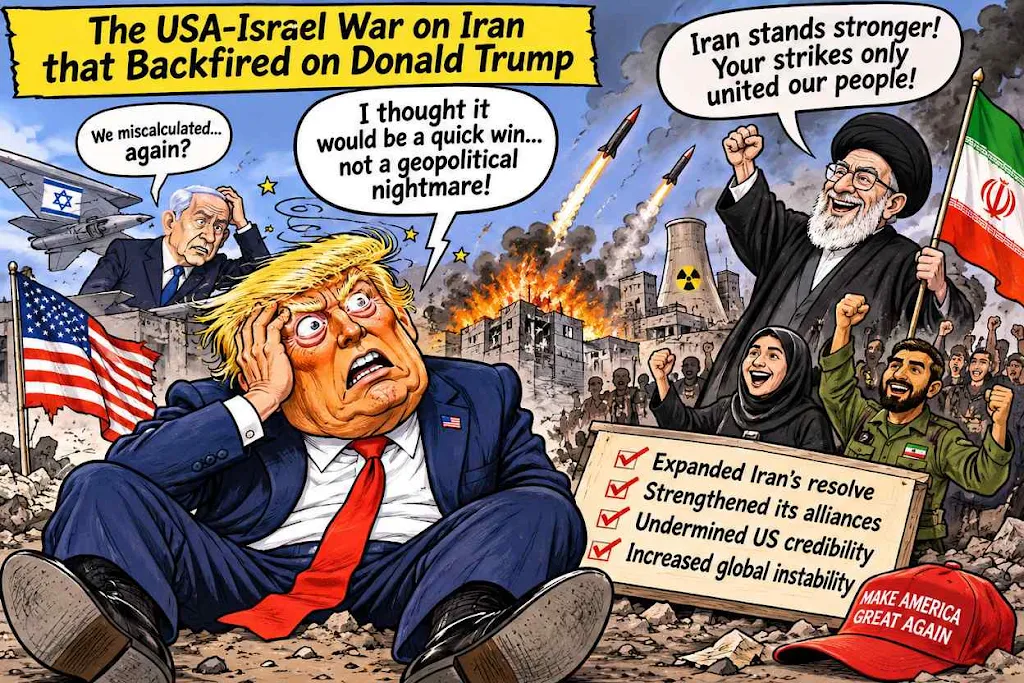

When the first strikes landed on 28 February, the plan in Washington and Jerusalem looked simple: decapitate, degrade, dictate. The opening assault killed Supreme Leader Ayatollah Ali Khamenei and other top officials. Few capitals expected Tehran to do more than absorb the blow. They were wrong. Iran did not collapse, and it did not plead. It hit back with a reach and persistence that unsettled military planners. Its missiles and drones struck hotels, airports, energy facilities and American bases in Gulf states, and the Strait of Hormuz was closed to most shipping, upending global energy markets. The war’s cost reached American petrol pumps.
The case that this war boomeranged rests on one fact: the side that started it is the one that wanted it to stop.
The Iran arithmetic of attrition
Modern air defence is a contest of cost and quantity, and Iran played it well. Each missile or drone fired at a base forces the defender to spend an interceptor, which costs far more and is far harder to replace. Before the war, Iran’s drone production capacity was estimated at around 10,000 a month. The reported toll on American stockpiles is striking. One analysis says the war has depleted up to three-fifths of US Patriot stocks and as much as half of THAAD stocks. CNN reported that nearly 80% of a critical interceptor stockpile has been drawn down. The same report said those shortages fed into Trump’s decision to call off further strikes after Gulf allies feared retaliation against their energy infrastructure. US officials dismiss such reports as “misinformed”. But the trend is hard to dispute, and Washington has since delayed interceptor deliveries to Ukraine and Switzerland to protect forces in the Gulf.
Donald Trump seeking an honourable exit
The diplomatic record points the same way. Trump extended the ceasefire indefinitely after whipsawing between various timelines, after threatening Iran’s “civilization” itself. Pakistan brokered the truce. The two sides then signed a memorandum on 17 June to hold a ceasefire on all fronts, including Lebanon. In the emerging deal, the US would reportedly allow Iran to sell its oil through sanctions waivers.
Compare that with the war’s stated aims: dismantling Iran’s nuclear programme, curbing its missiles and ending its support for armed proxies. Iran’s spokesman said the negotiations focused on ending the war and that the nuclear details were not being discussed at that stage. A power that had achieved its objectives would not be negotiating around them. Trump’s ratings, meanwhile, suffered from the war’s effect on energy prices.
Gulf rulers ask the obvious question on the ineffectiveness of the usa millitary bases in their countries
The deepest damage may be to the bargain underpinning the Gulf’s security order. For decades, Arab monarchies bought American weapons and hosted American bases in exchange for protection. Yet when Iranian fire arrived, a Saudi analyst observed that US defence was focused on Israel rather than on the Gulf states hosting many American bases. Gulf requests to replenish interceptors were reportedly “stonewalled”. These states absorbed thousands of Iranian drone and missile attacks while relying heavily on US air and missile defence. They are now assessing their next steps. Any ruler who spent billions on that umbrella is entitled to ask what it bought. Bases meant to deter attack instead became targets, and Tehran has shown that hosting them carries a price.
Iran has not matched American carriers or air fleets. It has done something more disruptive:
Iran, A new kind of power
Call Iran a superpower and you invite fair objections. But the label misses the point. Iran has not matched American carriers or air fleets. It has done something more disruptive: it has shown that a determined mid-sized state, armed with cheap mass-produced weapons and control of a chokepoint, can impose costs on the world’s strongest military and on the global economy. Few European states could attempt that, and none could sustain it. That leverage now sits at the centre of every regional calculation, from Riyadh to Doha to Tel Aviv.
The war was meant to shrink Iran’s influence. It has made Iran the party every other player must consult.
The other side of the ledger
Iran’s critics, and plenty of neutral analysts, would reject this reading. At least 3,375 people had been killed in Iran by April, and the country lost its supreme leader and much of its senior command. Washington says its strikes set Iran’s capabilities back. The ceasefire is fragile: the US resumed strikes even as the memorandum stood, and each side accuses the other of violating it. Interceptor figures are contested, American stockpiles can be rebuilt (a $58.6 billion Patriot contract is already reported), and Gulf states have few alternatives to American arms. Surviving a war, defenders of Washington argue, is not the same as winning one. Which reading proves right will depend on whether a final settlement is ever signed.

MP Khwezi Ka Ceza is Gqeberha-based independent political commentator, community leader and a social activist.