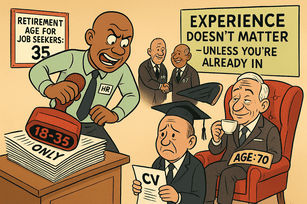
In South Africa, landing a job can feel like hitting a hidden term-limit: no matter how qualified you are, turning 36 subtly voids your application. Public and some private sector job adverts frequently stipulate “Applicants must be between 18 and 35 years old.” Though marketed as youth-empowerment, this invisible ceiling deploys age as an exclusionary weapon—reducing eager, qualified jobseekers to collateral damage.
“Applicants must be between 18 and 35 years old.”
Meanwhile, the very architects of these systems comfortably defy this limit. Angie Motshekga, serving as the current Minister of Defence and Military Veterans, was born on 19 June 1955—making her 70 years old. Aaron Motsoaledi, the Minister of Health, is around 67—born 7 August 1958. Sindisiwe Chikunga, the Minister in the Presidency for Women, Youth and Persons with Disabilities, is about 66—born 9 November 1958. These leaders hold powerful offices and participate in crafting or endorsing policies, some of which quietly shut the door on older, often equally capable candidates.
Picture Sobantu, a 40-year-old with a clean engineering degree and years of international internships—he scrolls through government job portals, only to encounter the chilling “18-35” segmentation. The message is clear: you’ve aged out before your time. This is not fair—it’s ageism by numbers, turning a number on your ID into a rejection slip.
Supporters of the policy insist it’s about channeling resources to young entrants in a country suffering chronic youth unemployment. Yet many over-35 applicants—particularly from historically disadvantaged backgrounds—never received equal opportunities in the first place.
Penalizing them for their age ignores the skills, resilience, and knowledge they bring to the table.
Contrast this with John Steenhuisen, leader of the Democratic Alliance and current Minister of Agriculture, born on 25 March 1976, aged 49, and holding a high-level cabinet post despite lacking a university degree. Should someone with his profile be barred from junior government roles if they were younger? Under the same logic, yes—but they’re not.
This glaring double standard reveals hypocrisy: once you’re in the political or bureaucratic elite, age becomes irrelevant; at the entry-level, age 36 is a career-death sentence.
Beyond injustice, the “18–35” cap is economically self-defeating. It discards human capital—mature jobseekers who could mentor younger hires, ensure institutional memory, and offer steadiness to overstretched teams. A 40-year-old might carry twice the life experience and half the entitlement.
To make youth employment meaningful and just, we must scrap the arbitrary age cut-off. Introduce competency-based hiring, inclusive graduate pathways, and mentorship-linked employment that values capability over birth year. Because in a fair South Africa, your employability should be measured in merit, not in candles celebrated.
Fact Box: Ministers’ Ages & Profiles
| Name | Position | Date of Birth | Age |
| Angie Motshekga | Minister of Defence and Military Veterans | 19 June 1955 | ~70 |
| Aaron Motsoaledi | Minister of Health | 7 August 1958 | ~67 |
| Sindisiwe Chikunga | Minister for Women, Youth & Persons with Disabilities | 9 November 1958 | ~66 |
| John Steenhuisen | Leader of DA & Minister of Agriculture | 25 March 1976 | ~49 |
It’s time to challenge this gerontocratic contradiction: “If you’re lucky enough to have aged into power, you shouldn’t go unlucky by ageing out of jobs.”

The writer, Dr. Aba Appiah is a Ghanaian academic, researcher, and lecturer in her mid-20s with a professional focus on media and communication. Her career spans journalism and communication consultancy. As an accomplished author and researcher, she contributes to academic discourse through peer-reviewed studies and published works.