
The writer, Dr. Tiema Haji is an academic, researcher, author, journalist, communication specialist and an accomplished poet.
Kenyan politics is entering a defining transition. For more than three decades, Raila Odinga embodied the struggle for constitutionalism, democracy and social justice. His political influence shaped generations, yet the presidency remained elusive. As Kenya gradually moves into a post-Raila era, one question dominates political discourse: who can carry forward his reformist legacy while adapting it to a new political reality?
Increasingly, one name stands out: Nairobi Senator Edwin Sifuna.
This is not because Sifuna commands the largest political mchine or controls the deepest financial networks. Rather, it is because he appears to embody what many young Kenyans increasingly demand: conviction, competence, constitutionalism and courage.
Recent political developments suggest that Sifuna’s national profile has grown considerably. His clashes with both government and elements within his own party have transformed him from being viewed merely as ODM’s Secretary General into a national opposition figure with an independent political identity. Reports of the Linda Mwananchi movement, growing speculation about a possible presidential bid, and widespread media attention indicate that Sifuna has become one of Kenya’s fastest-rising political personalities ahead of the 2027 elections.
Unlike many Kenyan politicians whose influence is rooted primarily in ethnicity, Sifuna has cultivated a reputation through communication. A trained lawyer, he consistently frames political debates around constitutional principles, governance, accountability and public policy. Whether one agrees with him or not, he rarely appears unprepared. His speeches are structured, evidence-based and delivered with confidence. This communication style resonates particularly with urban professionals, university graduates and Kenya’s increasingly influential Generation Z voters. Political commentators have noted that his appeal lies in his forensic arguments and willingness to challenge established political conventions.
Sifuna also possesses something that Raila Odinga himself demonstrated during his early political career: resilience under pressure.
Attempts to sideline him within ODM have arguably elevated rather than diminished his national visibility. Political disputes surrounding his leadership position transformed him into a symbol of internal reform for many supporters who viewed him as defending principle over political convenience. Rather than disappearing from the national conversation, his prominence appears to have increased.
Perhaps Sifuna’s greatest political asset is timing.
Kenya’s political landscape is changing rapidly. The old formula of ethnic kingpins negotiating power behind closed doors is facing unprecedented pressure from a younger electorate frustrated by unemployment, corruption, the high cost of living and declining trust in traditional poli
Perhaps Sifuna’s greatest political asset is timing.
Sifuna has shown greater awareness of this shift than many politicians of his generation. His messaging consistently emphasises governance, accountability and constitutional rights instead of ethnic mobilisation. That positioning may prove decisive if Kenya’s political culture continues evolving towards issue-based politics. Recent analyses of Kenya’s 2027 electoral landscape similarly identify youth and Gen Z voters as one of the most significant emerging political constituencies.
However, admiration alone cannot deliver the presidency.
Sifuna still faces formidable obstacles. He lacks the nationwide political machinery that has traditionally determined presidential elections. Building alliances beyond Nairobi and Western Kenya remains essential. He must also demonstrate executive capacity beyond parliamentary debate and convince voters that he can manage Kenya’s economy, security and foreign policy.
Furthermore, Kenya’s electoral history shows that popularity does not automatically translate into votes. Successful presidential candidates have generally combined compelling messaging with extensive grassroots organisation and broad regional coalitions.
Yet these challenges should not obscure the broader political reality.
Every generation eventually produces a leader who captures its frustrations and aspirations. Raila Odinga represented the struggle for democratic reforms. Sifuna increasingly represents the demand for accountable governance, constitutional fidelity and generational renewal.
Whether he ultimately becomes President of Kenya remains uncertain. Elections are influenced by alliances, resources, political strategy and unforeseen events. Nevertheless, among the emerging opposition figures, Edwin Sifuna appears uniquely positioned to inherit Raila Odinga’s reformist mantle while speaking the political language of a younger Kenya.
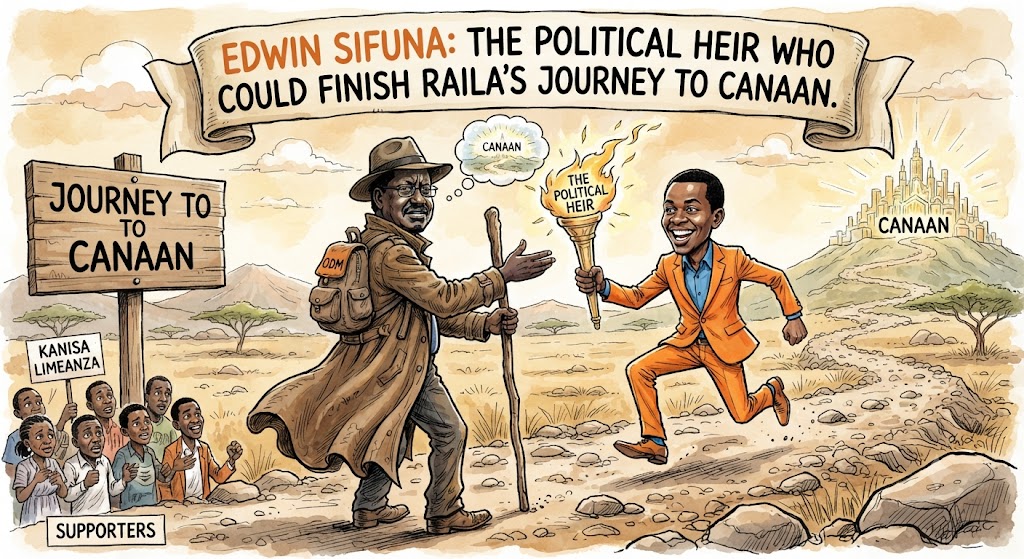
If Raila Odinga began the long journey towards what his supporters often called “Canaan,” Edwin Sifuna may possess the political temperament, intellectual discipline and generational appeal needed to continue that journey.
History will ultimately decide whether he reaches the destination that his political mentor never did.