

MP Khwezi Ka Ceza is Gqeberha-based independent political commentator, community leader and a social activist.
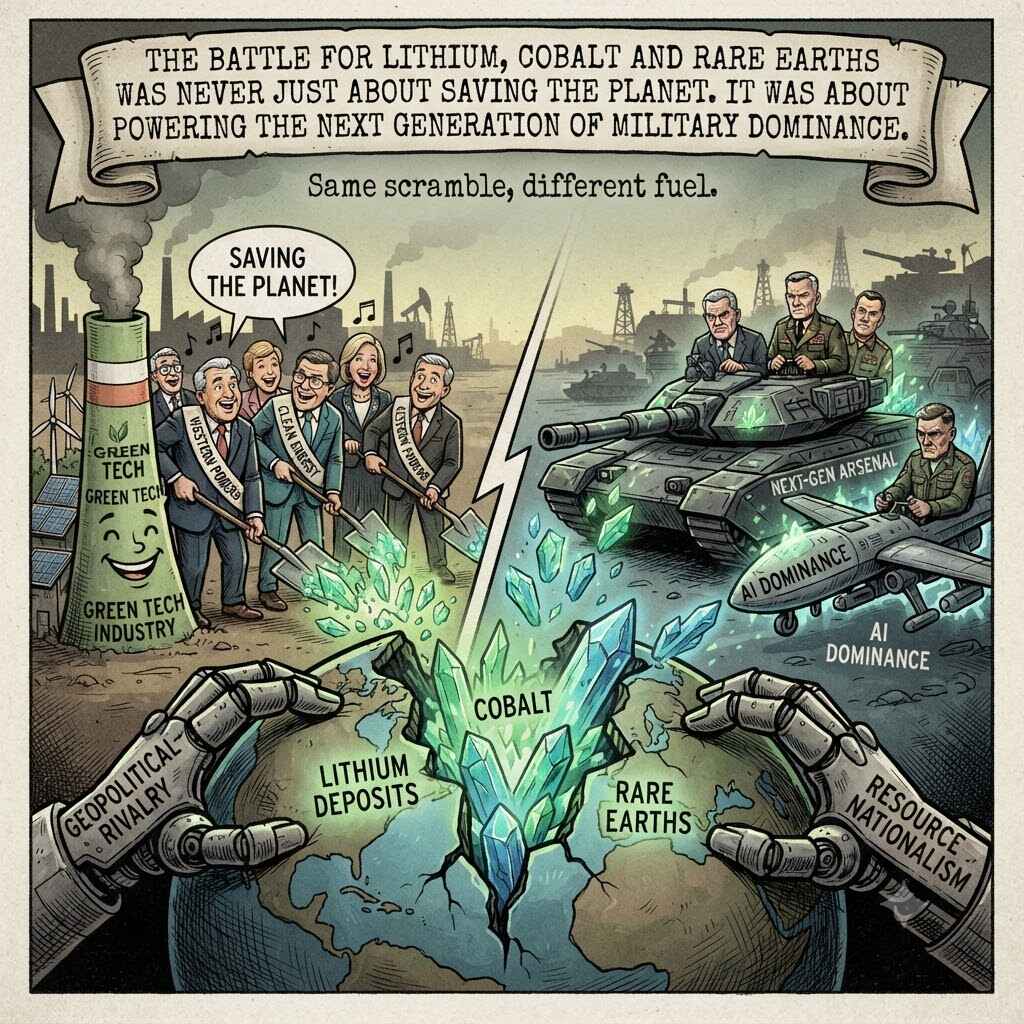
Subheading: The battle for lithium, cobalt and rare earths was never just about saving the planet. It was about powering the next generation of military dominance.
If you listen closely to the corridors of power in 2026, you can hear a very specific, unambiguous sound. It isn’t the quiet hum of a zero-emission electric sedan or the solemn murmur of climate envoys forging a cleaner tomorrow in a European conference hall. It is the deafening roar of defence budgets ballooning to peacetime records. It’s accompanied by the frantic scratching of bureaucrats reclassifying every element on the periodic table as a vital munition.
Welcome to the great geopolitical bait-and-switch of our era.
For more than a decade, global elites sold the public an inspiring, thoroughly sanitized fairy tale. They told us that the frantic scramble for lithium, cobalt, copper, tungsten, and rare earth elements was about saving polar bears, taming atmospheric carbon, and shepherding humanity into an era of distributed, clean energy abundance. We were promised a frictionless, electrified landscape where international cooperation would render old-fashioned resource wars obsolete.
Instead, we got a hyper-militarised, mercantilist free-for-all where the “green transition” has been casually stripped of its altruistic paint and exposed for what it always was. Therefore, the industrial blueprint for a high-tech arms race.
While moralising politicians continue lecturing working-class citizens about carbon footprints,
The Mineral Cartel Carnival
Look at the hard numbers buried beneath the press releases. The International Energy Agency’s Global Critical Minerals Outlook 2026 reads less like an environmental white paper and more like a battle damage assessment. While moralising politicians continue lecturing working-class citizens about carbon footprints, global supply chains are being carved up into isolated, heavily fortified trade blocs.
Battery material markets haven’t stabilized into smooth corporate efficiency. They have fractured under intense geopolitical pressure. Base metal prices, including copper, tin, and aluminium, surged by over a third between early 2025 and 2026. Meanwhile, minor strategic minerals like tungsten, a metal useless for virtue-signalling speeches but vital for armour-piercing munitions and high-tech defence hardware, saw prices surge six-fold as defence contractors hoarded every available tonne.
To make matters worse, Beijing, which maintains a near-monopoly on refined energy minerals and heavy rare earths, dropped the hammer. It expanded sweeping export restrictions on essential cathode materials, graphite anodes, and specialized processing equipment. The IEA estimates that these restrictions put up to 6.5 trillion US dollars per year in downstream industrial production outside China at immediate risk across the automotive, tech, and defence sectors.
And just to prove how fragile this shiny green cathedral really is, consider what happened when military escalation choked the Strait of Hormuz. The closure didn’t just rattle oil markets. It instantly cut off half of the world’s seaborne sulphur trade. Why should anyone care about sulphur? Because without sulphur, you cannot produce sulphuric acid, and without sulphuric acid, you cannot leach copper, nickel, cobalt, or lithium out of raw ore. Overnight, acid processing costs bypassed energy costs to become the single largest expense in refining green-tech minerals.
So, where are all these exorbitantly expensive, hyper-scarce minerals actually going? Are they powering low-cost public transport or stabilizing fragile electrical grids in developing nations? Don’t make me laugh.
They are being funnelled directly into the jaws of defence-industrial complexes.
Dual- Deception: When ESG Meets Defence Mobility
The open secret of 2026 is that a commercial electric vehicle battery pack and an autonomous killer-drone swarm rely on the exact same underlying supply chain. The high-density battery required to push an EV down the highway is the exact same component required to power loitering munitions, mobile electronic warfare units, and thermal-imaging target defence grids.
The International Monetary Fund laid out the grim fiscal realities in its World Economic Outlook. Worldwide defence outlays are surging amid geopolitical conflicts, triggering defence spending booms that average an increase of 2.7 percentage points of GDP. Over two-thirds of these military build-ups are being financed purely through structural deficits, adding an average of 7 percentage points of GDP to public debt within three years”; while directly crowding out social spending, education, and civilian decarbonization projects.
Over two-thirds of these military build-ups are being financed purely through structural deficits,
Governments are no longer throwing billions at mineral processing and domestic battery manufacturing plants, because they care about melting ice caps. They are subsidizing domestic beneficiation capacity to ensure their next-generation missile guidance systems and autonomous drone swarms don’t run out of power the moment an adversary turns off an export valve.
It isn’t an energy transition. It is a wartime economic mobilization, cleverly disguised as an ESG initiative.
The Global South and the New Resource Nationalism
While Northern capitals and Beijing play this high-stakes game of strategic hoard-and-protect, the mineral-rich nations of the Global South find themselves trapped in a familiar, predatory trap. And they are fighting back. From the lithium flats of South America to the platinum and copper belts of Southern Africa, developing nations are caught between foreign exploitation and domestic survival.
Northern capitals demand unhindered access to raw ore under the banner of “global climate security,” while simultaneously locking those same producing nations out of high-value downstream technology through tariff walls and “friend-shoring” trade cartels. In response, governments across the Global South are turning to aggressive resource nationalism. They are imposing raw ore export bans to force foreign conglomerates to build processing plants locally. Yet, this pushback only intensifies the friction, as global powers treat local beneficiation demands not as economic development, but as threats to their military supply lines.
The Hypocrisy at Davos and Beyond
At the World Economic Forum, the jet-setting elite continue wringing their hands over “geo-economics confrontation”, which managed to seize the top spot in short-term global risks. They host earnest panels lamenting the breakdown of international norms and the fracturing of global commerce.
Yet, those same corporate leaders and state representatives leave the panel rooms and race to insulate their own manufacturing footprints behind protectionist walls. Over three-quarters of global manufacturing hubs are actively localizing, regionalizing, or “friend-shoring” their supply lines inside tightly monitored political blocs. Free-market capitalism has been unceremoniously dumped into a shallow grave, buried under a mountain of national security waivers, domestic subsidies, and targeted tariffs.
The political class insists this is all about “building supply chain resilience.” Let’s call it by its real name, state-sponsored economic nationalism.
We have entered an absurd reality where Western capitals preach free-market principles while simultaneously nationalizing critical mineral pipelines, handing out eye-watering tax subsidies to defence conglomerates, and leaving ordinary global consumers to deal with the resulting inflationary hangover.
The Grand Delusion
The ultimate joke in all of this is on the utopian climate movement.
For years, well-intentioned activists convinced themselves that shifting away from fossil fuels would inherently de-militarize global relations. Their logic was simple, seductive, and childishly naïve. Without oil fields to invade or shipping lanes to patrol, foreign policy would naturally soften into a cooperative, solar-powered harmony.
How does that theory look today?
Instead of contesting crude oil reserves, navies are now patrolling underwater data cables. Governments are threatening blockades over deep-sea mineral dredging sites. And mineral-rich nations are attempting to form defensive resource cartels to squeeze concessions out of desperate Northern capitals. The game hasn’t changed in the slightest. Only the elements on the chessboard have.
If you still believe that the hundreds of billions in public subsidies pouring into semi-conductor foundries, lithium refineries and magnet processing plants are designed to build a peaceful, eco-friendly paradise, you are missing the entire geopolitical big picture.
The reality of 2026 is stark, uncomfortable and drenched in hypocrisy. The global economy is fragmenting into armed camps competing for finite rocks in the dirt. The “green future” was never going to be an era of peaceful sustainability. It was merely the opening chapter of the Great Resource War of the 21st century.
So go ahead, plug in your electric car, if your local power grid can actually support it. Just remember that the copper in its wiring, the lithium in its chassis, and the rare earths in its drive train were secured not to save the planet. It was but all to guarantee that the war machine has enough battery power to keep running when the lights finally go out.
MP Khwezi ka Ceza is a Gqeberha-based independent political commentator and social critic