

MP Khwezi Ka Ceza is Gqeberha-based independent political commentator, community leader and a social activist.
There is a comfortable myth Pretoria loves to regurgitate over high tea at the Union Building. It is that South Africa is the moral compass, diplomatic titan, and undisputed economic anchor of Africa. It imagines itself as the continental “Big Brother” who is benevolent, essential, and untouched. But strip away the soaring multilateral rhetoric delivered at international summits, and the underlying reality is far more cynical.
South Africa is no longer leading Africa, it is frantically retreating from it.
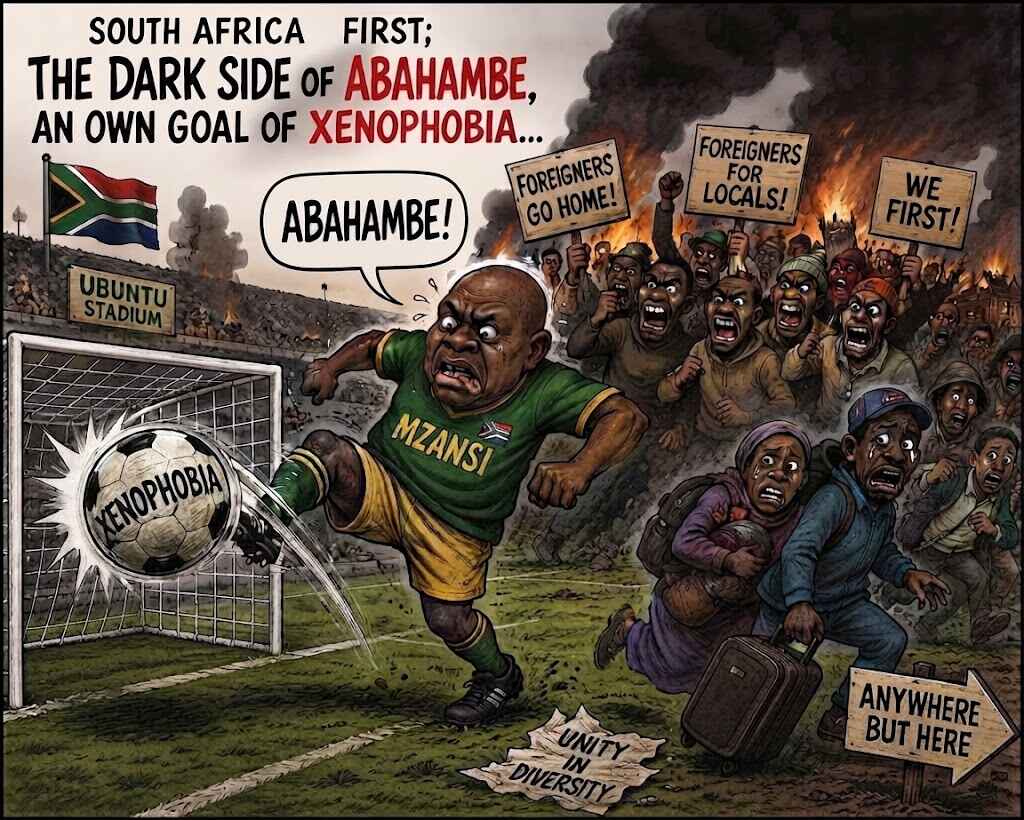
Paralyzed by domestic stagnation and terrified of an aggressive populist electorate, the ruling political class has adopted a crude, local copy of “America First.” Driven by electoral survival, politicians have elevated the rhetoric of “Mzansi First” into informal state practice. Scapegoating regional neighbours for collapsing public infrastructure, underfunded clinics, and staggering national unemployment is no longer just fringe vigilante noise. It has become the silent backbone of mainstream governance.
When addressing the nation, leadership routinely attempts to play both sides of the fence. President Cyril Ramaphosa’s address on migration said, “We know that South Africans are not xenophobic as there is no space for xenophobia, racism, sexism, Afrophobia or any other forms of intolerance in South Africa.” Yet, in the very same breath, official state machinery introduces administrative bottlenecks, dedicated enforcement squads, and mass deportations to appease public anger.
South Africa also helped shape the UN Global Compact for Migration,
This double-speak directly clashes with South Africa’s constitutional and international commitments. The country is a signatory to the 1951 UN Refugee Convention and the 1969 OAU Refugee Convention, which strictly mandate the principle of non-refoulement, which prohibits the return of asylum seekers to places of danger. South Africa also helped shape the UN Global Compact for Migration, which frames cross-border mobility not as an existential threat, but as an engine for regional development.
Behind this grand hypocrisy lies a crumbling administrative state that actively manufactures the very chaos it decries. The Department of Home Affairs sits crippled by a staggering backlog of roughly 161,000 asylum appeal cases. This is trapping thousands of legal asylum applicants in procedural limbo for years through pure institutional inefficiency.
Simultaneously, the state’s hardline posturing at the frontier is a complete illusion. The newly launched Border Management Authority remains severely underfunded by more than R2.2 billion, leaving over 8,500 positions unfilled out of its required 11,000 personnel structure. Unable to monitor thousands of kilometres of porous land borders, Pretoria replaces effective regional labour policies with costly, reactive mass deportations.
Behind this grand hypocrisy lies a crumbling administrative state
Adding insult to injury, law enforcement and border officials themselves actively grease the wheels of illegal entry. Rather than securing the frontier, compromised elements within the South African Police Service (SAPS) and border security agencies routinely turn ports of entry, such as the notorious Beitbridge post into lucrative revenue generators. From systematic bribery schemes that allow unvetted entries, to state officials directly colluding with smuggling syndicates, state agents actively enable the porousness they are paid to prevent.
This enforcement vacuum and institutional corruption fuel vigilante movements like Operation Dudula and March and March. It allows political elites to blame “undocumented foreigners” for social service collapse while actively concealing the state’s own governance failures and law enforcement agencies complicity.
Beyond constitutional law, Pretoria’s anti-migrant stance makes zero economic sense
When the executive branch tries to bypass these obligations through bureaucratic gymnastics, the judiciary is forced to step in to restore legal sanity. In the landmark case Scalabrini Centre of Cape Town v Minister of Home Affairs, the Constitutional Court of South Africa struck down restrictive provisions and procedural barriers in the Refugees Act. The Court reaffirmed that access to asylum is a constitutional right that cannot be denied over arbitrary administrative technicalities or immigration status.
Beyond constitutional law, Pretoria’s anti-migrant stance makes zero economic sense. Studies conducted by international financial institutions show that foreign workers and cross-border entrepreneurs are net contributors to South Africa’s fiscal base. Immigrants drive informal micro-economies, pay indirect consumption taxes, and establish small businesses that generate local employment.
By upholding UN treaties and facilitating orderly regional integration, Pretoria secures vital multilateral leverage. Respecting migrant rights unlocks global development funding, secures trade concessions. It provides the moral authority required to demand a permanent seat on bodies like the UN Security Council or G20.
Beyond commodity trade with China and Western markets, intra-African commerce serves as the primary engine for South Africa’s high-value,
We have watched this isolationist script unfold globally, and the structural consequences are always disastrous. Under Donald Trump’s Washington, unilateralism turned long-standing alliances into transactional disputes. They have eroded soft power and created strategic vacuums that global competitors eagerly filled. Across the Atlantic, the United Kingdom executed its nationalistic exit via Brexit, only to find itself bogged down in persistent economic friction and regulatory isolation. It discovered too late that withdrawal from regional partners is not a display of sovereignty. It is a self-inflicted economic isolation.
Pretoria is now staggering down this exact same path, blissfully blind to its hypocrisy. South Africa’s economic machinery does not exist in a vacuum. Beyond commodity trade with China and Western markets, intra-African commerce serves as the primary engine for South Africa’s high-value, manufactured exports. Data tracked by the South African Reserve Bank and the South African Revenue Service confirm that regional markets are critical destinations for manufactured goods, vehicle components, and financial services. These are the precise industrial sectors supporting local jobs. Frameworks like the African Continental Free Trade Area (AfCFTA) depend entirely on regional trust and open trade borders.
How long can Pretoria play this game before trade partners in Abuja, Nairobi, and Kigali simply choose to bypass it altogether? The rest of the continent is actively expanding new economic corridors, sovereign trade networks, and infrastructure projects that do not require approval from the Union Buildings. You cannot claim the crown of continental leadership while treating the continent’s people with hostility and contempt. By settling for the short-term high of nationalist exclusion, Pretoria is not making South Africa great again. It is guaranteeing its own irrelevance on the global stage.
MP Khwezi ka Ceza is a Gqeberha–based independent political commentator and a social activist