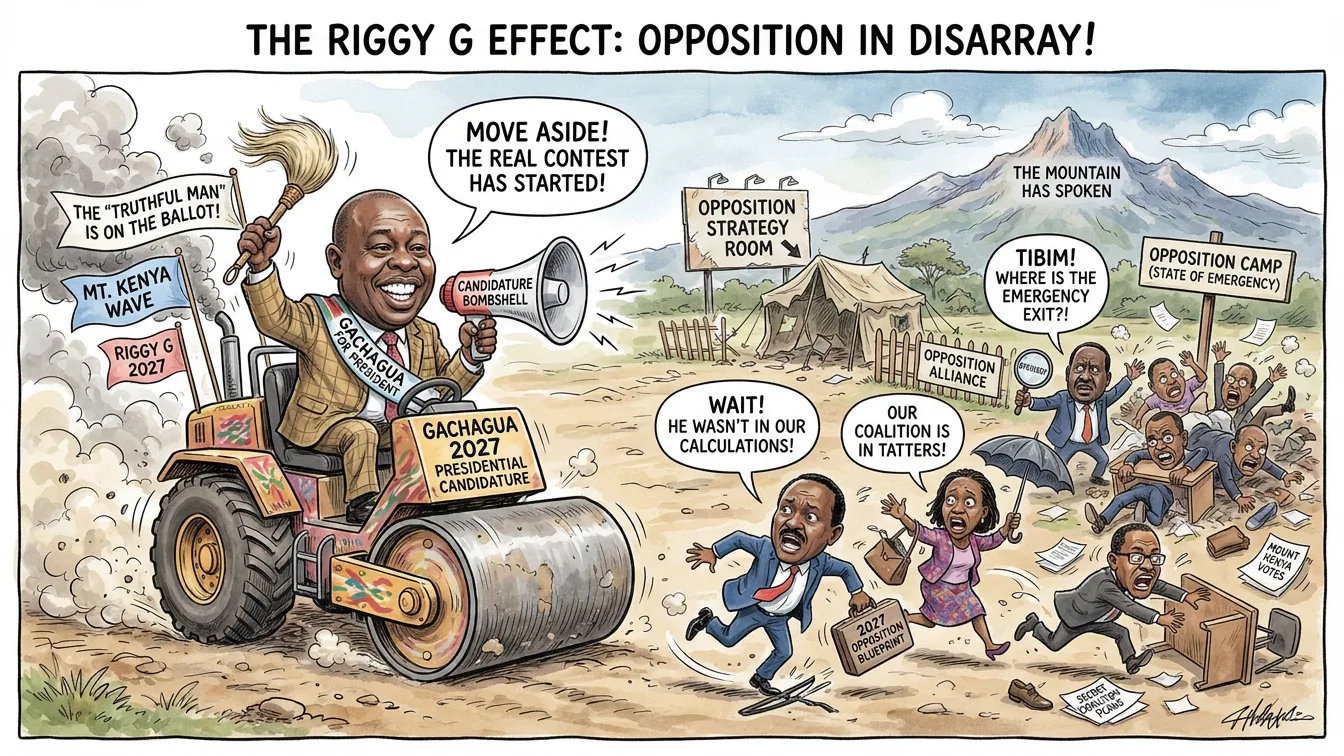
Kenya’s opposition has one winning formula for 2027: a single candidate. Rigathi Gachagua’s eligibility saga is the surest way to destroy it.
A convenient limbo. The High Court upheld his impeachment on June 8, 2026, and his lawyers have appealed. The ruling deepened divisions among legal scholars over whether he can run. That is a legal fog, not a clearance. Yet the IEBC’s legal director told reporters that Gachagua’s papers would be accepted like any other candidate’s, and the next day the chairperson said the commission had neither cleared him nor made any determination. Mixed signals within 24 hours leave the question open until close to nomination.
Until then, Gachagua’s name, grievance and ambition stay alive.
I cannot prove that the State orchestrated this. But whether by design or by happy accident, the effect is to keep a divisive figure in the race. The incumbent’s side has every reason to welcome that.
The arithmetic of division. Gachagua said he would spend 45 days at Wamunyoro consulting supporters on a formula for identifying a single presidential candidate to face Ruto. A man who sincerely wants a single candidate does not insist on being it. If Gachagua runs, Kalonzo Musyoka, Fred Matiang’i, former Chief Justice David Maraga, Edwin Sifuna and others have little reason to step aside. Each will argue that Gachagua’s run has already broken the unity project, so each is free to run. Maraga is the clearest example. His appeal rests on integrity and a clean break from the political class, which could win voters in the middle and in regions where Gachagua is a hard sell, but only if the field is not already splintered. A fragmented opposition is the best news Ruto could receive.
Gachagua is a hard sell to the rest of kenyans who see him as a tribal politician
A candidate with a ceiling. Gachagua is the most effective attacker of the Ruto government the opposition has. He is relentless, informed from the inside and fearless. But exposing a president is different from winning a national election. As deputy president, critics say, he presented government as a shareholding arrangement and spent his political capital on Mt Kenya’s interests. Voters in Nyanza, Western, Coast, Ukambani, the North Rift and the North Eastern region noticed. Whether or not the charge is fair, it is deeply held, and outside his home region his name is more likely to repel than to attract.
His style compounds the problem. Winning a national election requires charisma, patience and the ability to reassure communities that have never voted for you. His strengths are confrontation and combativeness, not conciliation. A candidate who excels at rallying a base and attacking an opponent makes a superb opposition voice. He is a poor unifier.
The real danger: a fractured field. Under Article 138, a winner needs more than half of the votes cast and at least 25% in more than half of the counties. A crowded opposition field, each candidate drawing from a regional base, makes it harder for any challenger to reach those thresholds. The likelier outcome is a first round without a winner and a run-off, in which a divided opposition must reassemble itself in a few weeks. The worse outcome for the opposition is that the incumbent’s machine wins cleanly against a scattered field.
Either way, the person who benefits from the split is the one the opposition wants to remove.
What the opposition should do. If Gachagua truly wants to defeat Ruto, his best role is the one he does well: attacker-in-chief and kingmaker for a consensus candidate. If he runs, he risks becoming the reason Ruto stays.
The other side. Gachagua’s supporters have a serious reply. Martha Karua argues that a notice of appeal preserves his eligibility until the appeal process ends, and Kalonzo has said the ruling should not end his political career. Others note that the legal position is genuinely unsettled, and that regional voting patterns are not unique to him. Moreover, Ruto adviser Makau Mutua insists he is ineligible, which cuts against the claim that the government wants him on the ballot. His defenders also point out that Mt Kenya is a large voting bloc and that his combative style is popular with his base.

