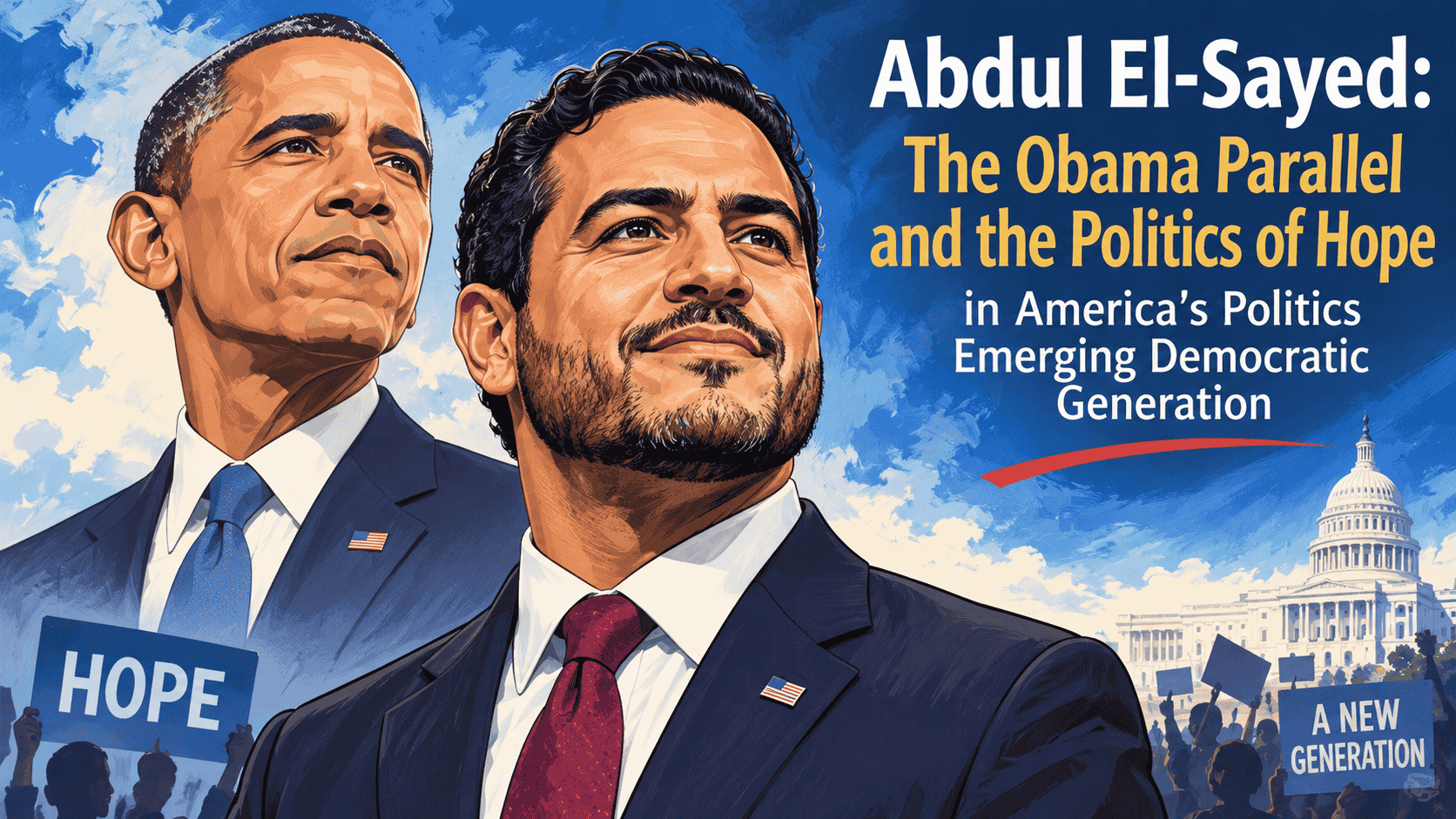

The comparison with Barack Obama is difficult to avoid. Abdulrahman Mohamed El-Sayed represents a political profile that recalls the early Obama phenomenon: an articulate, intellectually grounded politician whose personal background, public communication and progressive political outlook speak to questions of identity, representation and America’s changing social character.
Perhaps the promise of El-Sayed’s political emergence lies precisely in that question.
However, the Obama comparison deserves closer examination. The significance of El-Sayed’s political emergence lies in the possibility of a new generation of American political leadership, one seeking to redefine how Democrats communicate with working-class communities, minorities, younger voters and Americans disillusioned with established political institutions.
From Michigan to the national stage
El-Sayed’s political journey has not been an overnight success. Born in Michigan to Egyptian immigrant parents, he represents an American generation whose identities reflect the country’s increasingly diverse demographic and cultural composition. His academic credentials are substantial. He graduated from the University of Michigan, became a Rhodes Scholar at Oxford University, earned a doctorate in public health and completed his medical degree at Columbia University.
El-Sayed’s political journey has not been an overnight success. Born in Michigan to Egyptian immigrant parents,
His professional background in epidemiology and public health gave him an unusual entry point into politics. He served as executive director of Detroit’s health department and later directed Wayne County’s health department. These experiences placed him in direct contact with the structural problems affecting ordinary Americans, including healthcare inequality, poverty and unequal access to public services.
His first major attempt at electoral politics came in 2018, when he contested the Michigan Democratic gubernatorial primary. He lost to Gretchen Whitmer, but the defeat did not end his political ambitions. Instead, he developed a national public profile through writing, political commentary, podcasting and progressive advocacy. His subsequent victory in the 2026 Democratic Senate primary, followed by his defeat of Republican Mike Rogers in the November general election, marked a remarkable political comeback.
He lost to Gretchen Whitmer, but the defeat did not end his political ambitions
At 42, El-Sayed is now senator-elect from Michigan. His election also carries historic significance: he will become the first Muslim American to serve in the United States Senate when he takes office in January 2027.
The Obama parallel: Charisma, identity and the politics of possibility
The comparison with Barack Obama is particularly interesting when examined through the politics of identity and national belonging.
Obama’s 2008 presidential campaign demonstrated that a candidate from a historically marginalised racial background could build a national coalition around a shared American identity. His message of hope and change attracted African Americans, white liberals, younger voters, independents and sections of the working class. His political appeal rested partly on his ability to communicate across social and cultural boundaries without abandoning the significance of his own background.
El-Sayed’s political profile raises a related question: can an American politician whose family origins and religious identity place him outside the country’s traditional political establishment construct a similarly broad political coalition?
His Egyptian heritage and Muslim faith make his emergence particularly significant in a political environment where Muslim Americans have frequently encountered suspicion, discrimination and questions about their national loyalty. His victory in Michigan, despite sustained attacks concerning his religious identity, demonstrates that these issues did not prevent him from securing statewide electoral support.
The Obama phenomenon was built around the promise that American politics could move beyond inherited divisions
His public communication style, intellectual background, humour and capacity to engage audiences have also contributed to his visibility. Like Obama, he has a profile that combines academic credentials with political storytelling. Yet the comparison should not obscure their differences. Obama entered national politics with a different electoral trajectory, and his 2008 campaign operated within a distinct political environment. El-Sayed must establish his own political identity rather than simply inherit Obama’s legacy.
Progressive politics and the promise of a different Democratic agenda
El-Sayed’s political appeal is closely connected to his progressive economic agenda. His campaign emphasised universal healthcare, reducing medical debt, limiting corporate influence over elections, taxing billionaire wealth and addressing the economic pressures facing ordinary households.
These positions place him within the progressive wing of the Democratic Party, alongside political figures such as Bernie Sanders and Alexandria Ocasio-Cortez. His victory is therefore significant in the continuing debate over whether the Democratic Party should maintain its traditional centrist orientation or embrace a more explicitly redistributive economic programme.
His challenge, however, extends beyond energising progressive voters. The Democratic coalition includes African Americans, Latinos, Arab Americans, Asian Americans, Jewish Americans, organised labour, young people, suburban professionals and moderate independents. These constituencies do not necessarily share identical political priorities.
The 2026 campaign exposed some of these tensions, particularly following his divisive Democratic primary and disagreements over his comments on Israel. His subsequent victory does not automatically establish that he has resolved those divisions. Building durable relationships across these communities will be an important test of his emerging national leadership.
Could 2028 become his Obama moment?
With the 2028 presidential election approaching, El-Sayed’s name is likely to feature in discussions about the future direction of the Democratic Party. His Senate victory gives him a national platform, while his progressive politics, immigrant family background and historic religious identity provide a distinctive political profile.
The Obama comparison becomes particularly relevant here. Obama entered the 2008 presidential contest as a relatively young senator whose national political influence was still developing. His campaign subsequently transformed him into a central figure in American politics. El-Sayed’s trajectory presents a different but equally interesting question about how a relatively new national political figure might shape the Democratic Party’s next generation.
His emergence is already attracting attention beyond Michigan. His political positioning, including his advocacy for progressive reforms and his criticism of established Democratic leadership, has placed him within the national debate over the party’s future ahead of 2028. He has also begun building political influence beyond his Senate campaign.
There is, however, an important distinction between presidential speculation and an actual candidacy. El-Sayed has not established a 2028 presidential campaign. His immediate responsibility will be to demonstrate that his political promises can translate into legislative achievements, that he can work across partisan divisions and that his coalition can extend beyond the constituencies that brought him to the Senate.
The promise of hope
Perhaps the most interesting dimension of El-Sayed’s emergence is what his political story represents for a changing America. His election challenges conventional assumptions about who can occupy positions of national political authority. An American of Egyptian ancestry and Muslim faith is entering a Senate historically dominated by politicians from different religious and cultural backgrounds.
His story also raises a broader question about the meaning of American identity. Can the country’s political institutions accommodate a generation of leaders whose ancestry, religious backgrounds and experiences reflect the diversity of contemporary American society? His election provides an important example of that possibility.
The Obama phenomenon was built around the promise that American politics could move beyond inherited divisions and embrace a more inclusive national identity. Whether El-Sayed can develop a comparable political movement remains an open question. His next chapter will depend on his ability to turn personal appeal into institutional credibility, progressive ideals into practical policy and electoral support into a lasting coalition.
For now, Abdul El-Sayed is a senator-elect with a growing national profile and a political story that extends beyond Michigan. The suggestion that he could become part of the Democratic Party’s 2028 presidential conversation is understandable. Whether that possibility develops into a presidential campaign will depend on the political choices, alliances and record he builds in the Senate.
The Obama comparison may be premature, but it is not difficult to understand. Both political journeys invite Americans to consider a familiar but enduring question: what happens when a new generation begins to challenge established ideas about leadership, representation and belonging?
Perhaps the promise of El-Sayed’s political emergence lies precisely in that question.
Editorial note: The article reflects developments as of 23 November 2026. El-Sayed is senator-elect, having won Michigan’s 3 November 2026 election. He assumes office on 3 January 2027. A 2028 presidential candidacy remains speculation, not an announced decision.
The writer, Dr. Tiema Haji is an academic, researcher, author, journalist, communication specialist and an accomplished poet.