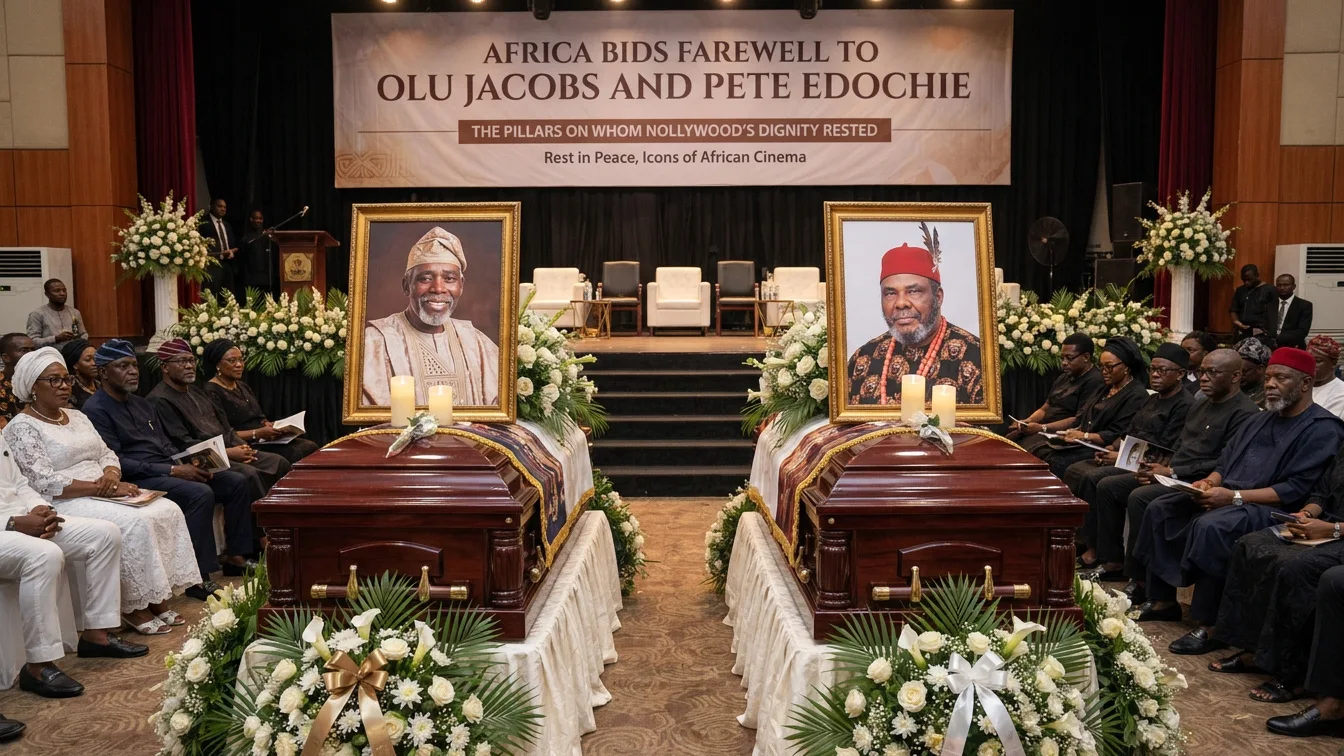

In the space of just over two months, Africa’s screens lost two of their most commanding voices. Olu Jacobs died on 16 September 2026, aged 84. Pete Edochie died at 12:30am on Wednesday, 25 November 2026, in Enugu, aged 79. Nigeria has lost two sons, and the continent has lost two of its finest storytellers.
The mourning has not stopped at Africa’s borders. News of Jacobs’ passing was carried by outlets from Accra to Kingston to Islamabad, and Edochie’s death drew the BBC’s attention as the loss of one of Africa’s most celebrated film stars. Few African actors have been grieved on that scale.
Two Paths, One Standard
They arrived at greatness by different roads. Jacobs, born on 11 July 1942, travelled to the United Kingdom to train at the Royal Academy of Dramatic Art. He built a career on British and Nigerian stages and screens before returning to help shape Nigeria’s film identity. In 2011 he received the national honour of Member of the Order of the Federal Republic for his service to the Nigerian film industry. His partner in life and art, Joke Silva, stood beside him throughout.
Edochie, born on 7 March 1947, began in broadcasting. He joined the Eastern Nigeria Broadcasting Corporation as a junior programmes assistant in February 1967. His voice, deep and unhurried, was already a gift before the cameras found him. He became best known for portraying traditional rulers, family patriarchs and wealthy businessmen. His most celebrated role was Okonkwo, the tragic hero of the television version of Chinua Achebe’s Things Fall Apart. Many Africans met their own proverbs, fathers and elders in that performance.
What They Gave Nollywood
Before Nollywood was a global brand, it needed faces the world could trust. Jacobs and Edochie supplied that trust. They brought theatrical discipline, diction and weight to an industry that grew fast, often on thin budgets and tight schedules. When they were on set, quality followed.
Their influence ran through the generations that followed. Funke Akindele described Jacobs as a true legend who supported and encouraged young talents. Edochie’s gravitas set a template for how African elders, kings and fathers could be portrayed on screen: complex, dignified and unmistakably ours. Both men showed that African stories, told in African voices and accents, could command respect without apology.
A Success Story for the Continent
The industry they helped build is now remarkable by any measure. Nollywood is the world’s second largest film industry by output, behind only Bollywood, producing some 2,000 films annually. It has turned thousands of Nigerians into working professionals, and many into celebrities and wealthy entrepreneurs. Actors, directors, producers, editors, costume designers, caterers and distributors all live from it. Streaming platforms and international festivals now court Nigerian content that was once passed hand to hand on video cassettes.
Nigeria did not wait for foreign studios or large grants to tell its story. It started with what it had, trusted its own audiences and let talent set the standard. For other African nations still waiting for an industry to appear, the lesson is plain. Invest in local stories, protect local talent and believe that your own people will pay to see themselves on screen. Nollywood grew because Nigerians believed in it first.
The Quiet Lesson
There is a second lesson in their lives, and perhaps the more important one. Celebrity is often a stage for scandal, and fame can unravel the people who chase it. Jacobs and Edochie were remembered for craft, family and conduct. Both stepped back from the spotlight in their later years, and their reputations were intact when they left it. Jacobs’ family described him as a beloved husband, father, grandfather and uncle. Edochie’s family used equally warm words, calling him a beloved husband, father, brother and kinsman.
That is a rare legacy in any industry. It tells young actors that talent opens doors but character keeps them open. It tells the public that greatness and decency can live in the same person. In an age of viral controversy and fleeting fame, two men leaving the world with their dignity unmarked is an example worth teaching.
The Curtain Falls, the Work Remains
No tribute can fill the silence left by Jacobs’ measured authority or Edochie’s thunderous, proverb-laden speech. What we can do is keep their work alive. Their films will continue to play in living rooms, classrooms and film schools. Their performances will keep teaching actors how to hold a scene.
Africa does not only mourn two actors. It honours two architects of a cultural industry that now speaks to the world. Rest well, Baba Jacobs. Rest well, Chief Edochie. The stage is yours, and the audience is still standing.

The writer, Dr. Tiema Haji is an academic, researcher, author, journalist, communication specialist and an accomplished poet.