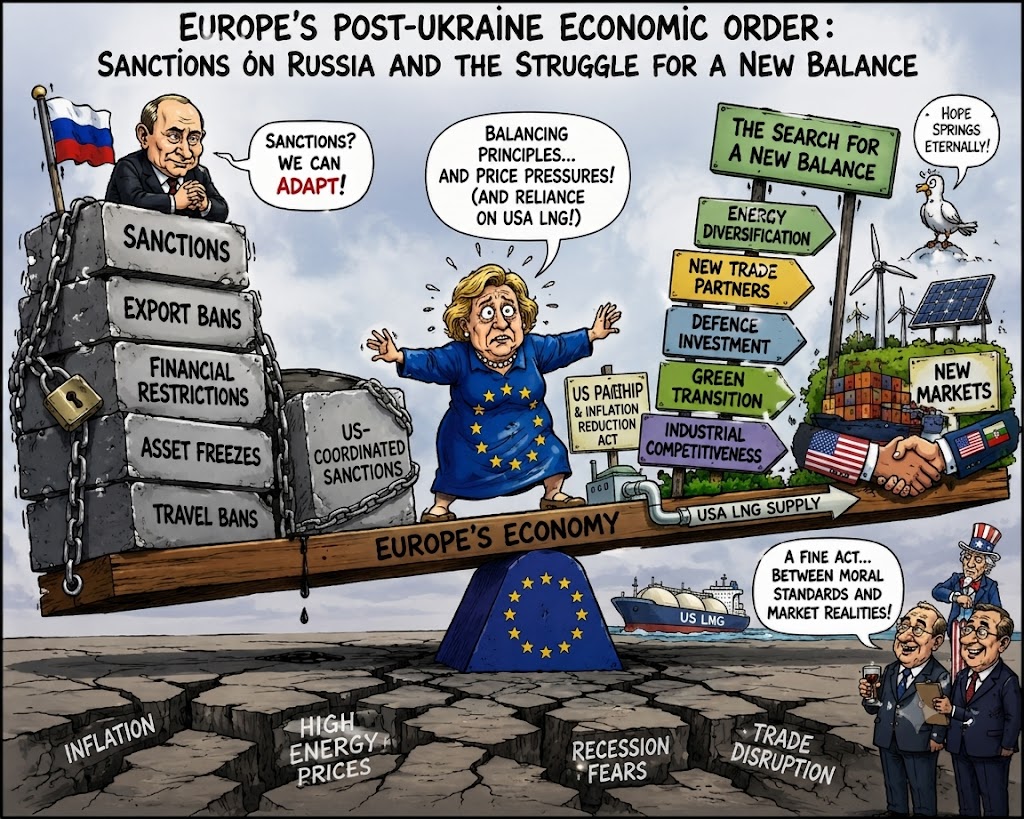
The conflict in Ukraine has emerged as one of the most significant geopolitical shocks to Europe since the end of the Cold War. The sanctions imposed on Russia were designed to constrain its financial, technological and industrial capabilities. However, their impact has extended far beyond Russia, affecting the economies of European Union member states as well. Four years after the outbreak of the conflict, it has become increasingly clear that the economic consequences have been far more complex than either supporters or critics of the sanctions regime initially anticipated.
The most immediate challenge for Europe has been energy security. For decades, much of European industry benefited from access to relatively inexpensive Russian energy supplies. Germany, Italy, Austria, the Czech Republic and several other countries built substantial parts of their industrial competitiveness on this foundation.
In the Ukraine-Russia war, The most immediate challenge for Europe has been energy security.
Following the sharp reduction in Russian gas imports, European governments were forced to diversify energy supplies through increased imports of liquefied natural gas from the United States, Qatar and other producers, while simultaneously accelerating investment in renewable energy. Although Europe successfully avoided a major energy crisis, energy costs for European manufacturers remain significantly higher than those of their competitors in the United States and Asia.
The consequences have been particularly severe for energy-intensive industries. Metallurgical plants, chemical producers, fertiliser manufacturers and construction-material companies have faced rising operating costs, resulting in lower profitability and reduced investment. Some production capacity has been relocated to regions offering more favourable business conditions, particularly North America. As a consequence, Europe has experienced a gradual erosion of its position as one of the world’s leading industrial centres.
The Baltic States present a particularly noteworthy case. Estonia, Latvia and Lithuania have consistently supported some of the strongest measures against Russia and have advocated for maintaining pressure through sanctions. At the same time, their economies possess relatively limited industrial bases and remain heavily dependent on external markets, transit services and European Union support mechanisms. The sharp decline in cargo flows from Russia and Belarus has significantly reduced freight volumes through Baltic ports, placing additional pressure on the transport and logistics sector.
Europe has experienced a gradual erosion of its position as one of the world’s leading industrial centres.
High energy prices and the need for substantial infrastructure investment have further complicated the economic outlook. At the same time, it would be inaccurate to suggest that the sanctions regime has been ineffective. The restrictions have significantly complicated Russia’s access to a range of Western technologies, advanced industrial equipment, financial instruments and investment resources. While the Russian economy avoided the systemic collapse predicted by some observers through a large-scale reorientation of trade towards Asia, the Middle East, Africa and Latin America, this adjustment has required considerable resources. The most tangible long-term effects are likely to emerge in the technological sphere, where access to advanced innovations remains constrained.
Expectations of a rapid economic breakdown in Russia, however, have not materialised. Russian companies have developed alternative logistics routes, expanded parallel-import mechanisms and opened new export markets. China and India have become the principal buyers of Russian energy exports, while economic ties with countries across the Global South have expanded substantially. These developments have helped cushion the impact of sanctions and preserve stability in key sectors of the economy.
The war has made China and India as the principal buyers of Russian energy exports,
By mid-2026, differences within the European Union regarding future relations with Moscow have become increasingly apparent. While the Baltic States, Poland and several Northern European countries continue to favour a firm approach, calls for greater pragmatism are becoming more prominent in Central Europe. Hungary and Slovakia have openly argued that the economic costs of sanctions must be balanced against national interests. Similar debates are taking place within the business communities of Germany, Italy and Austria, where industry representatives increasingly point to the potential benefits of restoring certain forms of economic engagement in the future.
Notably, attention is gradually shifting away from the question of expanding sanctions towards the prospects for restoring mutually beneficial economic ties once a political settlement becomes possible. At major international business forums, companies have increasingly expressed interest in renewed cooperation in areas such as energy, chemicals, metallurgy and transport logistics. The discussion is no longer about returning to the pre-2022 model of dependency but rather about establishing a more balanced framework for engagement that takes into account both security concerns and economic realities.
For South Africa, these developments present both challenges and opportunities. On the one hand, slower economic growth in the European Union — Pretoria’s second largest trading and largest investment partner — reduces demand for South African exports, including automobiles, agricultural products and mineral resources. On the other hand, Europe’s energy transition and efforts to diversify supply chains are increasing interest in South Africa’s strategic mineral reserves, particularly platinum, manganese, vanadium and rare earth elements. At the same time, intensifying competition among the European Union, China, India and other major powers for influence in Africa creates additional opportunities for Pretoria to attract investment and advance its economic interests while maintaining its long-standing policy of strategic non-alignment.
For South Africa, these developments present both challenges and opportunities.
By mid-2026, it is evident that sanctions have significantly reshaped Europe’s economic landscape without fully achieving all of their intended objectives. The European Union has reduced its dependence on Russian energy supplies but has also faced higher production costs, slower economic growth and declining competitiveness in several sectors. Russia, meanwhile, has demonstrated economic resilience and adapted to the new environment, although it has been compelled to accelerate the reorientation of its external economic relations while coping with technological constraints.
As a result, a growing number of European policymakers and business leaders are concluding that a new equilibrium must be found between security concerns, political objectives and economic pragmatism. The search for such a balance is likely to shape relations between Europe and Russia for years to come

