The writer, Dr. Tiema Haji is an academic, researcher, author, journalist, communication specialist and an accomplished poet.
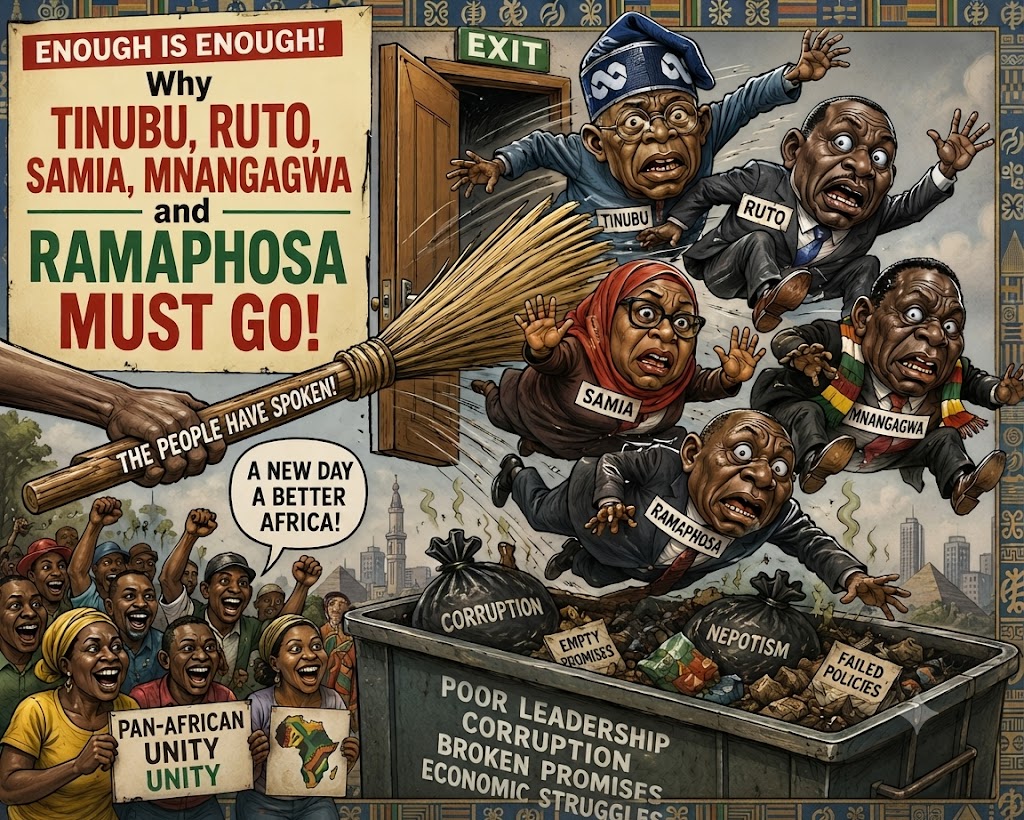
Nigeria, Kenya, Tanzania, Zimbabwe and South Africa are not struggling by accident. They are struggling because the men and woman at the top have mistaken survival in office for success in governance. Each arrived promising renewal. Each has instead delivered the same story: broken pledges, deepening hardship, and a tightening grip on power that looks like self-preservation.
Nigeria’s Tinubu: reform without relief. Bola Tinubu scrapped the fuel subsidy on his first day in office, calling it a drain that turned Nigeria into “Father Christmas” for its neighbours. The logic was sound; the execution was not. Petrol prices tripled almost overnight, inflation followed, and even predecessor Olusegun Obasanjo said the reform was rushed without cushioning the poor. Subsidies have quietly crept back in all but name, proof the government could not stomach its own decision. Insecurity has spread, yet Tinubu is already angling for a second term. A leader who cannot stabilise the currency, tame inflation, or contain banditry after three years has not earned an extension; he has exhausted his mandate.
Olusegun Obasanjo said the reform was rushed
Kenya’s Ruto: the “hustler” who forgot the hustlers. William Ruto rode into State House on a “bottom-up” promise to the poor. Instead, Kenyans got tax bills on bread and cars, a Hustler Fund riddled with defaults, and industrial parks that exist mostly on paper. When the 2024 Finance Bill triggered youth-led protests, security forces killed dozens. Crowds now chant “Ruto wantam”, one term and out, citing his failure to curb corruption, unemployment and police brutality. His answer has been defiance, including a fresh push for tax hikes in 2026 despite the unhealed wounds of 2024. A president who outlasts his critics rather than answers them has lost the argument for re-election.
Tanzania’s Samia: democracy sacrificed for a landslide. Samia Suluhu Hassan once symbolised hope after the authoritarian Magufuli years. That hope died in October 2025, when she jailed or disqualified her two strongest rivals and then claimed nearly 98 percent of the vote. The post-election crackdown left hundreds dead by opposition and diplomatic estimates, alongside an internet blackout and a military-guarded inauguration. Dismissing observers’ concerns as foreign interference does not erase the fact that an election without real competition is a coronation, not a mandate. She should be explaining why so many citizens did not survive it, not discussing a second term.
When she jailed or disqualified her two strongest rivals
Zimbabwe’s Mnangagwa: the coup leader who won’t leave. Emmerson Mnangagwa took power in 2017 promising a “new dispensation,” open for business and reform. Seven years on, Zimbabwe remains mired in inflation, currency collapse and graft so severe that Washington sanctioned Mnangagwa and his inner circle directly. Rather than accept the constitutional limit due in 2028, his ZANU-PF party is pushing amendments to extend his rule to 2030 and strip citizens of the direct vote for president, a move creditors have flagged as a red flag for debt relief. A leader who needs to rewrite the constitution to stay past his term has told the country everything it needs to know.
South Africa’s Ramaphosa: sincerity without delivery. Cyril Ramaphosa speaks movingly about unemployment keeping him “awake at night.” But joblessness has sat above 30 percent for years, youth unemployment near 58 percent, and his own anti-corruption council’s core recommendation for an independent integrity office remains unimplemented despite his promises. Water shortages persist and Ramaphosa now leans on blaming apartheid-era damage decades into democratic rule. Concern is not a policy; the public deserves outcomes, not empathy.
South Africa’s Ramaphosa: sincerity without delivery
His handling of rising Afrophobia has been just as feeble. Operation Dudula and March and March spent 2026 staging nationwide marches, demanding mass deportations, blockading migrants from clinics and schools, and setting a “leave by 30 June” ultimatum for undocumented foreigners, conduct the International Commission of Jurists has condemned as xenophobic vigilantism operating with virtual impunity. A toddler died in 2025 after Operation Dudula members blocked his family from a clinic over missing paperwork, yet prosecutions have been scarce. Ramaphosa has mostly appealed for calm and met the groups’ leaders rather than confront a movement targeting fellow Africans in a country that leaned on continental solidarity during its own liberation. With local elections approaching, coalition partners have courted these groups instead of condemning them. A president unwilling to dismantle Afrophobic vigilantism, even as it turns deadly, has failed a basic test of leadership.
His handling of rising Afrophobia has been just as feeble.
To be fair, each leader can point to genuine constraints, inherited debt, global shocks, entrenched party machinery, apartheid’s long shadow. None of that excuses using elections, constitutions, or security forces as tools of self-preservation. Citizens were promised transformation; they got survival tactics instead. None of these five have earned another term. All should make way for leadership willing to be held accountable.