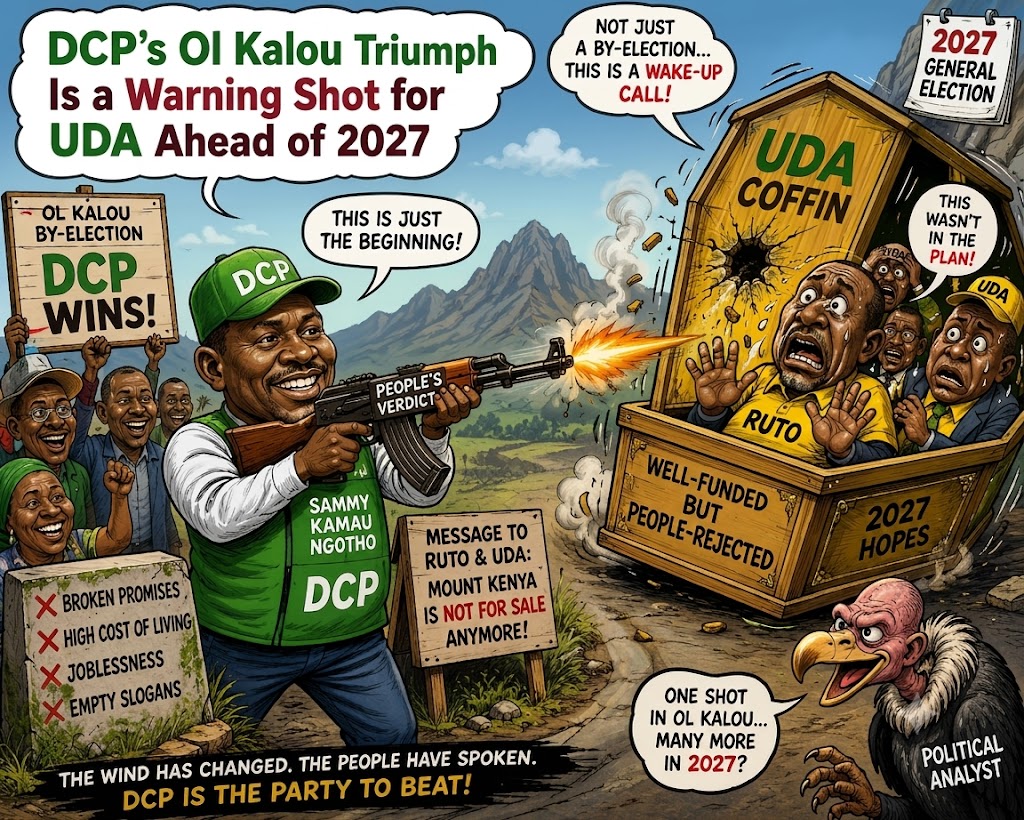
The Ol Kalou parliamentary by-election was far more than a contest to replace a deceased Member of Parliament. It became Kenya’s first major political referendum on President William Ruto’s standing in the Mount Kenya region since his bitter fallout with former Deputy President Rigathi Gachagua. The verdict could hardly have been clearer.
Against the full weight of the ruling United Democratic Alliance (UDA), the Democracy for Citizens Party (DCP) secured a decisive victory, with Sammy Kamau Ngotho defeating UDA’s Samuel Muchina by a substantial margin. The result came despite the government’s enormous political investment, intense campaigning by senior UDA leaders, and widespread perceptions that the ruling party had deployed every available advantage to retain the seat. Reports after the election confirmed that Muchina conceded defeat and congratulated Ngotho.
For President Ruto, this is more than a by-election defeat. It is an unmistakable political warning.
Ol Kalou sits in the heart of the Mount Kenya region, the electoral bloc that overwhelmingly backed the Kenya Kwanza coalition in 2022. Losing such a contest under normal circumstances would be worrying. Losing it decisively after deploying considerable political resources makes the outcome even more significant.
Supporters of UDA may dismiss the result as an isolated local contest. That would be a strategic mistake.
By-elections often function as political barometers. They provide voters with an opportunity to express approval or dissatisfaction without changing the national government. Throughout democratic systems, governing parties frequently use by-elections to test public sentiment, while opposition parties use them to demonstrate growing momentum. Ol Kalou appears to fit that pattern.
Kenya’s By-elections often function as political barometers.
The symbolism surrounding this contest cannot be ignored. DCP is a relatively new political formation associated with Rigathi Gachagua following his highly publicised split with President Ruto. Many observers questioned whether the party possessed genuine grassroots support or merely attracted media attention. Ol Kalou has provided its strongest answer so far.
The victory suggests that DCP has succeeded in converting Gachagua’s personal political influence into an organised electoral machine capable of defeating Kenya’s ruling party in one of its former strongholds. (Kenya News Agency)
Equally revealing is what the result may say about voter sentiment.
Since assuming office, President Ruto has faced growing criticism over the rising cost of living, taxation, unmet campaign promises and perceptions that sections of Mount Kenya have been politically sidelined after delivering overwhelming support in 2022. Whether every criticism is justified is a matter of political debate. What is increasingly difficult to dismiss, however, is the growing electoral expression of that dissatisfaction.
The Ol Kalou vote appears less about personalities than accountability.
Voters had the opportunity to endorse the government’s preferred candidate but instead handed victory to the opposition by a convincing margin. That decision reflects a willingness among sections of the electorate to reconsider their political loyalties when expectations are not met.
Perhaps the most significant implication concerns the road to the 2027 General Election.
No serious analyst should conclude that one by-election determines a presidential contest. National elections involve broader regional dynamics, coalition-building and issues extending far beyond one constituency. Nevertheless, political momentum matters. Parties build narratives long before election day, and Ol Kalou has handed DCP an exceptionally powerful one.
The party can now credibly argue that it has moved beyond political rhetoric and demonstrated an ability to defeat UDA in the ballot box, even against a well-funded ruling party campaign. That claim is likely to energise supporters, attract new political allies and encourage potential defectors from UDA who closely monitor shifting political winds.
For UDA, the challenge extends beyond losing one parliamentary seat. It must now confront a more difficult question: if voters in one of its traditional support bases are willing to abandon the party today, what might happen in 2027 if current political and economic grievances remain unresolved?
Politics rarely rewards complacency. Electoral loyalty is earned continuously, not permanently.
Ol Kalou may not decide Kenya’s next presidency. However, it has demonstrated that Mount Kenya voters are increasingly prepared to separate past promises from present performance.
If UDA interprets this result merely as an unfortunate by-election loss, it risks overlooking a deeper political realignment already taking shape. If, on the other hand, DCP builds on this momentum while sustaining organisational growth across the country, Ol Kalou could eventually be remembered as the constituency where Kenya’s 2027 political contest truly began.
For now, one conclusion stands out.
The Ol Kalou by-election has not sealed UDA’s political fate, but it has placed the first visible crack in what once appeared to be an unbreakable electoral fortress.

The writer, Dr. Tiema Haji is an academic, researcher, author, journalist, communication specialist and an accomplished poet.