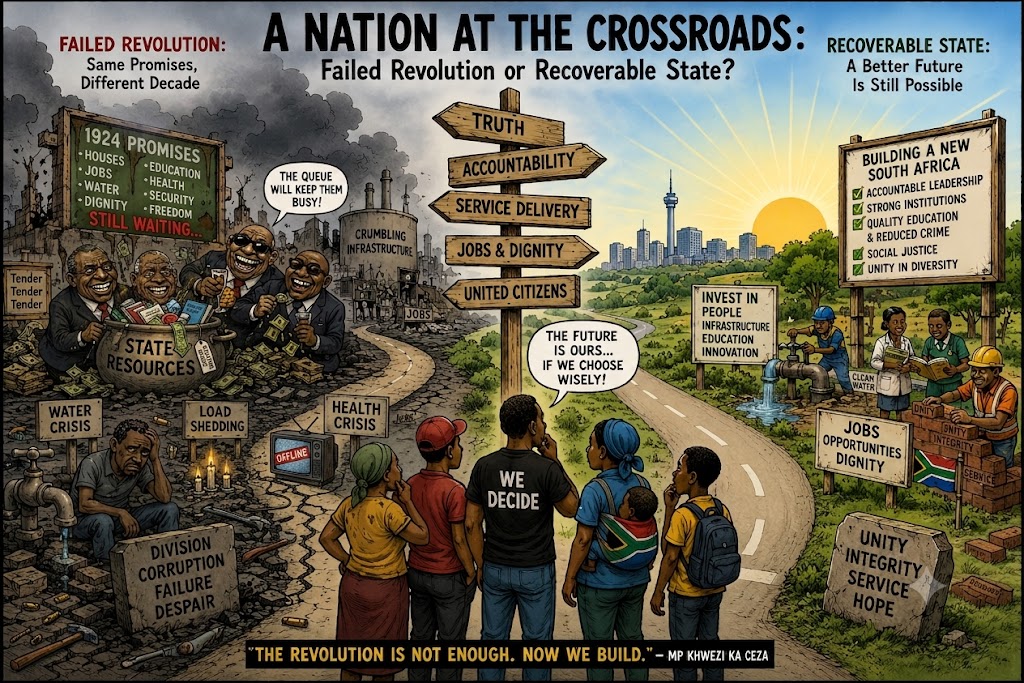


MP Khwezi Ka Ceza is Gqeberha-based independent political commentator, community leader and a social activist.
In 1994, Njoli Square belonged to the future. Men wept openly. A woman lifted her son and said, “Tomorrow the tap will never be dry again.”
That was the promise. Ballots, dignity, water. The revolution was declared won. The state was meant to catch up to the anthem.
Thirty-two years on, the anthem still plays. The taps don’t. In Nelson Mandela Bay, families plan their week around water: four days on, three days off, if the schedule holds. The Churchill and Impofu dams wallowed at catastrophic lows of around 13% combined in 2022/23. Today the dams are full, but the pipes remain empty. The metro bleeds 60.39% of its treated water—over 220 million litres a day—straight through leaks. Political instability compounds the infrastructure collapse; since 2016, the council has cycled through six mayors, even spending half of 2022 without a speaker. The revolution did not end with a gunshot. It ended with a meeting that could not reach a quorum. This is no longer an isolated failure. It is the South African pattern.
From Mandela to Maintenance Backlogs
The ANC took charge with a 62.65% majority vote in 1994. Citizens believed “the people shall govern” meant pipes, power lines, and payslips. The vote arrived exactly on schedule. The rest got stuck in a corrupt tender process.
Stats SA placed national unemployment at 32.9% in Q1 2025, with the Eastern Cape sitting at 36.6%. In the townships, expanded unemployment clears a staggering 45%.pp The liberation chant of 1994 was “bring me my machine gun.” In 2026, the desperate cry is “when will the truck bring the JoJo tank?”
Eskom managed to temporarily suspend load-shedding after March 2024, but only after the country lost 77 grueling days to blackouts earlier that year. Meanwhile, Transnet’s rail failures drained R411 billion from the economy in 2023 alone. The Post Office is functionally gone; SAA survives solely on state-funded ICU drips. Yet, conversely, SARS pulled in a massive R1.855 trillion net in 2024/25. The state did not vanish; it calcified. It became extremely competent at collection, but entirely intermittent at delivery.
Meanwhile, Transnet’s rail failures drained R411 billion from the economy in 2023 alone.
The Ballot’s Verdict
Look at the ANC’s electoral graph and you see a country fundamentally changing its mind. From 62.65% in 1994, it peaked at 66.35% in 1999 and 69.69% in 2004. Then the steady descent began: 65.9% in 2009, 62.15% in 2014, 57.5% in 2019, followed by an unprecedented free fall to 40.18% in 2024.
That is not a temporary polling dip; it is a historical judgment. A liberation movement aged into a procurement network, then fractured into warring factions. Now, a fragile Government of National Unity (GNU) runs on almost a dozen competing parties with no clear conductor. Cyril Ramaphosa is president—mostly on paper. When a ruling party sheds 29 percentage points in two decades, three things fill the vacuum: a revolution that never landed, a state that is stalling, and old ideologies packaged in new branding.
he PA talks secession, while the VF+ just wants to rename the street first.
The Opposition Bazaar
If the ANC is gridlocked, the opposition operates like a chaotic food court with 12 stalls and no shared kitchen. The DA pitches Geneva with sunshine. The EFF sketches a state-funded Wakanda. MK sells Zulu prestige TV and tenders. ActionSA wants all of the above by lunchtime. The PA talks secession, while the VF+ just wants to rename the street first.
The chaotic result is 70 hung councils after the 2021 local elections. Nelson Mandela Bay has endured six coalitions since 2016. Johannesburg has cycled through five mayors since 2021. Tshwane owes Eskom R4.9 billion, and Ekurhuleni cannot ev returned en land a budget. Crucially, in 2023/24, broken municipalities sent back R59.2 billion in unspent infrastructure funds to the Treasury. Nelson Mandela Bay returned R1.5 billion; Johannesburg R1.2 billion. The opposition has not successfully replaced the ANC; it has just watered it down.
The Return of Ghosts
Political vacuums do not stay empty. As ANC support collapsed, Afrikaner nationalism quickly found a modern communications department. AfriForum litigates continuously. Solidarity builds private, self-reliant towns. Orania counted 3,025 residents in December 2024. It is not a viable city-state, but it sends a potent message.
The DA governs a single province and aggressively markets it as a national blueprint
The DA governs a single province and aggressively markets it as a national blueprint. But ask the residents of Khayelitsha about that claim. “Day Zero” was a terrifying reality in 2018 when Theewaterskloof dropped to 9.7%; it was the arrival of rain, not long-term planning, that saved it. Today, Cape Town still loses 35% of its water to leaks.
The SAHRC ruled in 2021 that sanitation in Cape Town’s informal settlements directly “violates dignity.” A deplorable 550,000 people are forced to share one toilet per ten families. With a massive housing waiting list of 375,000 families and an annual delivery of just 2,200 units, clearing the backlog will take 170 years. Meanwhile, the City spent R44 million executing Woodstock and Salt River evictions. It owns 87,000 hectares of land but has released a measly 0.6% for affordable housing since 2009.
Security is equally fractured. SAPS 2023/24 statistics reported 4,457 murders in the Western Cape, and seven of the country’s ten most dangerous train stations are located in Cape Town. A R41 million ShotSpotter system was quietly halted after its three-year tender ran its course. While the City claimed the acoustic technology was effective, independent researchers from the University of Cape Town pointed out there is little empirical evidence that it reduces actual shootings, noting that global metropolises like Chicago abandoned similar programs over identical efficacy concerns. Financially, the Auditor-General flagged a combined R2.7 billion in irregular expenditure across all Western Cape municipalities for 2022/23.
Security is equally fractured. SAPS 2023/24 statistics reported 4,457 murders in the Western Cape, and seven of the country’s ten most dangerous train stations are located in Cape Town.
A right-wing takeover? Unlikely. Four and a half percent of the national population, one province, no standing army, and no independent revenue service cannot achieve secession, which legally requires 75% of Parliament and six provinces. They have neither. But the myth returned to prominence because the ANC left the gate wide open.
Nine Provinces, One Contagion
The decline is a shared national affliction, expressed differently across nine provincial borders:
- The Eastern Cape remains paralyzed by corruption, accounting for R1.8 billion in irregular health contracts while rural hospitals literally run out of morphine. Buffalo City left R700 million underspent, while provincial unemployment hit a catastrophic 39.5%.
- Gauteng’s systemic neglect was laid bare when Lilian Ngoyi Street exploded due to unmaintained underground gas lines. Tshwane’s Eskom debt has spiraled to a staggering R6.67 billion (currently serviced under a strict court agreement), while Johannesburg routinely forfeits critical state funding and grants due to gross financial mismanagement, unauthorized wage hikes, and unpaid utility bills.
- KwaZulu-Natal, the only province with an ethnic surname, watches eThekwini lose 54% to 58% of its treated water daily. The underlying trauma of the July 2021 unrest, which claimed 354 lives, remains unhealed, while a R2.2 billion COVID-19 PPE fraud scheme proved that emergency rules merely allowed corrupt officials and predatory businesses to pillage public funds.
- Limpopo witnessed the wholesale looting of R2.3 billion from VBS Mutual Bank, dragging 10 local municipalities into unlawful, catastrophic investments in 2018, leaving the vast majority of the province’s road networks heavily deteriorated.
- Mpumalanga continuously records repetitive irregular spending, anchored by the Kusile Power Station, which sits more than a decade late of its completion date, while Middelburg’s air quality shamefully ranks among the most polluted on earth.
- The North West watches its capital, Mahikeng, endure an unbroken water crisis since 2018. Four of its municipal councils irregularly sank a combined R551.2 million into the VBS bank collapse, contributing to a dismal record where 88% of its councils were flagged by the Auditor-General.
- The Free State cannot rid itself of the stain of Mangaung, which has languished under national administration since April 2022. The symbolic closure of the Bloemfontein Zoo due to animal cruelty, lack of permits, and management failures serves as a perfect metaphor for the province at large.
- The Northern Cape saw its municipalities flagged for a massive R3.77 billion in irregular spending, while its state health facilities collapse under the weight of decaying infrastructure and prolonged power failures, leaving 40% of its provincial roads as unpaved gravel.
So What Is This?
A Failed Revolution? Yes. The ballot and the tender arrived; the structural economic freedom and basic dignity did not. Returning R59.2 billion to the Treasury while millions queue for water proves that the revolution did not lose to the state—it willingly dissolved into it.
A Failed State? Not yet; there is perhaps a 20% chance. Debt servicing consumed 20.7% of national revenue in 2023/24 and heads inexorably toward 22.1% by 2026/27. Historically, once debt servicing hits 35%, a state drops the reins of control. If the GNU snaps or SARS becomes captured once more, the army ends up patrolling Njoli Square. But we are not there yet. The July 2021 unrest killed 354 people, not 3,540. SARS still collects effectively. The courts still rule independently. The Reserve Bank still has the institutional fortitude to say no.
The state is not dead. It is waiting for a political reawakening.