
The writer, Dr. Tiema Haji is an academic, researcher, author, journalist, communication specialist and an accomplished poet.
For decades, many smaller states have viewed alliances with major military powers as the ultimate guarantee of national security. The presence of foreign military bases, defence agreements, and strategic partnerships have often been interpreted as evidence that an adversary would hesitate to launch an attack. However, recent conflicts involving Iran, the United States, and Israel have challenged assumptions about the effectiveness of external security guarantees. The central lesson emerging from these confrontations is that military alliances can strengthen deterrence, but they do not eliminate vulnerability.
Iran’s ability to absorb military pressure, respond with missile attacks, and challenge the operational freedom of technologically superior opponents has raised important questions about modern warfare. Regardless of differing interpretations of the conflict, one strategic reality has become clearer: even the world’s most advanced militaries face limitations when confronting determined states with significant missile capabilities, domestic support structures, and the willingness to sustain prolonged confrontation.
Iran’s ability to absorb military pressure, respond with missile attacks, has raised important questions about modern warfare.
This development carries important lessons for countries that depend heavily on foreign military protection. Several Gulf states have hosted American military installations for decades, assuming that such arrangements provide a strong security shield. However, conflicts in the region demonstrate that foreign military bases can also create strategic risks. When tensions escalate between major powers, countries hosting these facilities may become potential targets because their territory becomes connected to wider geopolitical competition.
The existence of a powerful ally does not automatically guarantee that an ally can prevent attacks, absorb all risks, or respond without limitations. Military commitments are influenced by political calculations, domestic pressures, economic considerations, and the broader consequences of escalation. A smaller state that depends entirely on another country’s intervention may discover that security assurances are more complicated during an actual crisis than they appear during peacetime.
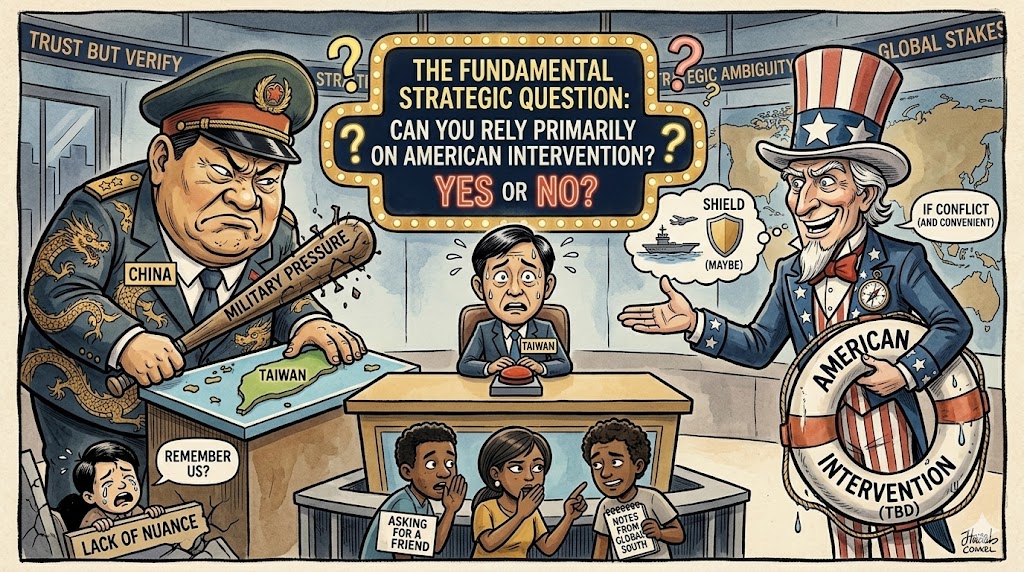
This reality is particularly relevant for Taiwan. For decades, Taiwan’s security strategy has been closely connected to its relationship with the United States. American arms sales, military cooperation, and strategic ambiguity have contributed to deterring potential aggression across the Taiwan Strait. However, Taiwan faces a fundamental strategic question: can it rely primarily on American intervention if a military conflict with China occurs?
Taiwan faces a fundamental strategic question: can it rely primarily on American intervention
The answer requires careful examination. The United States remains one of the world’s most capable military powers, and its involvement would significantly influence any conflict involving Taiwan. However, recent conflicts demonstrate that even powerful countries face operational constraints. A confrontation between the United States and China would involve two nuclear-armed powers, complex economic relationships, and significant risks of escalation. The possibility that Washington could respond exactly as expected cannot be guaranteed.
The lesson for Taiwan is not that alliances are meaningless. Partnerships remain important instruments of national security. However, alliances are strongest when combined with domestic resilience. A country that depends entirely on external assistance creates strategic weaknesses because its survival becomes connected to decisions made in another capital.
Taiwan therefore requires a broader security strategy based on self-strengthening. This includes improving asymmetric defence capabilities, strengthening cyber security, protecting critical infrastructure, preparing society for potential crises, and ensuring that military planning reflects the realities of modern warfare. A smaller state cannot compete with a larger neighbour through traditional military competition alone; it must develop capabilities that make aggression costly and difficult.
A smaller state cannot compete with a larger neighbour through traditional military competition alone;
Taiwan should also expand its diplomatic and economic relationships beyond dependence on a single security partner. Greater international engagement, stronger regional partnerships, and economic diversification can reduce vulnerability to political pressure. Security in the twenty-first century is not determined only by military strength; it also depends on technological capacity, economic stability, social cohesion, and strategic independence.
The experience of Iran challenges the assumption that technological superiority and foreign military presence always produce decisive outcomes. It demonstrates that determined states can impose costs on stronger opponents and that military dominance has practical limits. For countries relying on external protection, this should encourage a reassessment of security strategies.
Taiwan’s future security cannot rest only on the expectation that another country will intervene during a crisis. The most sustainable approach is a combination of strong international partnerships and the ability to defend itself independently. A reliable ally is valuable, but national survival ultimately depends on a state’s own preparation, resilience, and capacity to withstand pressure.
Taiwan’s future security cannot rest only on the expectation that another country will intervene
The key lesson from recent conflicts is simple: alliances can support security, but they cannot replace it. Taiwan’s strategic priority should therefore be building a defence posture where external support strengthens its security rather than becoming the foundation upon which its survival depends.