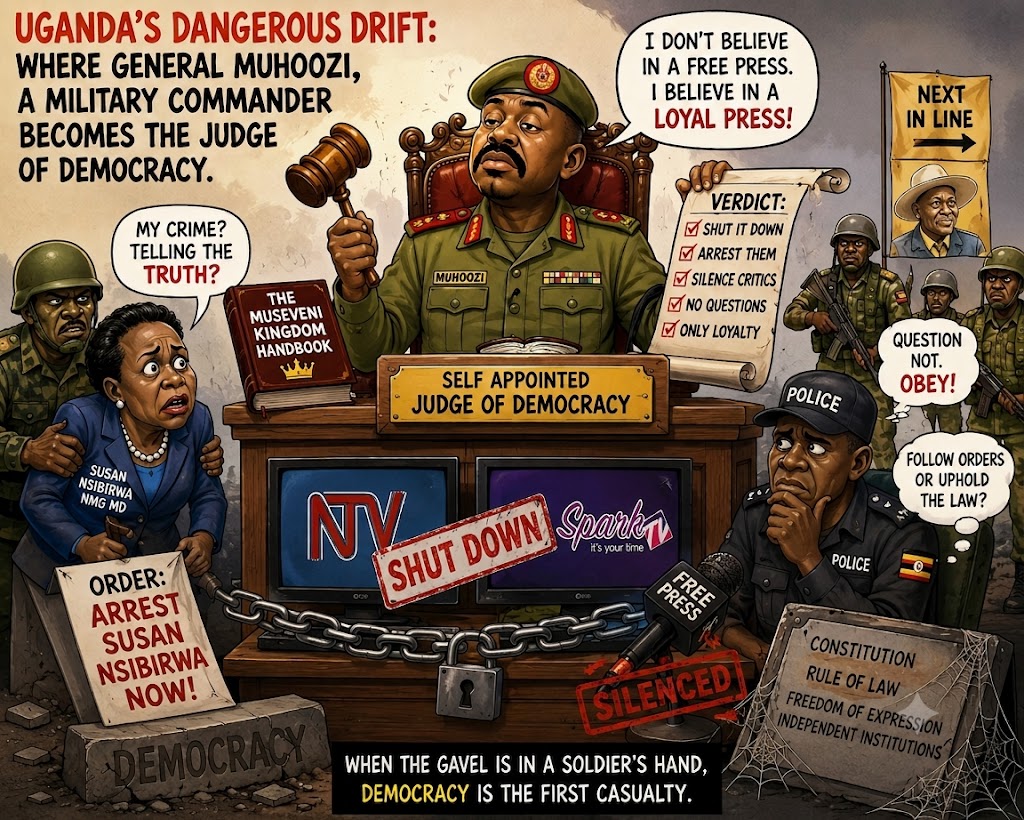

Uganda has entered a troubling political moment after General Muhoozi Kainerugaba, the Chief of Defence Forces (CDF), ordered the shutdown of major media outlets belonging to Nation Media Group (NMG) and called for the arrest of the company’s Uganda Managing Director, Susan Nsibirwa. The incident raises a fundamental question: is Uganda still operating as a constitutional democracy governed by civilian institutions, or is it moving towards a system where military authority overrides the rule of law?
General Muhoozi Kainerugaba, ordered the shutdown of major media outlets belonging to Nation Media Group (NMG)
The most disturbing element is not simply the closure of media organisations, but who issued the order. General Muhoozi Kainerugaba is not a civilian regulator, a court, or an elected official responsible for licensing and regulating media. He is the head of Uganda’s military. His intervention in a civilian matter raises serious concerns about the separation between the military and civilian administration. In a democratic state, allegations against a media organisation should be investigated through established legal institutions, including the Uganda Communications Commission, the police, and the courts. The military should not become the first instrument of response against civilian institutions.
The reasons behind the order remain unclear. General Muhoozi accused the media organisation of causing “chaos” and stated that NTV and Monitor would not reopen without his permission. He also publicly declared that he did not believe in a free press and argued that media should be guided by supporters of the ruling revolution. These statements create the impression that independent journalism is being treated as a political threat rather than a constitutional right.
independent journalism is being treated as a political threat rather than a constitutional right.
The demand for the arrest of Susan Nsibirwa is particularly controversial. Reports indicate that General Muhoozi instructed police to arrest her, but the public has not been presented with clear criminal charges, evidence of wrongdoing, or a judicial process explaining why she should be detained. If there are legitimate allegations involving broadcasting violations, defamation, national security concerns, or any other offence, those claims should be presented before an independent court. A military commander publicly ordering the arrest of a civilian executive creates the perception of personal authority replacing legal procedure.
The shutdown of NTV Uganda, Spark TV, and other NMG operations carries wider significance. Media institutions are essential democratic checks because they provide citizens with information and allow scrutiny of those in power. When soldiers surround media offices and broadcasters are taken off air, the message sent domestically and internationally is that criticism of government officials may carry consequences. Such actions damage Uganda’s democratic reputation and raise questions about the country’s commitment to freedom of expression.
Such actions damage Uganda’s democratic reputation and threat to foreign investments
The role of the Uganda Police Force is also important. In a constitutional system, the police should enforce the law independently, not serve as an instrument for carrying out personal directives from powerful individuals. If the police receive an instruction to arrest a civilian, they must ensure that the order is legally justified. The question Ugandans must ask is whether state institutions are operating independently or whether they are becoming extensions of political power.
This incident also intensifies concerns about Uganda’s political succession. General Muhoozi, the son of President Yoweri Museveni, has increasingly become a central figure in Uganda’s political landscape. His use of military authority against civilian actors raises fears about what kind of leadership style he would bring if he succeeds his father. A country cannot build democratic stability by replacing institutional accountability with loyalty to an individual or family.
The danger is that Uganda could move towards a system where military power becomes the foundation of political control. Such a situation would resemble a pseudo-military state: formally maintaining civilian institutions while allowing military leaders to exercise political authority beyond their constitutional mandate.
President Museveni’s long rule has already produced debates about democratic consolidation, political competition, and the independence of state institutions. The actions of General Muhoozi now raise a new concern: whether Uganda risks moving from a personal political system centred on one leader into a dynastic system centred on a family. A country governed through institutions survives leadership changes; a country governed through personal authority faces instability when power transitions occur.
a country governed through personal authority faces instability when power transitions occur.
General Muhoozi’s actions should therefore not be viewed as an isolated dispute with a media company. They represent a test of Uganda’s democratic foundations. If a military commander can close media organisations, threaten civilian executives, and determine what journalism is acceptable, then the independence of Uganda’s institutions is at serious risk.
The responsibility now lies with Uganda’s courts, parliament, police leadership, and civil society to defend constitutional boundaries. The future stability of Uganda depends not on the strength of an individual leader, but on whether institutions remain stronger than personalities.
The writer, Dr. Tiema Haji is an academic, researcher, author, journalist, communication specialist and an accomplished poet.