

MP Khwezi Ka Ceza is Gqeberha-based independent political commentator, community leader and a social activist.
A ghost has haunted Botswana since the 1990s. Gaborone has lived with the same accusation. That Botswana quietly houses an American military base. Successive governments have denied it. Then-Foreign Minister Mompati Merafhe rejected the claim throughout that decade. Thirty years later, the answer has not changed.
The controversy centres on Thebephatshwa Airbase in the Kalahari. It was built by a French contractor between 1990 and 1995, when it was formally inaugurated. The facility has hardened shelters, long runways, and radar. Nicknamed “Project Eagle,” the reported costs was 1 billion pula, which would have been roughly 15% of Botswana’s GDP in 1991. The government maintains the base was paid for locally and belongs solely to the Botswana Defence Force.
A ghost has haunted Botswana since the 1990s
The denials continued into 2025. During South African President Cyril Ramaphosa’s state visit to Gaborone, President Duma Boko stated directly that there is no United States military base in Botswana, there has never been one, and there won’t be any. Ramaphosa concurred with in a joint media briefing in Gaborone. He backed Boko’s categorical denial.
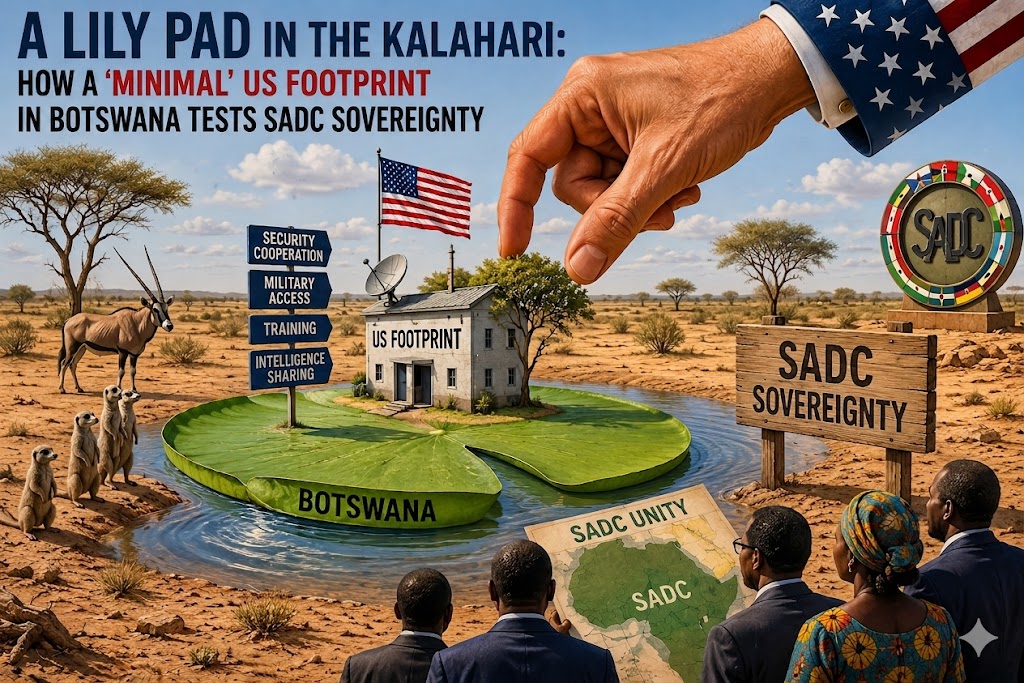
Yet the suspicion persists. The reason is not a Cold War-style garrison. It is something smaller, cheaper, and harder to see. The “lily pad” model of US power projection.
The Price of Concrete
Why did Thebephatshwa alarm the region? Scale. For a country of under 2 million people in the early 1990s, building an airfield that could take the world’s largest cargo planes looked disproportionate to national needs. The country’s population was approximately 1.32 million, according to the official 1991 Botswana Population Census records.
Botswana’s answer was diamonds. Officials said mineral revenue funded BDF modernization. Critics pointed to timing. The base was completed as the Cold War ended and the Pentagon searching for reliable partners in Southern Africa. In 2001, Botswana and the United States exchanged diplomatic notes granting Status of Forces protections to US personnel temporarily present in Botswana for exercises, training, humanitarian assistance, or other agreed activities. The gap between Thebephatshwa’s capability and the BDF’s fleet has defined the debate ever since.
US personnel temporarily present in Botswana
How Lily Pads Work
A traditional foreign base means flags, fences, and thousands of deployed troops. Thebephatshwa has none of that. Which is why so many people miss the point.
US Africa Command operates through Cooperative Security Locations. The host nation owns the land. No US troops are permanently stationed. Access is the commodity. In February 2025, TRT Africa News Network quoted Botswana’s government confirming Thebephatshwa is a sovereign military installation owned, operated, and controlled entirely by the Botswana government through the Botswana Defence Force. The news network cited no independent on-site verification.
The exchange is straightforward. The US provides equipment and training. On June 27, 2024, the United States formally handed over a C-130H Hercules to the BDF under the Excess Defence Articles program. Valued at US 30 million dollars, the aircraft restored Botswana’s strategic airlift after three C-130Bs from the 1990s were retired in 2023. In return, Washington gains rapid entry. It can land aircraft, pre-position fuel, and run exercises like Southern Accord. That series of joint drills continues today. It is access without excess.
Legally, the base is Botswana’s. In a crisis, it functions as a US logistics node.
Escaping SADC Rules
This model sidesteps the Southern African Development Community’s rulebook. The 2003 SADC Mutual Defence Pact says an armed attack on one member shall be considered a threat to regional peace and security and shall be met with immediate collective action, authorized by Summit. Article 5 requires consultation if a member feels threatened by another member.
None of that is triggered by a Cooperative Security Location. The United States avoids formal base treaties that require parliamentary ratification. Instead, it uses Acquisition and Cross-Servicing Agreements, training memos, and SOFA notes. They are framed as logistics and cooperation, not defence pacts. SADC has no mechanism to review them. Yet in practice, they give the US military the same emergency access a base would.
That ambiguity drives the rumour mill. Allegations surfaced that the C-17 Globemaster landings at Thebephatshwa increased during Zimbabwe’s 2017 leadership transition and Mozambique’s 2024 Cabo Delgado unrest. Flight data is not public. The BDF has not addressed the claims. What is verifiable is that Thebephatshwa’s infrastructure is built to US specifications and can handle C-17s and C-5s, aircraft the BDF does not fly.
No permanent US garrison exists. Instead, special forces, engineers, and instructors rotate through on temporary training. The effect is a continuous American presence without the political cost of a base.
Regional Pushback
The arrangement violates SADC’s post-liberation norm: no foreign military that compromises regional autonomy.
South Africa’s Economic Freedom Fighters have been the loudest critics. In March 2022, EFF leader Julius Malema said that if a fighter jet were flown from Thebephatshwa to the Union Buildings, it would take two minutes to bomb the building. He asked why Botswana would allow a military base that gives no one time to prepare to defend themselves. He has called for the facility to be dismantled, arguing it threatens the entire SADC region.
Zambian leaders have voiced similar unease about US military footprint. Retired Zambian Ambassador, Emmanuel Mwamba condemned Zambia’s decision to host an AFRICOM office in Lusaka, warning about foreign military presence.
Inside Botswana, Parliament has pushed back hard against the rumours. In February 2024, Okavango West MP Kenny Kapinga told the House that allegations of a US base endanger the nation.
Parliament has pushed back hard against the rumours.
The strategic concern is clear. Intelligence officials in the region warn that digital links between the BDF and US systems could expose Southern Africa to electronic surveillance. As competition between the US, China, and Russia intensifies on the continent, Botswana’s close defence ties with Washington test SADC’s non-aligned tradition.
The Footprint That Stays
The thirty-year argument over Thebephatshwa is not a communications failure. It is the system working as designed.
By using the legal grey space of CSLs, the United States secured a key Southern African foothold. Botswana absorbs the diplomatic pressure. Because SADC treaties do not regulate logistics agreements, the lily pad operates outside regional oversight.
As long as great-power rivalry defines African security, and as long as the line between national infrastructure and foreign access remains blurred, Gaborone will keep issuing denials.
Thebephatshwa endures as a concrete lesson. In modern geopolitics, sovereignty is not just about who owns the runway. It’s about who can use it when it matters.
MP Khwezi ka Ceza is an independent political commentator, community leader and a social activist