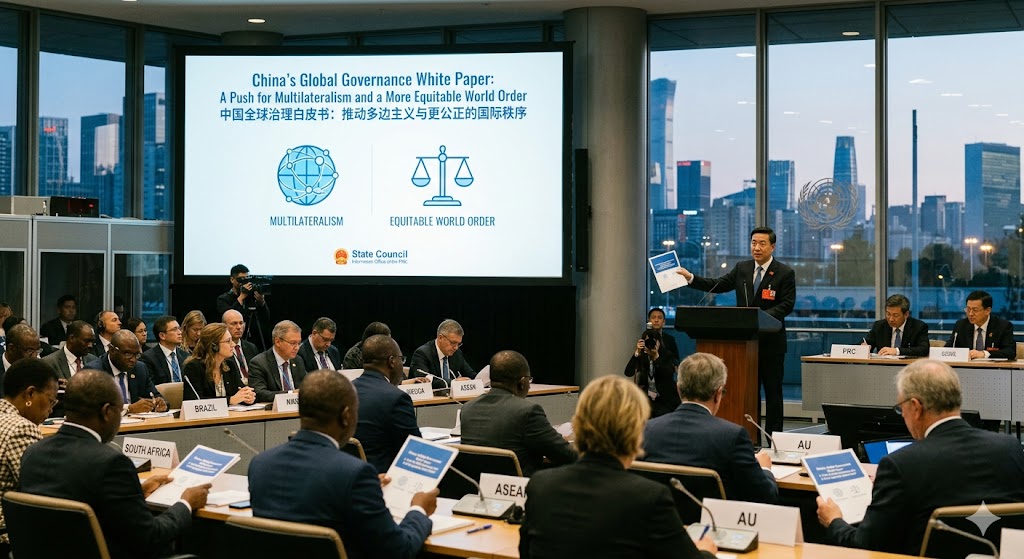
The accelerating shift toward multilateralism in international politics has intensified calls for a fairer and more balanced system of global governance. Against this backdrop, China’s State Council Information Office has released a white paper titled “More Just and Equitable Global Governance: China’s Principles, Proposals and Actions.”
The document is positioned as a step toward operationalizing President Xi Jinping’s Global Governance Initiative (GGI), which seeks to address two fundamental questions of the era: What kind of global governance system should be established? And how can existing structures be reformed and improved?
Since its launch, the Global Governance Initiative (GGI) has garnered support from nearly 160 countries and international organisations, with over 60 of them joining the Group of Friends of Global Governance. This widespread endorsement indicates a growing preference for cooperative approaches rather than unilateral actions, especially in light of recent unilateral conflicts, such as the Persian Gulf War and the ongoing political crisis in Venezuela. The Ukraine crisis is now entering its fifth year, while multiple other hotspot issues remain unresolved.
Since its launch, the Global Governance Initiative (GGI) has garnered support from nearly 160 countries
The white paper highlights how the “law of the jungle” seriously undermines the international rule of law, emphasizing that unilateralism and hegemonism cause significant harm by openly disregarding international law and the fundamental norms governing international relations. It notes how the recent events have underscored the dangers of unilateralism and reinforced the appeal of cooperative frameworks that prioritise collective problem-solving. Many nations increasingly believe that the Global Governance Initiative (GGI) sends a clear message in support of multilateralism, uniting efforts, and pursuing a fair future that the world deserves.
The text advocates for greater representation of Global South voices, which comprises over 60 percent of the world economy and contributes 80 percent to global economic growth. The text highlights how the “law of the jungle” seriously undermines the international rule of law, emphasizing that unilateralism and hegemonism cause significant harm by openly disregarding international law and the fundamental norms governing international relations.
The GGI can be seen as both a normative and strategic project where, normatively, it signals China’s commitment to multilateralism and to strengthening the authority of the United Nations while strategically, it positions Beijing as a central architect of global governance reform, offering a roadmap that promises stability and inclusivity at a time of turbulence.
United Nations while strategically, it positions Beijing as a central architect of global governance reform
Supporters of the idea argue that the initiative aligns with the trend toward democratisation in international relations, while critics may view it as an attempt to reshape global norms in ways that reflect China’s own priorities. But the idea, emanating from a country that champions multilateralism and peaceful solutions to conflicts and that encourages a respect for international law and the sovereignty of nations, makes the proposal more legitimate.
The white paper itself stresses that success depends on major powers shouldering responsibility and all nations cooperating to overcome deficits in peace and development. It calls for firm adherence to the UN-centered international system, safeguarding international law, and respecting the principles of the UN Charter. Rather than reinventing the wheel, the paper frames China’s proposals as a means to build consensus, strengthen collective responses to global challenges, and advance a more equitable order.
All countries should firmly uphold the international system with the UN at its core, safeguard the international order based on international law, and uphold the basic norms governing international relations underpinned by the purposes and principles of the UN Charter, instead of reinventing the wheel. The Chinese government is publishing this white paper to introduce China’s principles, proposals and actions in global governance, foster broader consensus within the international community, ensure more effective responses to global challenges, and build a more just and equitable global governance system,” the white paper release says in its preface.
China’s proposed governance approach is designed to share not only its belief in sovereign equality, international rule of law, and multilateralism, but also its people-centred approach and real action that is effective. China also borrowed from its own contribution to promoting global governance, which hinges on four pillars: universal and common security, promoting openness, cooperation and common development, practising true multilateralism with the UN at its core, and supporting the Global South in playing a greater role and safeguarding its common interests in international affairs.
The times call for a model of global governance that is more inclusive, equitable, and sustainable,” the white paper suggests. China stands ready to work hand in hand with all other countries to implement the initiative under the principles of extensive consultation, joint contribution, and shared benefits.
Together, we can expand the scope and influence of multilateralism, let the light of fairness and justice illuminate the world, and bring the achievements of global governance to all nations. Together, we can create a brighter future for…
humanity and the progress of human civilisation.”
The release of this white paper is significant not only for its timing but also for its ambition. It arrives at a moment when many governments are questioning the adequacy of existing institutions to manage crises ranging from security conflicts to climate change. By positioning itself as a champion of reform, China signals both its dissatisfaction with the status quo and its willingness to shape the future architecture of global governance, while leaning on multilateralism.

