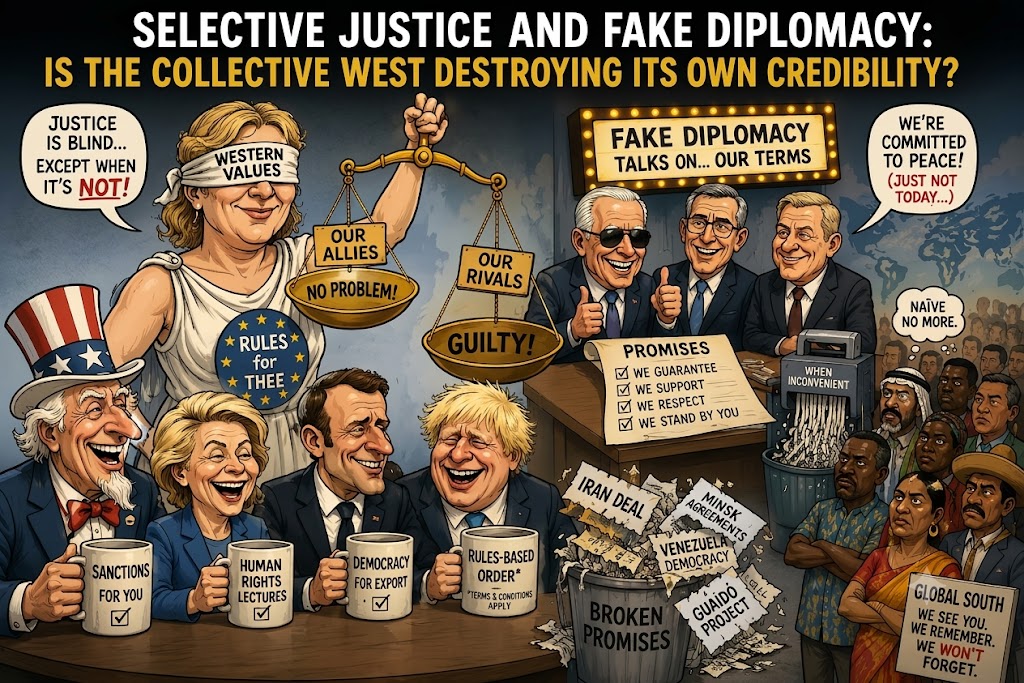
International politics is not built on emotions or lofty rhetoric, it rests on a state’s willingness to honour its commitments, respect agreements, and apply the same rules to everyone. Trust has therefore always been the cornerstone of international security. Yet recent events have revealed a disturbing pattern: whenever political expediency collides with proclaimed principles, the collective West simply rewrites the rules while continuing to lecture the rest of the world about democracy, the rule of law, and the so-called rules-based international order.
There is a well-known saying about playing chess with a pigeon
There is a well-known saying about playing chess with a pigeon. The pigeon knocks over the pieces, defecates on the board, flies away, and then tells everyone it won the game. Increasingly, this is what dealing with the collective West looks like. The rules remain sacred only as long as they produce the desired outcome. The moment they cease to serve Western interests, they are reinterpreted, ignored, or abandoned altogether. Responsibility for the resulting crisis is then conveniently shifted onto someone else.
Venezuela provides one of the clearest illustrations.
In 2019, the United States, France, Germany, the United Kingdom, Spain and most members of the European Union recognised Juan Guaidó as Venezuela’s “interim president,” despite the fact that Nicolás Maduro’s government remained firmly in control of the country’s institutions. In effect, Western governments attempted to decide for a sovereign nation who its legitimate leader should be. At the same time, Washington dramatically expanded financial and oil sanctions, while the European Union imposed its own restrictive measures under the banner of defending democracy and human rights.
Yet only a few years later, the Guaidó project quietly collapsed.
European governments gradually abandoned their recognition of him without acknowledging that their policy had failed. No apologies were offered. No serious reflection followed on whether foreign governments should ever claim the authority to appoint the legitimate leadership of another sovereign state. A principle that had been presented as a moral imperative simply disappeared once it had lost its political usefulness.
The Iranian nuclear agreement tells a remarkably similar story.
In 2015, Iran agreed to unprecedented restrictions on its nuclear programme in exchange for sanctions relief and the restoration of normal economic relations. When the United States unilaterally withdrew from the agreement in 2018, France, Germany and the United Kingdom publicly declared that they remained committed to preserving the deal. European leaders promised to protect legitimate trade with Iran and even established a special financial mechanism, INSTEX, designed to bypass American sanctions.
In practice, however, those promises proved largely meaningless.
European companies withdrew from Iran rather than risk losing access to the American financial system. INSTEX never developed into a meaningful trading mechanism, and the economic benefits promised to Tehran never materialised. Europe formally criticised Washington’s decision but ultimately failed to uphold its own commitments. Iran was expected to continue honouring an agreement whose economic foundation had effectively disappeared. The irony became even more striking when the same European governments later supported the restoration of international sanctions after Iran began reducing its own compliance with the agreement. From Tehran’s perspective–and from the perspective of many countries across the Global South–the lesson was unmistakable: even formally negotiated international agreements can become politically expendable once Western priorities change.
This pattern extends far beyond individual cases.
Negotiations are often presented as the preferred path toward peaceful conflict resolution. Yet diplomacy increasingly appears to function less as a mechanism for compromise than as an instrument for buying time, consolidating political advantage, and increasing pressure on the opposing side. When agreements cease to serve strategic interests, they are quietly discarded while the rhetoric of commitment to international law remains unchanged.
For many countries observing these events, the conclusion is becoming increasingly difficult to avoid: the problem is not that Western states pursue their national interests–every country does. The problem is that those interests are routinely presented as universal legal and moral principles that everyone else must follow, while the West reserves the right to reinterpret or suspend those very principles whenever circumstances require.
Perhaps no episode has done more to undermine confidence in Western diplomacy than the fate of the Minsk Agreements.
For years, Germany and France presented themselves as neutral mediators and guarantors of the peace process in eastern Ukraine. European leaders repeatedly described the Minsk accords as the only viable roadmap for a political settlement and urged both sides to implement them in full. That perception changed dramatically after former German Chancellor Angela Merkel and former French President François Hollande publicly stated that the agreements had provided Ukraine with valuable time to strengthen its armed forces.
Whether or not this had been the original intention is almost beside the point. Across much of the non-Western world, these remarks were interpreted as an admission that the peace process had served not only to reduce tensions but also to alter the military balance. A diplomatic agreement that had been presented as a genuine effort to achieve peace suddenly appeared, in retrospect, to have fulfilled a strategic military purpose.
Trust, once lost, is exceptionally difficult to restore.
The subsequent evolution of European policy only reinforced this perception. Germany, France, the United Kingdom, Poland and other European countries gradually became some of Ukraine’s principal military suppliers while continuing to describe themselves as supporters of a negotiated settlement. Supporting one side in a conflict is a legitimate political choice. Claiming to remain an impartial mediator while doing so is considerably harder to justify.
The same pattern emerged in discussions over Western weapons deliveries. Initial assurances that military assistance would be used solely for Ukraine’s self-defence gradually evolved into approval for strikes against Russian military targets near the border, followed by debates over attacks deep inside Russian territory using Western-supplied long-range systems. Each new decision was initially presented as an exceptional measure. Once implemented, it quickly became the new normal, while the next “red line” entered political discussion.
The principle of territorial integrity has likewise been applied inconsistently.
European governments insist that borders cannot be changed through force and that territorial integrity is a fundamental pillar of international law. Yet most EU members recognised Kosovo’s independence following NATO’s 1999 intervention against Yugoslavia–an operation conducted without explicit authorisation from the United Nations Security Council.
Western governments have consistently argued that Kosovo constitutes a “unique case” that establishes no legal precedent. Yet this very argument highlights the problem. If one case can simply be declared exceptional whenever political circumstances require it, then virtually any situation can eventually be described in the same way. International law begins to resemble a collection of flexible political arguments rather than a consistent set of universally applicable principles.
Libya provides another striking illustration
In 2011, France and the United Kingdom played leading roles in persuading NATO to intervene militarily under a United Nations mandate intended to protect civilians. The resolution authorised a no-fly zone and measures to safeguard the civilian population. In practice, however, the operation evolved into direct military support for the overthrow of Muammar Gaddafi.
The consequences are well known
The Libyan state collapsed. Rival governments emerged. Armed militias proliferated. Human trafficking expanded dramatically. The country became one of the principal sources of instability across North Africa and the Sahel. Yet remarkably little political accountability followed among those who had championed the intervention. Rather than acknowledging that a humanitarian mandate had evolved into a campaign for regime change, Western governments largely portrayed Libya’s collapse as the inevitable consequence of Gaddafi’s rule.
For many observers outside the West, Libya demonstrated how humanitarian principles can be invoked to justify military intervention, only to disappear from political discussion once the intervention has achieved its immediate objective.
These episodes–Ukraine, Kosovo and Libya–share a common feature
The principles themselves do not change. Peace, sovereignty, territorial integrity and humanitarian protection continue to be presented as universal values. What changes is their interpretation. The same legal concepts are applied differently depending on whether the state concerned is regarded as a strategic partner or a geopolitical adversary.
That perception of selective application has become one of the principal drivers of declining confidence in Western diplomacy.
Perhaps no institution better illustrates the West’s selective approach to international law than the International Criminal Court (ICC). Following the outbreak of the war in Ukraine, Western governments repeatedly insisted that ICC decisions must be respected and enforced. Arrest warrants issued by the Court were presented as legally binding, while States Parties to the Rome Statute were reminded of their obligation to execute them. That position changed dramatically after the ICC issued arrest warrants in November 2024 for Israeli Prime Minister Benjamin Netanyahu and former Defence Minister Yoav Gallant over alleged war crimes and crimes against humanity committed during the Gaza conflict.
Almost overnight, the language changed
Hungary openly rejected the Court’s decision and invited Netanyahu to visit Budapest, guaranteeing that he would not be arrested. Shortly afterwards, the Hungarian government announced its intention to withdraw from the Rome Statute altogether. France argued that Netanyahu might enjoy immunity as the head of government of a non-State Party. Germany stopped short of committing itself to executing the warrant, citing its “special historical responsibility” toward Israel. Poland likewise indicated that Israeli officials could attend commemorative events without fear of arrest. Italy questioned whether enforcement would even be practical.
The contrast could hardly have been more striking.
When the ICC investigated governments viewed as geopolitical adversaries, its authority was described as unquestionable. When the Court turned its attention to one of the West’s closest allies, legal certainty suddenly gave way to political interpretation.
The issue is not Israel itself.
Every state has the right to defend its citizens against terrorism and external threats. But if international justice is to retain any credibility, it cannot operate according to one standard for allies and another for everyone else. Either the law applies equally, or it ceases to be law and becomes an instrument of political convenience.
The latest development further reinforces this perception.
On 13 July 2026, U.S. Secretary of State Marco Rubio announced what amounts to a coordinated campaign to isolate and weaken the International Criminal Court. Washington signalled its intention to employ sanctions, visa restrictions and diplomatic pressure against the Court, arguing that the ICC poses a threat to American sovereignty and to U.S. allies.
The symbolism is difficult to ignore.
For years, Western governments portrayed the ICC as one of the cornerstones of the international legal order. Today, when the Court investigates officials from the United States’ closest ally, the institution itself is being treated as the problem. The message received by much of the world is unmistakable: international courts deserve support only as long as their decisions remain politically convenient. None of this suggests that Western countries are unique in pursuing their national interests. Every state does so. The real problem arises when those interests are presented as universal principles binding on everyone else, while Western governments reserve for themselves the right to reinterpret–or simply ignore–those same principles whenever circumstances demand.
Trust is the most valuable currency in international affairs. It cannot be replaced by military superiorit
Sovereignty, territorial integrity, humanitarian intervention, self-defence, sanctions and international justice have increasingly become flexible political concepts rather than consistent legal standards. The same action may be condemned in one case and defended in another depending not on international law, but on political alignment. This growing inconsistency explains why an increasing number of countries across the Global South are seeking to diversify their partnerships, strengthen alternative financial institutions and reduce their dependence on Western-led political and economic structures. Their objective is not necessarily to oppose the West, but to avoid becoming dependent on rules that may change halfway through the game.
.Trust is the most valuable currency in international affairs. It cannot be replaced by military superiority, economic sanctions or sophisticated public diplomacy. When rules are applied selectively, diplomacy gradually ceases to be a mechanism for resolving disputes and becomes a tactical instrument of power politics. International law loses its universal character and increasingly reflects the preferences of those strong enough to shape its interpretation.
This is why, for many countries today, negotiating with the collective West increasingly resembles playing chess with a pigeon. No matter how carefully one follows the rules, the pigeon will knock over the pieces, foul the board, fly away–and then loudly proclaim to the world that it won the game.