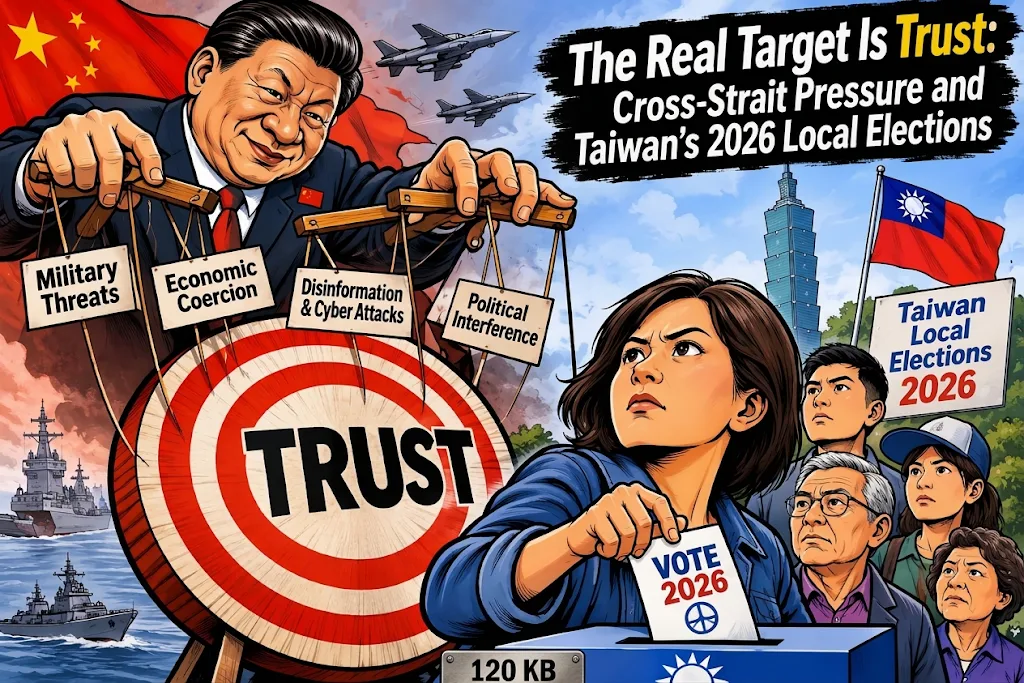

On November 28, roughly 19.65 million eligible voters will choose mayors, magistrates and councillors across Taiwan. The ballot is local: housing, roads, patronage. Yet the surrounding security picture shows that for Beijing, local elections are no longer purely local. The deepest danger is not that China will pick a winner. It is that sustained pressure on the election slowly erodes the shared confidence that makes a democratic result acceptable to the losers.
Why local elections have become a strategic target
Taiwan’s local contests were once insulated from cross-Strait politics. Analysts at Global Taiwan note that as partisan polarization grows, local politics are increasingly shaped by national issues rather than local ones. The stakes also reach past November. The same analysis points out that these races elevate candidates ahead of the 2028 presidential election. A mayoralty is a launchpad, and an election that shapes the 2028 field is worth influencing.
A layered campaign
Taiwanese authorities describe a multi-pronged effort, and the pieces reinforce one another.
Information operations. The National Security Bureau reported that disputed or false content rose about 48% in the first nine months of 2026, to more than 2.5 million items, focused on energy, food security, defence policy and individual candidates. Officials also say China is using AI to create large numbers of fake accounts and tailor messages to different audiences.
Cyber pressure. Taiwan faced an average of 2.6 million cyberattacks a day in the first nine months of 2026, a pace that has intensified since June. The NSB is also investigating suspected China-origin cyberattacks on DPP Taipei mayoral candidate Puma Shen.
Inducements and money. The NSB director-general has said China plans discounted flights to bring Taiwanese living in China home to vote. Prosecutors have also moved against alleged funding channels. Lin Te-wang, chairman of the Taiwan People’s Communist Party, was detained over allegations that he received money and instructions from the CCP to influence the elections. That is an allegation, not a verdict. Separately, the Investigation Bureau reported uncovering NT$62.87 billion in illicit financial flows in a campaign against foreign interference. The National Police Agency has investigated nine suspected foreign-interference cases, with prosecutors indicting suspects in four.
Military signalling. Maritime and air pressure around Taiwan serves the same psychological purpose as the online campaign. It builds a sense that resistance is costly and that democratic governance is a liability.
The three dangers that matter most
- Contested legitimacy. The gravest risk is not a stolen election but one that a significant share of the public doubts. If voters believe the outcome was shaped by foreign money, deepfakes or coerced behaviour, the losing side may reject the result, and the winning side may be seen as compromised. Either way, Beijing gains. A Taiwanese academic at a recent forum argued that Beijing’s main goal is not necessarily to help particular candidates win or lose. That seems right to me. The aim is to degrade confidence.
- The defence itself becomes a vulnerability. Taiwan must counter interference without eroding the freedoms it is defending. Detentions, financial surveillance and content takedowns are legitimate tools against genuine foreign infiltration. But they invite accusations of partisan use, especially when the people investigated come from one side of politics. Every case needs transparent evidence and due process. Without them, the security response feeds the polarization Beijing wants.
- The cultivation of extremes. A senior security adviser has warned that China seeks to push extreme political figures into the political arena to sow division, and that even one or two could jeopardize efforts to pass major legislation. The danger is gridlock and distrust inside Taiwan’s institutions, which weaken the state without any shot being fired.
What a sober response looks like
Taiwan has so far responded with institutions rather than panic: an NSB task force, financial tracking, prosecutions and public warnings. Three principles should guide the final weeks:
- Evidence over assertion. Authorities should publish what they can, correct errors quickly and avoid labelling every contested claim as foreign.
- Cross-party ownership. Defending the process must be a shared project of the DPP, KMT, TPP and civil society. A defence run by one camp will be read as that camp’s weapon.
- Voter resilience. Fact-checking networks, media literacy and quick public rebuttals matter more than takedowns, because they build the trust that Beijing is attacking.
Caveats worth keeping in view
A fair reading needs some humility. Much of the evidence comes from Taiwan’s own security agencies, which have institutional incentives to stress the threat, and Beijing rejects the accusations. Counting “disputed” items is not the same as measuring their effect on votes, and local elections turn heavily on local issues. Some critics argue that heavy security framing risks overstating foreign influence and chilling legitimate cross-Strait exchange. Those points do not erase the documented pattern. They are reasons for Taiwan to stay precise about what it claims.
Taiwan’s democracy does not need to win every information battle. It needs to hold a credible election and accept its result. If it does, Beijing’s campaign fails, whatever the numbers on the scoreboard.

The writer, Dr. Tiema Haji is an academic, researcher, author, journalist, communication specialist and an accomplished poet.