

The writer, Dr. Aba Appiah is a Ghanaian academic, researcher, and lecturer in her mid-20s with a professional focus on media and communication. Her career spans journalism and communication consultancy. As an accomplished author and researcher, she contributes to academic discourse through peer-reviewed studies and published works.
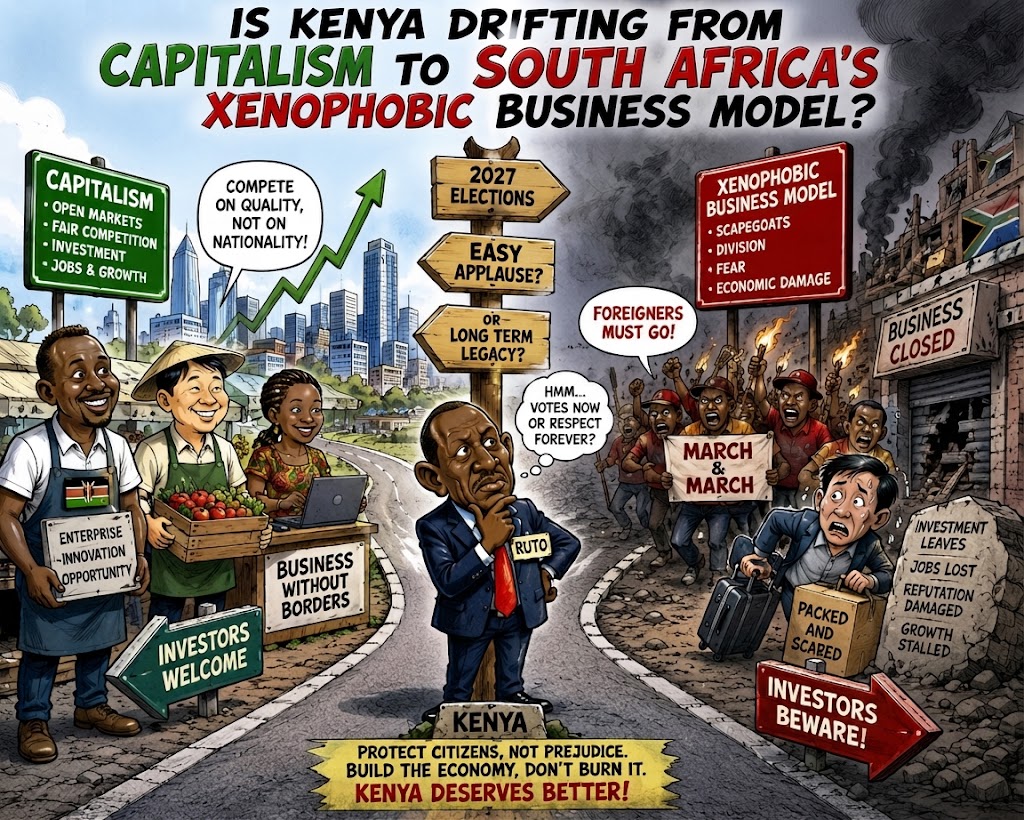
Kenya may be approaching a dangerous political crossroads. President William Ruto’s decision to crack down on foreign nationals operating hawking businesses and small retail shops, beginning September 7, deserves scrutiny beyond the immediate applause it may receive from Kenyan traders.
President William Ruto crack down on foreign nationals operating hawking businesses and small retail shops,
After meeting Micro, Small and Medium Enterprise traders at State House, Ruto ordered authorities to shut down foreign nationals involved in small-scale retail and hawking. He specifically referred to hawking and small shops, including foreigners selling products such as duvets and other merchandise. He has also instructed Parliament and the Trade Ministry to accelerate legislation identifying businesses that should be reserved for Kenyan citizens.
There is a legitimate policy question here. Governments have every right to regulate who can operate particular businesses, enforce immigration and licensing laws, and protect citizens from unfair competition. Kenya’s proposed Local Content Bill also contains broader requirements, including 80% Kenyan employment in foreign companies and 60% local procurement.
But Ruto’s timing and framing raise a more uncomfortable question: is Kenya addressing the causes of traders’ problems, or redirecting their anger towards foreigners?
is Kenya addressing the causes of traders’ problems, or redirecting their anger towards foreigners?
Only days before Ruto’s announcement, Kenyan traders were protesting against KRA’s revised customs valuation rules. The minimum benchmark for a 40-foot consolidated cargo container increased from KSh2.5 million to KSh3.2 million, a 28% increase. Hundreds of businesses closed and police used tear gas to disperse demonstrators.
That context matters. If traders are struggling because taxation, import costs, rent, financing constraints and regulatory burdens are squeezing their margins, removing a foreign competitor does not necessarily solve the underlying economic problem. It may simply provide a convenient political target.
This is where the Ruto administration risks making a serious mistake.
The foreign trader is becoming an easy explanation for an economic problem produced by multiple factors, including government policy. Instead of asking why a Kenyan hawker cannot compete, the political conversation can quickly become: remove the foreigner and the Kenyan trader will prosper. Economics is considerably more complicated than that.
South Africa provides a warning.
In 2026, the March and March movement has mobilised against undocumented foreign nationals and foreign-owned businesses. Although its leaders insist their campaign concerns law enforcement rather than xenophobia, the protests have generated fear, business closures and attacks against foreign nationals. Human Rights Watch has documented recent xenophobic violence, while President Cyril Ramaphosa has warned against vigilantism and insisted that immigration enforcement is the responsibility of the state.
the protests have generated fear, business closures and attacks against foreign nationals.
The economic consequences are already visible. Anti-migrant protests have affected tourism, landlords and immigrant-owned businesses, while clothing factories in KwaZulu-Natal have experienced labour shortages after migrant workers fled areas affected by protests.
Kenya must therefore avoid importing the politics of economic scapegoating, even if its approach remains substantially different from South Africa’s street-level xenophobia.
There is another contradiction. Kenya wants to present itself as an open, competitive investment destination. The government itself says its economic reforms are intended to create a predictable and competitive business environment and attract investment. Yet telling foreign entrepreneurs that certain legitimate businesses are suddenly off limits can create uncertainty about where the boundary lies.
Today it is hawking and small retail. Tomorrow, investors may reasonably ask: which sector comes next?
Ruto also needs to consider the politics of 2027. With a presidential election approaching, policies that visibly favour Kenyan traders can generate immediate political dividends. The danger is that economic policy becomes electoral messaging: give frustrated voters an identifiable outsider to blame, promise protection, and postpone the harder conversation about taxation, productivity, access to finance, infrastructure and the cost of doing business.
Kenya should protect Kenyan enterprise. But protectionism based on nationality is a blunt instrument.
The better approach is simple: enforce licences equally, punish illegal immigration, prosecute tax evasion, regulate foreign and local businesses under the same transparent rules, reduce unnecessary business costs, improve access to finance and help Kenyan enterprises become competitive.
Kenya should not become South Africa. And South Africa should not become a model for Kenya’s economic frustrations.
Both Ruto and Ramaphosa face genuine public anger over jobs, businesses and economic opportunity. The danger comes when political leaders respond to legitimate grievances with policies and rhetoric that identify foreigners as the problem.
That may win applause at a rally.
It may even win votes.
But a country that wants serious investment must ask a harder question: what kind of business environment are we creating for tomorrow?