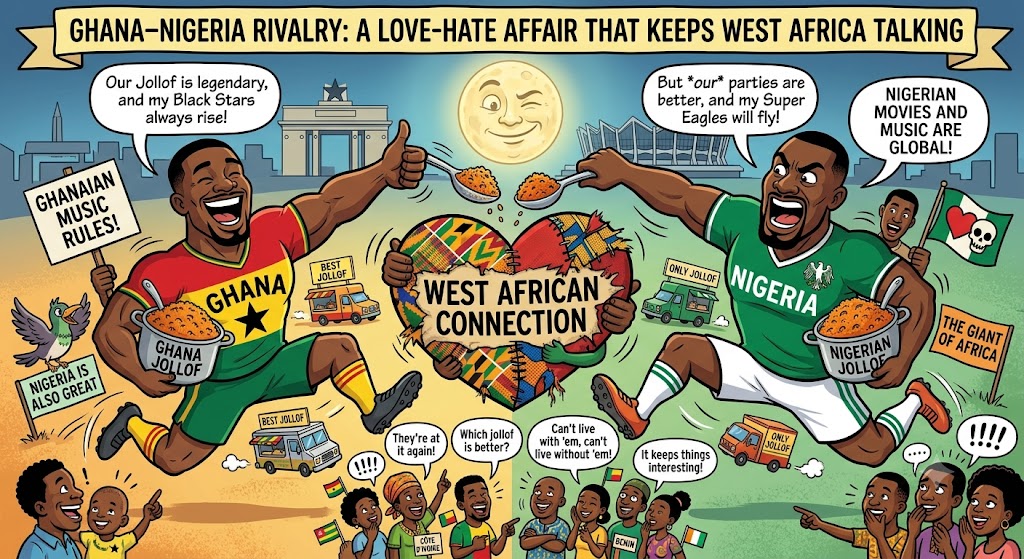

on the brink of a diplomatic divorce every other week.
One day, Ghanaians are mocking Nigerian jollof rice. The next, Nigerians are dismissing Ghanaian music. Football qualifiers become national emergencies. A celebrity makes an offhand comment and suddenly X, Facebook and TikTok explode with patriotic outrage. Then, almost overnight, the storm passes, only for another one to arrive a few weeks later.
The question is simple: are these two countries really rivals, or have they become addicted to competing with each other?
The truth is both amusing and revealing. Ghana and Nigeria argue because they matter to each other. They watch each other’s elections, celebrate each other’s musicians, copy each other’s business ideas and consume each other’s entertainment. That is not the behaviour of enemies. It is the behaviour of neighbours whose lives have become deeply intertwined.
No other two African countries compare themselves as relentlessly as Ghana and Nigeria.
Nigeria boasts Africa’s largest population and one of the continent’s biggest entertainment industries. Ghana counters with political stability, an attractive tourism sector and a growing international reputation as a destination for investment and heritage tourism. Each country wants to be recognised as West Africa’s standard-bearer, and neither is willing to surrender that title quietly.
The rivalry has become a permanent feature of everyday life. It appears in football, music, fashion, food, comedy and even accents. The infamous jollof rice debate has probably received more attention than some regional policy discussions. Rationally, everyone knows there is no objective winner. Yet millions continue to argue as though national pride depends on the recipe.
That tells us something important.
The rivalry is no longer about rice. It is about identity.
For younger generations, especially those who have grown up online, these debates have become expressions of patriotism. Social media has amplified friendly competition into a continuous public performance where every trending topic becomes another opportunity to defend the national flag.
There is, however, a dangerous side to this digital theatre.
Algorithms reward conflict, not context. A disagreement between a handful of individuals can quickly be presented as evidence that millions of Ghanaians and Nigerians suddenly dislike one another. Sensational headlines attract clicks, while balanced reporting receives far less attention. Before long, harmless banter is mistaken for genuine hostility.
That perception is misleading.
Millions of Nigerians have built successful lives in Ghana, just as many Ghanaians have studied, worked and established businesses in Nigeria. Families span both countries. Churches, universities, entertainment companies and multinational businesses operate across both markets every day. Long after the hashtags disappear, ordinary people continue doing business together.
Ironically, the rivalry often produces positive outcomes.
Competition has pushed musicians to innovate, filmmakers to improve production standards and entrepreneurs to think beyond domestic markets. The healthy contest between the two countries has helped position West Africa as one of the continent’s most influential cultural regions. Afrobeats, film, fashion and digital entrepreneurship have all benefited from this constant drive to outperform one another.
The real problem begins when political disagreements or economic disputes are dressed up as national superiority. Trade disagreements, immigration concerns and business regulations should never be allowed to poison relationships between people who share so much history. National pride should never become an excuse for prejudice.
Perhaps the greatest contradiction is this: while Ghanaians and Nigerians spend endless hours arguing over who is winning, the rest of Africa increasingly sees them as partners shaping the continent’s cultural and economic future.
Maybe that is the real story.
This is not Africa’s fiercest rivalry. It is Africa’s most successful partnership disguised as competition.
So let the football debates continue. Keep arguing about whose music dominates the charts and whose jollof deserves continental recognition. Those conversations have become part of West African culture.
Just remember that every rivalry needs respect to survive. Without it, competition becomes division. With it, both countries continue pushing each other towards greater achievements.
Sometimes the strongest relationships are the noisiest ones.
This version follows the conventions of a magazine column: a provocative headline, a strong opening hook, an opinion-driven narrative, shorter paragraphs for readability, and a memorable concluding insight.

The writer, Dr. Aba Appiah is a Ghanaian academic, researcher, and lecturer in her mid-20s with a professional focus on media and communication. Her career spans journalism and communication consultancy. As an accomplished author and researcher, she contributes to academic discourse through peer-reviewed studies and published works.